
Quick Answer: Dutasteride is more powerful (blocks both DHT enzyme types vs. finasteride’s one), but finasteride is the FDA-approved first-line choice with a much faster safety “exit.” Start with finasteride; switch to dutasteride only if results disappoint after 9-12 months.
Dutasteride is statistically more effective than finasteride for treating male-pattern hair loss, showing a significantly greater increase in hair count and reversal of hair miniaturization in studies.
Hair loss is stressful, and honestly, choosing between Finasteride and Dutasteride adds a whole new layer of confusion. Both medicines are popular, both are backed by research, and both work by blocking DHT (Dihydrotestosterone), the hormone responsible for male pattern hair loss.
But the real question most people ask is simple:
Finasteride vs Dutasteride, which is better? Which gives faster hair growth? Which is safer? Which should YOU take?
This blog cuts through the noise and gives you a clear, easy-to-understand comparison, based on medical facts, expert insights, and real-world results.
Let’s dive in.
Quick Glance: Why This Is Such a Tough Choice
Here’s the breakdown that matters most in a conversation with your doctor:
| Feature | Finasteride (Propecia, Proscar) | Dutasteride (Avodart) |
|---|---|---|
|
How It Works
|
Blocks Type II 5-Alpha Reductase (It’s a great partial shield)
|
Blocks Type I & II 5-Alpha Reductase (The Full Armor)
|
|
DHT Reduction
|
Reduces circulating DHT by a solid ~70%
|
Reduces circulating DHT by an incredible ~90-95%, confirmed by a randomized controlled study published in the Indian Journal of Dermatology, Venereology and Leprology, which found dutasteride 0.5mg/day reduces serum DHT by more than 90%
|
|
Hair Loss Status
|
The Gold Standard and FDA-Approved for hair loss (1mg)
|
More Potent in studies, but usually used “Off-Label” |
|
Quickest Effect
|
Works faster for BPH symptoms (a rapid DHT drop within 8 hours)
|
Longer half-life means it builds up slower, but has a stronger overall effect
|
|
The “Clean Up”
|
If you stop, it’s out of your system in about two weeks
|
Stays in your system for 4-6 months, a critical factor for some men
|
The Science Explained: Why Dutasteride Hits Harder
Both drugs belong to a class called 5-alpha reductase inhibitors (5-ARIs). Think of the 5-alpha reductase enzyme as the little worker that turns your natural testosterone into the powerful hormone DHT.
Excessive DHT is the common enemy, causing your hair follicles to shrink (miniaturize) and your prostate gland to swell up.
Finasteride for Hair Loss: Why It's the First-Line Treatment
Finasteride’s strength is its focus. It zeroes in on Type II of the 5-alpha reductase enzyme. This is awesome because Type II is the primary enzyme responsible for the DHT in the prostate and hair follicles.
Result: You get a very effective 70% drop in DHT. For most men, that’s enough to stop hair loss dead in its tracks and significantly relieve BPH symptoms.
Dutasteride for Hair Loss: Why It's More Powerful
Dutasteride doesn’t just block Type II; it blocks both Type I and Type II.
Result: By covering both bases, it suppresses DHT by a massive 90% to 95%. This sheer potency is why it’s considered the stronger drug, but it also carries bigger questions about its long-term impact, which we’ll address below.
If Finasteride is enough to solve your problem, that’s the one you want. If Finasteride isn’t cutting it, or if your condition is very aggressive, Dutasteride is the next level of treatment.
A 2017 randomized, open-label, evaluator-blinded study published in the Indian Journal of Dermatology, Venereology and Leprology followed 90 men with androgenetic alopecia over 24 weeks. Total hair count rose from 223 to 246 hairs per cm² in the dutasteride group, compared to just 227 to 231 hairs per cm² in the finasteride group, confirming dutasteride’s dual-enzyme blockade produced meaningfully greater hair regrowth and reversal of miniaturization.
Finasteride 1mg vs Dutasteride 0.5mg for Hair Loss: The Standard Dosage Comparison
These are the exact doses your doctor is most likely to prescribe, so here’s how they stack up head-to-head:
Finasteride 1mg is the FDA-approved standard dose for male pattern hair loss. It delivers a consistent ~70% DHT reduction with decades of safety data behind it. Most dermatologists start every new patient here, it’s predictable, well-studied, and reversible quickly if you don’t tolerate it well.
Dutasteride 0.5mg is the dose most commonly used off-label for hair loss (it’s actually the same dose approved for BPH). At this dosage, it delivers 90-95% DHT suppression, noticeably stronger than finasteride 1mg, but takes longer to build up in your system due to its long half-life, and takes far longer to clear out if you need to stop.
Bottom line: Neither dose is “wrong.” Finasteride 1mg is the safer starting point for most men. Dutasteride 0.5mg is generally reserved for men who don’t respond adequately to finasteride, or for more aggressive hair loss from the outset, always under a doctor’s supervision.
The Big Fight: Which is Better for Hair Loss?
This is where the conversation gets real, and where the FDA approval matters most.
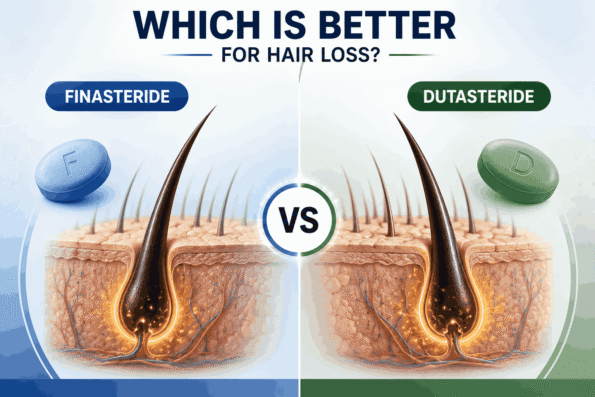
Finasteride
Finasteride 1mg is the industry standard for male pattern baldness. It has decades of clinical evidence proving it not only stops hair loss but often causes significant regrowth.
- Why It’s Safe: It’s been FDA-approved specifically for hair loss for years. Your dermatologist knows exactly what to expect.
- The Go-To: For most men just starting treatment, Finasteride is the logical and responsible first choice. You start with the proven, approved treatment before moving to the heavier artillery.
Dutasteride
In head-to-head clinical trials, Dutasteride often outperforms Finasteride in terms of hair count and thickness. Why? That deeper 90-95% DHT suppression simply provides a better environment for hair to thrive.
- The Caveat: In the U.S., it’s not officially
- FDA-approved for hair loss. Doctors prescribe it “off-label” (meaning for a condition other than its official approval).
- Who It’s For: It’s often reserved for men with severe, aggressive hair loss, or those who faithfully took Finasteride for a year and felt disappointed with the results. If Finasteride fails you, Dutasteride is your most likely next step to try.
Start with Finasteride. If you’re still losing ground after 9-12 months, you and your doctor can confidently discuss making the switch to the more potent Dutasteride.
Expert Opinion
“In our clinical practice, we usually start suitable male patients with finasteride because it offers an excellent balance between effectiveness and long-term safety. If hair loss continues despite consistent treatment for 9-12 months, we may consider dutasteride after evaluating scalp progression, medical history, and future treatment goals. The choice should always be personalized rather than based only on potency.”
– Dr. Chintan Bhavsar
Chief Hair Transplant Surgeon, Hairfree Hairgrow
Still Not Sure Which Medicine Is Right for You?
Hair loss treatment isn’t one-size-fits-all. Our hair specialists evaluate your hair loss stage, scalp condition, age, and medical history before recommending finasteride, dutasteride, or alternative therapies.
Switching from Finasteride to Dutasteride: What to Expect
If you’ve been on finasteride for close to a year and aren’t seeing the results you hoped for, switching to dutasteride is a common and reasonable next step, but it should always be guided by your doctor, not self-initiated.
What usually happens when you switch:
- Shedding during the transition is uncommon, but your doctor may want to monitor you closely in the first few months regardless.
- Because dutasteride has a much longer half-life, your body doesn’t fully clear the previous finasteride before dutasteride builds up, your doctor will guide the transition timing.
- Many men combine the switch with topical minoxidil or PRP therapy to support results during the changeover period.
- Improvement, when it happens, is usually gradual, give it a full 6-12 months before judging whether the switch worked.
Never combine finasteride and dutasteride at the same time on your own, this doesn’t add benefit and only increases the risk of side effects. Only switch between them, never stack them, and only under medical supervision.
The Health Concern: Which is Better for BPH (Enlarged Prostate)?
Both drugs are excellent treatments for BPH, an incredibly common problem that affects up to 50% of men over 60. This is what both drugs were originally designed for.
Finasteride vs. Dutasteride for BPH
| Treatment Goal | Finasteride (5mg) | Dutasteride (0.5mg) |
|---|---|---|
|
FDA Status
|
Approved for BPH
|
Approved for BPH
|
|
Prostate Shrinkage
|
Very effective, reduces volume by about 18%
|
Superior, reduces volume by up to 25%
|
|
Symptom Speed
|
Works very quickly to drop DHT, offering rapid symptom relief
|
Takes a little longer to feel the full effects, but the long-term results are very powerful
|
For BPH, the choice often depends on severity. If your symptoms are extremely bothersome and you need the maximum prostate reduction possible, Dutasteride might be slightly preferred. If you need quicker relief and your BPH is moderate, Finasteride is fantastic. Both significantly reduce the risk of needing BPH-related surgery.
Side Effects and Half-Life
Let’s talk about the sensitive stuff. The biggest hesitation for any man considering a DHT blocker is the worry about sexual side effects.
The Sexual Side Effect Profile
The common side effects (decreased libido, erectile dysfunction, and reduced ejaculate volume) occur because you are intentionally altering a sex hormone (DHT).
The Good News: The incidence rate for these side effects is low for both drugs, typically in the 1% to 4% range in clinical trials.
Many medical experts agree that since Dutasteride is a much more powerful DHT blocker (90-95% vs. 70%), it theoretically carries a slightly higher risk of sexual side effects. You are taking a more potent sledgehammer to the system, so there’s a greater chance of unintended consequences. However, for most men, the difference is negligible.
Why Half-Life is a Big Deal
This is the most critical difference for men worried about side effects.
- Finasteride is Temporary: If you start Finasteride and experience side effects, you can stop the pill, and the drug is cleared from your body within two weeks. Your body’s hormone levels can then begin returning to normal quickly.
- Dutasteride is Long-Term: Dutasteride has an extremely long half-life. If you stop taking it, the drug will remain in your system and continue to have effects for four to six months. If you develop a side effect and stop treatment, you have to wait much, much longer for your body to fully flush it out.
If you are nervous about starting a DHT blocker, Finasteride gives you a much safer, faster “out” if you experience an adverse reaction.
Worried About Side Effects?
Our doctors create special treatment plans just for you to maximize hair growth while minimizing unwanted effects through proper evaluation and follow-up.
Dutasteride vs Finasteride After a Hair Transplant: Which Should You Continue?
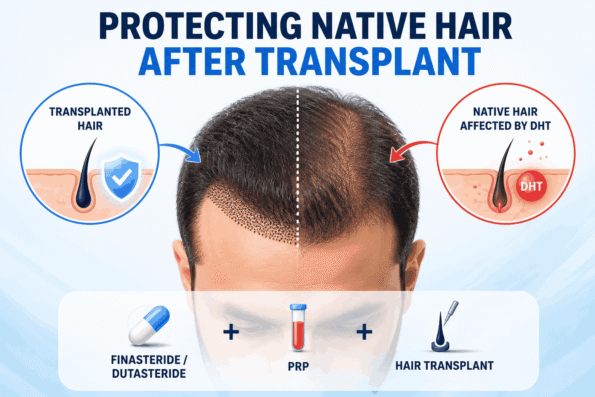
If you’ve had a hair transplant, the DHT conversation doesn’t end at surgery, protecting your existing (non-transplanted) native hair is just as important as the graft itself, since your transplant only moves hair, it doesn’t stop DHT from continuing to miniaturize the hair around it.
Why this matters post-transplant:
- Transplanted follicles (usually taken from the back/sides of the scalp) are naturally DHT-resistant, so they aren’t at risk. But your existing native hair in the treated area, and the hair you didn’t transplant, is still vulnerable to DHT-driven thinning.
- Continuing finasteride or dutasteride after surgery helps preserve this native hair, giving you a fuller, more long-term rather than just isolated transplanted grafts surrounded by continued thinning.
- Many clinics combine a DHT blocker with PRP (Platelet-Rich Plasma) therapy post-transplant for enhanced density and faster recovery. This approach is often recommended based on the severity of ongoing hair loss.
- Which one to continue, finasteride or dutasteride, depends on how aggressive your hair loss was before surgery and your doctor’s assessment during follow-up visits.
At Hairfree Hairgrow, our doctors build a personalized post-transplant medical maintenance plan for every patient because a great transplant result depends as much on protecting your remaining native hair as it does on the surgery itself.
Finalizing Your Decision
So, which is the better drug? There is no single answer, but we can summarize the best path forward:
Choose Finasteride If:
- You are starting treatment: It is the FDA-approved first-line treatment for hair loss, with an excellent safety record.
- You are anxious about side effects: Its short half-life means you can stop quickly if you have an issue.
- Your hair loss or BPH symptoms are mild to moderate: The 70% DHT suppression is likely all you need.
Choose Dutasteride If:
- Finasteride failed you: You took 1mg daily for a year and your hair loss continued or was unsatisfactory.
- You have very aggressive hair loss: You need the maximum DHT blockade possible from the start.
- You are treating BPH and need maximum prostate shrinkage: Its 25% reduction is superior to Finasteride’s 18%.
The most important point? This is a lifelong medical decision. Do not buy these drugs online without a diagnosis. You must have a thorough consultation with a doctor (Dermatologist or Urologist) who can monitor your progress and check critical markers like your PSA levels.
Choosing between Finasteride vs Dutasteride depends on your hair loss stage, tolerance, and medical evaluation. Your journey to better hair and health starts with an informed conversation, and now, you’ve got all the information you need to lead it.
At Hairfree Hairgrow, thousands of men have already reversed thinning, rebuilt density, and restored confidence with the right treatment plan.
Ready to stop stressing and start treating?
The next step is scheduling that consultation with a specialist. Your turn is now.
Frequently Asked Questions (FAQ)
-
1. Can Finasteride and Dutasteride be taken together?
No. Since both drugs are 5-alpha reductase inhibitors and work on the same system, taking them concurrently is not recommended and significantly increases the risk of side effects without offering a guaranteed increase in benefit.
-
2. How long does it take to see results?
For both medications, it can take a minimum of 3 to 4 months to see initial changes (reduced shedding, slight growth), and up to 12 months or longer to see the full, maximum benefit. Consistent daily use is essential.
-
3. Does stopping the medication cause hair loss to return?
Yes. Both medications only maintain your hair and prostate size while you are taking them. Once you stop treatment, DHT levels will return to pre-treatment levels, and any hair gained or prostate size reduced will slowly reverse over the next 6 to 12 months.
-
4. Which grows more hair, finasteride or dutasteride, according to recent studies?
Recent comparative studies, including Indian clinical research, consistently show dutasteride producing greater improvements in hair count and thickness than finasteride, largely because it blocks both forms of the enzyme responsible for producing DHT, not just one. That said, individual response varies, and your doctor's assessment matters more than any single study.
-
5. Can I switch from finasteride to dutasteride if it's not working for me?
Yes, this is a common next step if finasteride hasn't given you satisfactory results after 9-12 months of consistent use. Your doctor will guide the switch, never do this on your own, and never take both together.