
Quick Answer: Most hair loss medicines cannot be judged before 6 to 12 months, and even then they slow pattern baldness rather than cure it.
If you have used them correctly for 12 months and photos show no change or ongoing loss, it may be a real plateau, but only a doctor can confirm it.
The next step is a proper diagnosis, then a doctor-led plan: adjust your medicines, add supportive treatment, or consider a hair transplant.
If your hair loss medicine is not working, you are not alone. You took it regularly and your hair is still thinning, which is frustrating but far more common than people admit.
How Long Should You Wait Before Deciding Your Hair Loss Medicine Is Not Working?
Wait at least 6 months, and 12 months for a firm verdict. Most people judge far too early.
| Time on medicine | What is normal | Can you judge it yet? |
|---|---|---|
|
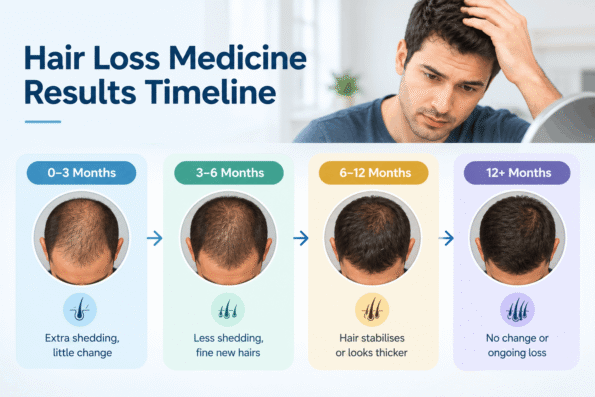
0 to 3 months
|
Extra shedding, little visible change
|
No
|
|
3 to 6 months
|
Less shedding, fine new hairs
|
Not yet
|
|
6 to 12 months
|
Hair stabilises or looks thicker
|
First fair verdict
|
|
12 months or more
|
Photos show no change or ongoing loss
|
Likely a plateau, but confirm with a doctor
|
Take photos of your hairline, temples and crown at the start, at 6 months and at 12 months, in the same light.
Memory is unreliable. Photos are not.
What Is the Difference Between Hair Loss Medicine Not Working and Only Holding Your Hair?
If your hair loss has slowed or stopped, the medicine is working, even without visible regrowth.
Finasteride and minoxidil mainly protect the hair you already have. Stabilising is a real result, and the American Academy of Dermatology notes that full regrowth is unlikely.
A medicine is not working when same-light photos show continued thinning despite correct use over 12 months. Even then, no visible change alone does not prove failure, because your diagnosis, starting stage and ongoing progression all play a part.
Why Do Hair Loss Medicines Like Finasteride and Minoxidil Stop Working?
Hair loss medicines seem to stop working for five main reasons.
- Wrong diagnosis. Thyroid problems, low iron, low vitamin D or B12, and stress shedding can cause hair fall that pattern baldness medicines do not fix.
- Technique and consistency. Missed doses, long breaks, and applying minoxidil to a wet scalp or only to the hair all cut the result.
- Your scalp enzyme. Minoxidil needs an enzyme in the scalp to activate it, and the level varies from person to person. Some people simply respond weakly.
- Progression. Finasteride lowers DHT and minoxidil prolongs the growth phase, but neither changes your genes. The loss continues, only slower.
- Follicles already gone. Medicines can thicken weak follicles. They cannot revive follicles that are completely lost.
Still losing hair even though you never miss a dose?
Is Hair Shedding After Starting Minoxidil or Finasteride a Bad Sign?
No, early shedding is usually a normal phase. In the first weeks, medicines like minoxidil can push resting hairs out so new ones can grow.
The mistake is quitting during this phase, just before the benefit starts.
One more catch: stress or illness shedding can overlap with pattern baldness. It makes the loss look worse than it really is, and it often settles once the trigger passes.
What to Do When Finasteride or Minoxidil Is Not Working: The 5-Step Treatment Ladder
When finasteride or minoxidil stops working, doctors usually follow a 5-step ladder, and surgery is only the last step.
| Step | What it means | Read more |
|---|---|---|
|
1. Fix the basics
|
Correct technique, daily consistency, a fair 12-month trial
|
This guide
|
|
2. Add or switch a DHT blocker
|
A stronger or combined approach, only under a doctor
|
|
|
3. Move from topical to oral minoxidil
|
Often prescribed off-label, for suitable patients, after a heart and blood pressure check
|
|
|
4. Add supportive therapy
|
PRP, GFC, microneedling or laser to support weak follicles
|
PRP and GFC
|
|
5. Restore what is gone
|
A hair transplant for areas medicines cannot rebuild
|
Please do not start or switch any of these on your own. The right step depends on your age, health and pattern of loss.
When Should You Consider a Hair Transplant After Medicines Fail?
A transplant starts to make sense when medicines hold your hair but cannot bring it back.
- Your hairline or temples have receded and density is not returning.
- You have visible bald or very thin patches where follicles are long gone.
- You used medicines correctly for 12 months or more and the loss still progressed.
- You cannot tolerate a medicine, or do not want to take it for life.
- You still have healthy, stable donor hair at the back and sides.
That last point decides everything. A transplant moves your own DHT-resistant hair, so donor supply sets the limit.
When Is a Hair Transplant Not the Right Next Step?
A transplant is not always the right answer, even after medicines plateau.
- Your pattern is still changing. In younger patients with active loss, a transplant can end up as an island of hair as the surrounding hair thins.
- Your donor hair is limited. There may not be enough grafts for a natural result.
- Your medicines are still working. If you are stable, there may be no need to rush.
- Your expectations are not realistic. A transplant restores density, but it does not recreate teenage hair.
An honest doctor will tell you to wait when waiting is right.
Wondering what a transplant would cost compared to years of medicines?
Hair Loss Medicines vs Hair Transplant: Which Is Better?
Medicines protect the hair you still have, while a hair transplant restores areas that have gone bare. For most people it is not either or.
| Table Header | Medicines | Hair transplant |
|---|---|---|
|
Main job
|
Protect the hair you still have
|
Restore areas that have gone bare
|
|
Works best for
|
Early to moderate hair loss
|
Established loss with good donor hair
|
|
Ongoing use
|
Needed to keep the benefit
|
Not needed for transplanted hair
|
|
Limit
|
Slows loss, cannot rebuild a lost hairline
|
Does not stop native hair from thinning
|
For many people the best result is both. Transplant what is gone, and protect what is left with medicines.
We explain that in finasteride after a hair transplant. For the money side, see our hair transplant cost in India guide.
What If You Stopped Your Hair Loss Medicine Because of Side Effects?
Talk to your doctor before you stop anything. Fear of side effects is the real reason many people quit or take medicines half-heartedly.
Side effects are reported in a small minority, and options exist, such as a different form or a non-hormonal approach. Our article on minoxidil and heart conditions clears up a common fear.
Quietly stopping is the risky choice, because the hair the medicine was holding can thin again within months.
What Should You Do This Month If Your Hair Loss Medicine Is Not Working?
- Write down how long and how regularly you have used each medicine.
- Take hairline, temple and crown photos in the same light.
- Do not stop or switch your medicine without a doctor.
- Get a scalp examination. Your doctor will decide from your history and exam which blood tests, if any, you need.
- Ask whether you are a transplant candidate now, or later.
“When a patient tells me their hair loss medicine has stopped working, I first assess the diagnosis, treatment duration, consistency and current scalp condition. Continued thinning does not always mean the medicine has failed. If hair loss has stabilised but significant bald areas remain, a hair transplant may be an option for suitable candidates with adequate donor hair. The decision should always be based on an individual assessment, not medication response alone.”
Dr. Jinkal Kunjadiya : M.B.B.S., D.D.V (Skin – V.D). Dermatologist & Hair Transplant Surgeon
Frequently Asked Questions
-
1. How do you know if hair loss medicine is no longer working?
Compare same-light photos taken at the start, at 6 months and at 12 months. If you used the medicine correctly and the photos show continued thinning, ask a doctor to reassess. If your hair loss has slowed, the medicine is likely still doing its job.
-
2. Why is my minoxidil not working anymore?
You may not have used it long enough, applied it to a wet scalp, or your hair loss may have moved past what it can hold. Some people also respond weakly because of low scalp enzyme activity.
-
3. Why is finasteride not working after several years?
Finasteride slows hair loss but does not cure the genetic cause. Thinning can continue slowly even while DHT is reduced. Many people would have lost more hair without it.
-
4. How long should I use finasteride or minoxidil before deciding it has failed?
Give it at least 6 months, and up to 12 months for a firm verdict. The American Academy of Dermatology says minoxidil can take 6 to 12 months to show results, and finasteride about 6 months.
-
5. Does minoxidil stop working after years of use?
It can plateau, because the underlying hair loss keeps progressing. That does not mean it is useless. It may still be holding back further loss.
-
6. Can I use oral minoxidil if topical minoxidil is not working?
Some doctors prescribe low-dose oral minoxidil for suitable patients, since it does not depend on scalp absorption. It is usually used off-label for hair loss, so it needs a doctor's assessment first, including a heart and blood pressure check. Do not switch from topical to oral on your own.
-
7. Can I stop my hair loss medicine if it is not working?
Speak to your doctor first. In pattern baldness, hair held by these medicines can fall again after you stop.
-
8. Is a hair transplant the next step when medicines stop working?
Often, but not always right away. It depends on your stage of loss, age and donor hair.
-
9. Do I still need finasteride or minoxidil after a hair transplant?
Many surgeons advise it, because a transplant does not stop your native hair from thinning.
-
10. Do hair loss medicines like minoxidil work for women?
It depends on the diagnosis. Minoxidil is widely used for female pattern hair loss, but finasteride is not suitable for everyone. It is avoided in pregnancy and in women who could become pregnant, because it can harm a male baby, so a doctor must decide.
Medical Sources
- American Academy of Dermatology: Male pattern hair loss treatment
- ISHRS: Oral Minoxidil for Hair Loss: Efficacy, Dose, and Side Effects
- Androgenetic alopecia: an evidence-based treatment update, American Journal of Clinical Dermatology, 2014
- Management of androgenic alopecia: a systematic review of the literature, Journal of Cosmetic and Laser Therapy, 2024
Our doctors bring 15+ years of experience and 25,000+ surgeries to every consultation.
Tired of guessing whether your medicine is still working?