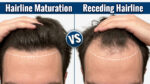
Quick Answer: For a hair transplant before wedding, plan 9 to 12 months. Six months can work for a hairline, but you will be in the early growth phase, not at full density. With less than 4 months left, surgery usually isn’t the right tool for the wedding itself.
The rishta is fixed, the hall is booked, and then you look at the photographer’s sample album and notice your hairline. Most guys we speak to say the same thing. They want to fix it before the big day, and they have no idea how long a transplant takes to show.
A hair transplant before wedding is very doable. The trouble is that a transplant is not a salon service with instant results. The hair has to fall, rest, and grow back. According to StatPearls, a medical reference published on the NIH’s NCBI Bookshelf, new hairs typically appear 3 to 6 months after surgery, and doctors keep reviewing the patient for 6 to 12 months until the grafts have fully matured.
If you plan around that cycle, you walk into the mandap with a natural hairline. If you ignore it, you walk in at the exact point where things look worst.
How Long Does a Hair Transplant Take to Show Results?
Visible results take about 6 to 12 months. That is the honest answer, and it is why the wedding date matters so much.
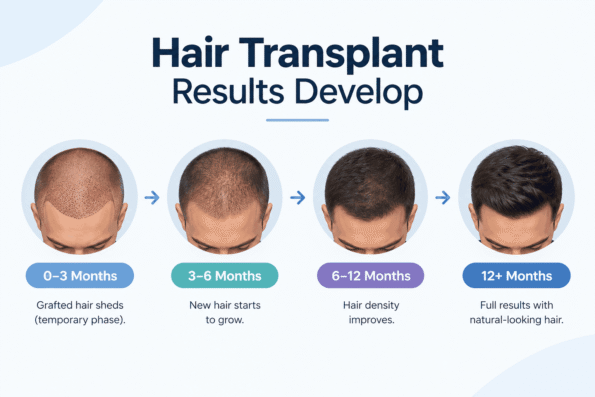
Here is the usual pattern after surgery. These are approximate ranges, and your own body will not follow a calendar.
| Time after surgery | What you will see |
|---|---|
|
Week 1-2
|
Scabs and redness on the scalp. This settles as the scalp heals.
|
|
From a few weeks in, up to about Month 3
|
Transplanted hair shafts fall out. This is called shedding or shock loss.
|
|
Month 3-6
|
New, fine hairs begin to appear.
|
|
Month 6-12
|
Hair thickens and matures. Doctors review progress during this window.
|
|
Month 12 onwards
|
Results are judged. Some people keep improving a little after this.
|
The shedding phase is what scares people most. It is expected, and StatPearls notes that the shedding of implanted hairs is temporary, with new hairs appearing later. The hair shaft falls out, but the follicle stays under the skin and restarts its growth cycle.
A case report in the journal Annals of Dermatology describes two patients whose hair loss began about a month after a hair transplant. Scalp biopsies showed a temporary resting-phase shedding called telogen effluvium, and both patients were simply reassured and monitored, without treatment.
Not sure which phase your wedding day will land in?
Count back from your date and you might be surprised. A doctor can place you on the timeline in minutes.
When Should You Get a Hair Transplant Before Your Wedding?
Ideally 9 to 12 months before the date. Here is the simple logic behind that number. New hairs show up around 3 to 6 months, and the hair keeps maturing for up to 12 months. To look presentable in photos and on the day, you want your wedding to fall after the shedding phase, with growth well underway.
Why not do it a month or two before? Because the surgery would be done, but the result would not. You could be in the shedding stage on your wedding day, and shedding can look worse than your starting point.
Here is how to think about it by time left:
| Months left | What is realistic |
|---|---|
|
12 or more
|
Best case. The full growth cycle completes before the wedding.
|
|
9-12
|
Strong result. Hair is thick enough for photos and styling.
|
|
6-9
|
Workable, mostly for the hairline. Density will still be building.
|
|
4-6
|
Risky. You may be at the thin, patchy stage around the wedding.
|
|
Under 4
|
Not recommended for wedding-day results. See the options below.
|
Crown areas tend to fill in later than the hairline, so if your concern is the crown, give yourself more time.
Can It Be Done in 6 Months?
Sometimes. A 29-year-old streamer featured by The Daily Beast had his hair transplant about six months before his wedding and was happy with how it looked by the day. That is one case, though, not a promise. Growth depends on your donor hair, your hair type and how you heal. Use it as proof that 6 months is possible, not as a plan.
Is Your Hair Loss Stable? This Can Change Your Timeline
This is the part most wedding guides skip, and it matters more than the date.
StatPearls says ideal candidates have a stable, clear pattern of hair loss. It also says that people whose hair loss is still progressing quickly, or who have more than 15% miniaturization (hair getting finer) in the area, should have 6 to 12 months of medical treatment first, so the loss settles before surgery. Operating on unstable hair loss carries a risk of shock loss that can be permanent.
For a groom, that can change the math. If your hair loss is still moving, the real timeline might be 6 to 12 months of treatment, then surgery, then 9 to 12 months of growth. That is why seeing a doctor early matters.
Age also matters. According to the same reference, hair loss in young men often progresses fast, and surgery too early can use up donor hair. Doctors generally prefer to treat first and, ideally, operate only after age 25.
What If Your Wedding Is Less Than 6 Months Away?
Don’t rush into a decision you can’t undo. You have a few options, and a good doctor will go through them with you.
Postpone the surgery until after the wedding. This is sometimes the smartest call. If your hair loss isn’t stable or your timeline is very tight, a calmer plan gives a better result than a rushed one.
Use non-surgical options for the wedding, then transplant later. StatPearls lists options like minoxidil, finasteride, low-level laser therapy and platelet-rich plasma (PRP) to slow hair loss and support regrowth, particularly for people who are not ready for surgery. Scalp micropigmentation (SMP) is another option for the look of density. Ask your doctor which suits your pattern. Our SMP vs hair transplant guide covers the comparison.
Style around it. A good barber can do a lot with cut and length. Camouflage products exist too. These are temporary, but they can bridge a short gap.
Wedding is close and you’re stuck between “do it now” and “skip it”?
That is exactly the call a doctor can make once they see your scalp, not a guess from a blog.
Shock Loss and Your Wedding Date: Where Will You Be on the Calendar?
Count backward from your wedding and see which phase you will be in.
- Wedding falls in month 1 to 3 after surgery: You will likely be mid-shedding. This is the worst time to be photographed.
- Wedding falls in month 3 to 6: Early fine hair is coming in. Better, but not dense.
- Wedding falls in month 6 to 12: Visible growth, and most people look clearly improved.
- Wedding falls after month 12: The best window.
Shock loss can also affect some native hair near the transplanted area or in the donor area. StatPearls notes this is temporary too. Your surgeon should explain this before you book, so it doesn’t come as a surprise at month two.
Indian Wedding Season: What to Plan Around
Indian weddings are not one-day events. Between haldi, sangeet, mehendi and the pheras, you will have sun, sweat, heat, crowds, headgear and a lot of people touching your head for blessings and tilak.
StatPearls gives some general aftercare guidance that is useful here. Your own doctor’s instructions always come first.
- Sun: Avoid direct sun on the donor and recipient areas for the first month. Plan the baraat and outdoor functions accordingly.
- Haircut and colour: Wait about a month before cutting or colouring your hair.
- Styling products: Avoid them for the first 2 weeks.
- Activity: Skip heavy lifting and strenuous activity for the first week. That includes packing the wedding stuff yourself.
- Headwear: A clean, loose-fitting hat is fine right after surgery. A tightly tied safa, turban or sehra is a different matter, so ask your doctor before you wear one.
- Haldi and tilak: Ask your doctor when it is safe to have these applied near the transplanted area.
Winter is a popular wedding season in many parts of India, and clinic calendars fill up around then. If your date is in the cooler months, start the conversation early.
Hair Transplant for Brides and Women
Women also look into hair transplants before weddings, though it is talked about less. The approach is different. According to StatPearls, female pattern hair loss typically spares the hairline and shows up as diffuse thinning across the top and upper sides of the head. Transplants are suited to certain stages of female pattern hair loss, and a patient with diffuse, unpatterned loss and no healthy donor area may not get a good result.
If you are a bride-to-be, a proper diagnosis comes first. Some thinning can be treated without surgery, and some is temporary. A doctor needs to look at your scalp before any plan is made.
Who Is a Good Candidate Before a Wedding?
A transplant works best when:
- Your hair loss has a stable, clear pattern, or is being managed with treatment.
- Thinning is significant enough in at least one area. StatPearls uses at least 50% thinning as a guide.
- You have enough healthy donor hair at the back and sides.
- You are in good general health, and you have realistic expectations. A transplant creates the look of density, it doesn’t bring back every hair.
If any of these are missing, your doctor may recommend treatment first, and that is not a bad outcome. It is the plan that protects your result.
How to Choose a Clinic When the Wedding Date Is Fixed
A deadline makes people take shortcuts. Please don’t.
India’s National Medical Commission issued Guidelines on Aesthetic Surgery and Hair Transplant Procedures on 20 September 2022. They state that hair transplants should be done only by trained, registered medical practitioners, and that these are not emergency procedures, so there is no case for allowing untrained people to do them. The guidelines say hair transplants should preferably be done by doctors with formal surgical training, such as MCh/DNB Plastic Surgery or MD/DNB Dermatology.
Before you book, check these:
- Is a qualified, registered doctor actually performing or supervising the surgery?
- Is the procedure done in a proper medical facility?
- Can you see real before-and-after results with timelines, not just edited photos?
- Does the clinic explain shedding and timelines honestly, or only promise results?
- Will they tell you if your timing is too tight?
A clinic that says “yes, we can do it in 2 months, no problem” is worth questioning.
Worried about picking the wrong clinic with the wedding date already fixed?
Ask the questions above to our doctors directly, before you pay anything or lock a date.
Hair Transplant Before Wedding in Ahmedabad, Surat, Mumbai and Pune
If you are planning a hair transplant before a wedding in one of these cities, here is how we can help.
Ahmedabad
If your wedding is in Gujarat and the date is already fixed, the first thing to sort is the gap between surgery and the date. Our doctors at the Ahmedabad clinic will count it back with you and tell you honestly whether it works. See our hair transplant in Ahmedabad page for details.
Surat
Wedding planning in a big family usually means many functions, not one. Our Surat clinic helps you plan the surgery so your scalp is settled well before the first ceremony. Details are on our hair transplant in Surat page.
Mumbai
In Mumbai, work and travel eat up months quickly, and the wedding suddenly turns out to be 8 months away instead of 14. A short consultation at our Mumbai clinic shows how many months you actually have to work with. Visit our hair transplant in Mumbai page.
Pune
Our Pune centre is one of our main clinics, and it is a good starting point if you want your timeline checked before you plan anything else. Read more on our hair transplant in Pune page.
About Hairfree Hairgrow: Hairfree Hairgrow is a hair transplant and hair care clinic chain with multiple locations across India. Treatment is planned by a team of doctors (VERIFY: 14 doctors) and we work with FUE-based techniques including BIG FUE, Bio FUE, I-FUE and Stem Cell FUE, chosen according to your hair loss, donor area and timeline.
Expert Overview
The biggest mistake I see before a wedding is people counting the date from the day they book, not from the day they decide. A transplant needs months to show, and the early months can actually look worse than the starting point, which catches people off guard. The other thing that gets missed is whether the hair loss is stable. If it isn’t, we may need to treat it first, and that adds time. My advice is to see a doctor as early as possible, plan the surgery so the shedding phase is over well before the wedding, and if the date is too close, it is perfectly fine to treat for the wedding and transplant afterwards. A good result matters more than a fast one.
Dr. Richa Sanmukhani M.D. Skin – V.D. Dermatologist & Hair Transplant Surgeon
Conclusion: Plan Backward From the Wedding Date
The best hair transplant before wedding plan starts with one question: how many months do you have? With 9 to 12, you are in a strong position. With 6 to 9, it can work, mainly for the hairline. With less than 6, a doctor may suggest other options for the day and a transplant after.
Whatever your timeline, see a doctor early, get a proper hair loss assessment, and plan around the shedding phase, not against it. At Hairfree Hairgrow, we would rather tell you honestly that your date is too tight than book a surgery that won’t look right in your photos.
Frequently Asked Questions
-
1. How many months before the wedding should I get a hair transplant?
Ideally 9 to 12 months. New hairs usually appear around 3 to 6 months after surgery and keep maturing for up to a year. Six months can work for a hairline in some people, but density will still be building.
-
2. Can I get a hair transplant 3 months before my wedding?
It is not recommended if you want results for the wedding. At 3 months you will likely be at the end of shedding, with little new growth visible. Speak to a doctor about alternatives, or about doing the transplant after the wedding.
-
3. Will my hair grow back in time for the wedding if I do it 6 months before?
Some visible growth is likely, but it will not be full density. A doctor can give you a better idea after examining your donor area and hair type.
-
4. Is shedding after a hair transplant normal?
Yes. Shedding is a normal and temporary part of recovery. The hair shaft falls out while the follicle stays in place and restarts growing later.
-
5. When can I wear a sehra or turban after a hair transplant?
A clean, loose-fitting hat is generally fine right after surgery, but a tightly tied safa, turban or sehra depends on your healing. Ask your doctor for a specific date. (VERIFY with HFHG doctor before publishing)
-
6. When can I cut or colour my hair after a hair transplant?
General medical guidance is to wait about a month before cutting or colouring your hair. Your doctor’s instructions come first.
-
7. Can brides or women get a hair transplant before the wedding?
Some women can, depending on the pattern of hair loss. Diffuse thinning across the scalp often needs a different approach. A proper scalp assessment is the first step.
-
8. What if my wedding is only 2 or 3 months away?
A transplant is usually not the best fit for the wedding itself at that point. Options like medication, PRP, SMP or styling can help you look your best, and surgery can be planned after.
-
9. Is a hair transplant before wedding worth it, or should I wait until after?
It depends on your timeline and how stable your hair loss is. If you have 9 months or more and stable hair loss, it is usually worth it. If time is tight or hair loss is still progressing, waiting often gives a calmer and better outcome.
-
10. Does a hair transplant before wedding look natural?
When planned and performed by a qualified doctor, with proper hairline design and enough time to grow, the result can look natural. Rushed timelines are what cause trouble.
Sources
- Goldin J, Zito PM, Raggio BS. Hair Transplantation. StatPearls, NCBI Bookshelf (National Library of Medicine, NIH). https://www.ncbi.nlm.nih.gov/books/NBK547740/
- Localized Telogen Effluvium Following Hair Transplantation. Annals of Dermatology, 2018. PubMed: https://pubmed.ncbi.nlm.nih.gov/29606820/
- National Medical Commission, Guidelines on Aesthetic Surgery and Hair Transplant Procedures, 20 September 2022, as published by the Gujarat Medical Council: https://www.gmcgujarat.org/announcementdetail.aspx?id=60
- The Daily Beast, Man, 29, Gets Jaw-Dropping Hair Transplant Just in Time for Wedding: https://www.thedailybeast.com/streamer-huskerss-29-gets-jaw-dropping-hair-transplant-in-time-for-wedding