Quick answer: Yes, in many cases you can. A hair transplant with diabetes, thyroid or high blood pressure is possible when the condition is well controlled, and your doctor is comfortable with your latest reports.
The diagnosis alone does not decide it. What matters is how steady your sugar, thyroid levels or blood pressure are around the time of surgery.
If they are steady, surgery is usually on the table. If they are not, the usual advice is simple: sort that out first, then come back. A delay of a few months costs far less than a healing problem you could have avoided.
This guide covers what each condition changes, what surgeons actually check, and how to walk into your consultation prepared.
Not sure if your latest reports are good enough for surgery?
Send them to our team and find out where you stand before you plan anything.
Hair Transplant With Diabetes, Thyroid or High Blood Pressure: The Short Answer
A hair transplant is elective surgery. Nothing about it is urgent, so a responsible surgeon will not push ahead if your health is unsettled. The real question is never “do you have a condition?” It is “is the condition under control right now?”
| Condition | What the surgeon looks at | Usually fine when | Usually postponed when |
|---|---|---|---|
|
Diabetes
|
HbA1c, current sugar, medicines, any complications |
Sugar is steady on a settled routine and a doctor reviews it regularly
|
Readings swing a lot, the diagnosis is new, or no one has reviewed it lately
|
|
Thyroid |
TSH and how your hair is shedding
|
Levels are stable on treatment
|
Levels are off, or hair is shedding all over the scalp
|
|
High blood pressure |
BP readings, medicines, heart history
|
Readings are steady on prescribed medicines
|
Pressure runs high, is untreated, or is high on the day of surgery
|
These are general patterns, not rules. Your surgeon makes the final call after seeing your reports.
Why Your Health Matters Before a Hair Transplant
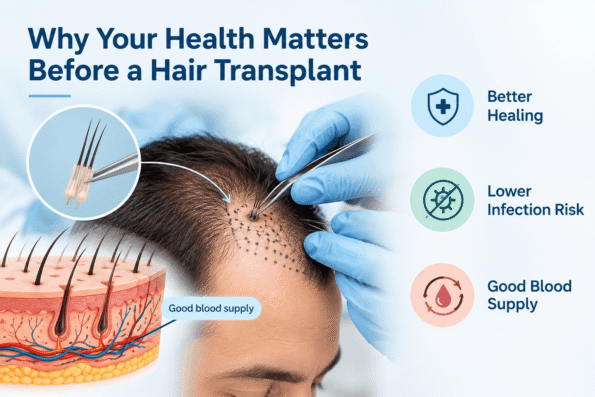
The procedure runs for several hours under local anaesthesia. In that time, hundreds to thousands of tiny incisions are made in the donor and recipient areas.
Each one is a small wound that has to heal, and every new graft needs a good blood supply to settle in. Anything that slows healing, raises infection risk, or makes bleeding harder to control matters here. Diabetes, thyroid problems, and high blood pressure can each touch one of those.
How Common Are These Conditions in India?
You are far from the only one asking. National data show:
- About 101 million people in India live with diabetes (around 11.4%), and another 136 million have prediabetes (ICMR-INDIAB study).
- An estimated 315 million have high blood pressure, around 35.5% (ICMR-INDIAB study).
- About 1 in 10 adults in a 2013 eight-city study, which included Ahmedabad and Mumbai, had hypothyroidism (10.95%), and 3.47% had it without knowing (Hypothyroidism in India).
These conditions are common, so one high sugar, thyroid or BP reading should not make you assume surgery is off the table.
Can Diabetics Get a Hair Transplant?
Most people with well-controlled diabetes can. Hair transplant for diabetic patients is planned around control, not the label.
High blood sugar slows wound healing and makes infection more likely. Over the years it can also narrow the small blood vessels that feed the scalp. That is why surgeons look closely at HbA1c, a test that reflects your average sugar over the past three months. One good reading on one morning tells them very little. Three months of steady numbers tells them a lot.
Alongside HbA1c, expect questions about your medicines, any low-sugar episodes, and diabetes-related problems such as kidney trouble.
Type 1 diabetes needs a little more planning, because sugar levels can move faster. It does not automatically rule you out, but your surgeon will want to work closely with your diabetes doctor.
The procedure is long, so plan the day in advance. Talk through meals and medicines with both your surgeon and your diabetes doctor. Do not skip insulin or tablets, or change a dose, on your own.
Does Diabetes Cause Hair Loss?
It can contribute, yes. Diabetes and hair loss are linked, though not always the way people assume.
Long-standing high sugar can narrow the small blood vessels, so follicles get less oxygen and fewer nutrients and growth slows. Poorly controlled sugar also stresses the body, which can push more hairs into the resting phase. Some diabetes medicines can add to thinning in a few people too.
It often looks different from pattern baldness. Hair thins broadly across the scalp instead of receding at the temples or opening up at the crown, and regrowth is slower than you would expect.
Insulin resistance and prediabetes can be part of the picture as well, sometimes before any diagnosis. In women it often sits alongside PCOS, which is a known cause of female pattern hair loss.
Why this matters for surgery: a transplant works on permanent, patterned loss. If part of your thinning comes from your sugar, surgery will not fix that part. Only a proper scalp evaluation can tell the two apart.
Hair Transplant With Hypothyroidism or Hyperthyroidism
A thyroid condition that is treated and stable is generally not a barrier. If you are looking at hair transplant with hypothyroidism or an overactive thyroid, the bigger issue is the hair loss itself.
How thyroid problems affect hair
Thyroid imbalance, low or high, can make hair shed across the whole scalp. A 2023 review reports hair loss in roughly half of people with hyperthyroidism and about a third of those with hypothyroidism. (Thyroid and hair loss review)
This thyroid hair loss has nothing to do with genetics. A transplant cannot fix it, and it hides your real pattern. Transplanting while the scalp is still shedding widely can give unpredictable results.
What surgeons check first
They usually check your TSH. If levels are off, the sensible order is:
- Treat the thyroid
- Wait for levels to settle and shedding to calm down
- Then plan surgery
Diffuse shedding from a thyroid problem is usually reversible once levels are corrected. [4] So in some cases surgery turns out to be less urgent than people thought.
If you have Hashimoto's thyroiditis
Tell your surgeon. It is common and not an automatic no, but they may want more detail on your reports.
Keep taking your thyroid medicine as prescribed unless your own doctor says otherwise.
What About Women?
For women, thyroid is only one of several things worth checking. Iron levels, hormonal conditions such as PCOS, and recent pregnancy can all cause shedding too, and they often overlap with thyroid trouble.
That is why women are often asked for a slightly wider set of blood tests before any plan is made. Finding the cause first protects you from surgery for hair loss that was never going to be permanent.
Hair Transplant With High Blood Pressure
High blood pressure is one of the most common conditions surgeons see, and when it is treated and steady it is usually manageable. The trouble starts when it is not controlled.
Raised pressure means more oozing from the small incisions. That blurs the surgeon’s view and can slow graft placement. Long hours in the chair, nerves, and the adrenaline often added to local anaesthetic can push readings up in some people too.
So your pressure is checked before you begin and watched through the day. If it is high on the day, the procedure may be postponed.
Many people worry about hair transplant and blood pressure medicines. The short version: do not stop or change them yourself, and ask your surgeon what to do on the day itself. The same goes for aspirin and blood thinners.
Some medicines may need to be paused before surgery, but that decision should be made together with the doctor who prescribed them. If you have a heart condition, expect your surgeon to ask for clearance from your cardiologist.
Mention your supplements too, especially high-dose vitamin E.
“Patients often assume that diabetes, thyroid or BP means a transplant is off the table. That is rarely the case. I look at control, not the label. Someone with steady reports and a doctor who follows them regularly is a very different patient from someone whose numbers swing every month.
If the numbers are not settled, I would rather ask you to wait a few months than operate and deal with healing problems later. And please bring your recent reports and a full list of your medicines to the first consultation, including the ones you think are minor. Nothing you tell us counts against you. It only helps us plan the day safely.”
Dr. Jinkal Kunjadiya, M.B.B.S., D.D.V (Skin – V.D). Dermatologist & Hair Transplant Surgeon
What Doctors Check Before Surgery
Before a date is fixed, the surgeon reviews your medical history and orders tests. Typical blood tests before hair transplant include:
- Complete blood count
- Clotting tests
- Blood sugar, plus HbA1c if you have diabetes
- HIV and hepatitis B and C screening
- TSH, if a thyroid problem is suspected or known
- Blood pressure check, and an ECG where your age or history calls for one
Your clinic may add or skip some of these depending on your history. [Confirm the exact HFHG pre-operative test list with the doctor]
How to Prepare for Your Consultation
A little preparation saves a lot of back and forth. Bring or note down:
- Your latest sugar, HbA1c or thyroid reports
- A week of home blood pressure readings, if you check them
- A full list of medicines with doses, including supplements
- The name of the doctor who manages your condition
- Any history of heart problems or surgery
Questions to ask your own doctor first
Your diabetes doctor, endocrinologist or physician knows your reports better than anyone. Before you book, ask them:
- Is my condition stable enough for a few hours of surgery under local anaesthesia?
- Do any of my medicines need to change before or on the day?
- Should I repeat any test closer to the surgery date?
- Can you give me a short note confirming I am fit, in case the surgeon asks?
And one rule that matters more than the rest: do not stop or change any medicine on your own. Any change should come from the doctor who prescribed it.
Have your reports ready but unsure how a surgeon will read them?
Book a consultation and we will go through them with you.
When a Surgeon May Ask You to Wait
Waiting is not a rejection. It is sequencing. A surgeon may suggest a pause if your sugar is swinging, your blood pressure is high on the day, your thyroid is still being adjusted and shedding is widespread, a medicine has just been changed, or you have had a recent heart procedure and your cardiologist has not cleared you yet.
Most of these can be fixed. People who sort them out and come back usually move forward without much trouble.
Will the Condition Affect Your Results?
When the condition is well controlled and aftercare is followed properly, outcomes can be satisfactory. What changes is how closely the healing phase is watched. Your final result still depends mostly on your donor hair, the technique used and how your hair loss progresses over time.
Aftercare When You Have a Medical Condition
The first few weeks matter more when your condition needs watching. The basics of hair transplant aftercare are the same for everyone: do not scratch or rub the grafts, follow the washing method you are shown, and take the medicines you are given.
What changes is how closely you watch the healing. With diabetes, keep tracking your sugar through recovery. With high blood pressure, keep checking it as usual and do not miss your follow-up visits.
Swelling, scabbing, itching and mild discomfort are common early on and usually settle within a few weeks. Shedding of the transplanted hairs is also part of the normal cycle.
Call the clinic early if redness or swelling keeps increasing instead of settling, if you notice pus or a bad smell, or if you develop a fever.
Frequently Asked Questions
-
1. Is a hair transplant with diabetes, thyroid or high blood pressure safe?
In many cases, yes, when the condition is well controlled and your surgeon has reviewed your reports. Safety depends on control, not the label. If your numbers are unsettled, the usual advice is to wait and stabilise them first.
-
2. Does diabetes affect hair transplant results?
When sugar is well controlled and aftercare is followed, outcomes can be satisfactory. What changes is the healing phase, which needs closer attention. Poorly controlled sugar can slow healing and raise infection risk, which is why surgeons may postpone.
-
3. Can a person with type 1 diabetes have a hair transplant?
Possibly. It needs more careful planning because sugar can swing faster. Your surgeon will usually coordinate with your diabetes doctor, and the decision is made case by case.
-
4. Can I have a hair transplant if I take thyroid medicine?
Yes, being on thyroid medicine is not a barrier by itself. What matters is that your levels are stable and your doctor is satisfied. Keep taking it as prescribed unless your doctor says otherwise.
-
5. Can I get a hair transplant with high blood pressure?
Yes, if it is treated and steady. Uncontrolled pressure increases bleeding and can lead to postponement. Your pressure is also checked on the day of surgery.
-
6. Should I stop BP medicine, aspirin or blood thinners before a hair transplant?
Not on your own. Some medicines may need adjusting, but that call belongs to your surgeon together with the doctor who prescribed them.
-
7. Will a hair transplant fix hair loss caused by thyroid or diabetes?
Not if the shedding comes from the condition itself. Widespread thinning from a thyroid problem often improves once levels are corrected. A transplant suits permanent loss such as pattern baldness, so the cause has to be identified first.
-
8. Which tests are needed before a hair transplant if I have a medical condition?
Usually a blood count, clotting tests, blood sugar and screening for HIV and hepatitis. Depending on your history, your clinic may also ask for HbA1c, TSH, a blood pressure check or an ECG.
-
9. Can diabetes cause hair loss?
Yes, it can contribute. Poorly controlled sugar can affect blood flow to the scalp and push more hairs into the resting phase, usually causing thinning across the scalp rather than a classic pattern. A scalp evaluation shows how much is diabetes and how much is genetic.
-
10. Will thyroid hair loss grow back?
Often, at least in part. Widespread shedding from an underactive or overactive thyroid tends to improve once levels are corrected, though it takes time. If you also have pattern baldness, that part will not recover on its own, and your doctor can tell you what to expect.
-
11. Does the local anaesthesia affect blood sugar or blood pressure?
It can in some people. The anaesthetic solution used in hair transplants often contains adrenaline, which may nudge blood pressure or sugar up, so your vitals are monitored during the procedure. Tell your surgeon about your condition in advance so the plan accounts for it.
The Bottom Line
Diabetes, a thyroid condition or high blood pressure does not close the door on hair restoration. It changes the order of things. Control first, surgery after, and a surgeon who looks at your actual reports instead of guessing.
Hair Free Hair Grow (HFHG) is a hair transplant and hair restoration clinic chain with 14 branches across India, including Surat, Ahmedabad, Mumbai, Pune and Bangalore. Over 15 years, our team of 30+ doctors has performed 25,000+ hair transplant surgeries.
If your hair loss has been waiting on a medical condition, speaking to a surgeon who sees your actual reports is the fastest way to know your next step.
This article is for educational purposes and does not replace medical advice. Every patient is assessed individually.