
No, it is not too late. A hair transplant after 50 works, and age on its own is not what stops it. Your donor hair, your general health, and how realistic your goal is will decide the result.
That last part is what most articles skip. They say “age is just a number” and move on. This one covers what surgeons actually check in a patient over 50, which health conditions need a plan, and what kind of density you can honestly expect.
If you are in your 50s, 60s, or beyond, it should save you a consultation or two that goes nowhere.
Quick facts before you read on
- Age alone does not rule out a transplant. The International Society of Hair Restoration Surgery (ISHRS) says men 50 and older can usually expect good results from a first transplant.
- Donor hair quality matters far more than your birth year.
- BP, diabetes, heart conditions, and blood thinners need a plan, not an automatic “no”.
- Goals are usually age-appropriate: a natural hairline and a fuller front, not the density of a 20-year-old.
- Most of the result shows by 9 to 12 months, and sometimes takes longer.
Is There an Age Limit for a Hair Transplant After 50?
There is no fixed upper limit. ISHRS says men are seldom too old for a transplant, and that good results are common even in men in their 70s who decide on one late in life. So a hair transplant at 60 is not unusual in practice.
What changes with age is not eligibility. It is the checklist. A 28-year-old is judged mostly on how much more hair he is likely to lose. A 55-year-old is judged on donor strength, general health, and expectations.
If you want to compare stages, we have written about a hair transplant in your 40s and a hair transplant at age 22. The wider question of timing is in our guide to the best age for a hair transplant.
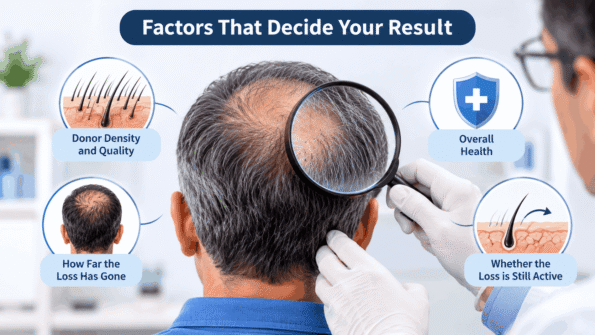
What Actually Decides Your Result After 50
Four things matter most. Surgeons look at them before they talk about graft numbers.
Donor density and quality.
The donor area is the band of hair at the back and sides of your scalp. In a study of 65 men who had strip-method transplants, donor follicular unit density was lower in older patients, and their scalp was less lax too. This is why a proper surgeon maps and counts your donor hair first, and does not quote a number over the phone.
A donor area that stays put.
In most men, the back and sides keep their hair for life. A small group has diffuse unpatterned alopecia (DUPA), where the donor area thins too. Hair taken from a thinning donor area can thin again after surgery, and candidacy guidelines list DUPA among the cases where surgery is best avoided. A scalp examination under magnification usually picks this up.
How far the loss has gone.
Donor hair is limited. If you are at an advanced stage on the Norwood scale, there simply may not be enough to cover everything. The smarter plan is to cover what matters most.
Whether the loss is still active.
Some men keep losing hair well into their 50s and 60s. Medicines can help hold on to the hair you still have, and your surgeon will plan around that.
Wondering whether your donor hair is strong enough at this stage of life?
Most medical conditions do not stop a transplant. They just need to be known and planned for. ISHRS lists heart disease, high blood pressure, diabetes and bleeding disorders as conditions that call for precautions, and says most pose little risk when they are recognised early.
Here is what usually comes up in a pre-surgery review:
- Blood pressure: it should be reasonably well controlled, and your readings will be checked.
- Diabetes: sugar control affects healing, so recent reports help.
- Heart conditions: surgery can sometimes be split into two or more shorter sessions to avoid a long single sitting.
- Blood thinners and aspirin: warfarin and aspirin reduce the blood’s ability to clot. Never stop them on your own. Your surgeon works this out together with your physician.
- Every other medicine and supplement you take: write the full list down, even the ones that seem unrelated.
If diabetes, thyroid or BP is your specific worry, we have a separate guide on having a hair transplant with diabetes, thyroid or high blood pressure.
What Results Can You Realistically Expect?
Most men over 50 do not want the hair of their twenties. They want to stop looking bald. That is a very achievable goal, and ISHRS describes it as a usually satisfying outcome for older patients.
A common plan is to rebuild the front hairline and place a limited number of grafts just behind it to create an impression of fullness. It works because the human eye struggles to tell 50% density from 100% density on the scalp. A good surgeon uses that. Sparing donor hair also keeps the door open if you ever need more.
One thing to be clear about: for some men over 50, the first transplant ends up being the only one, because the donor supply is limited. That is why planning matters more than speed. You can read full post on second hair transplant, which explain you what you should do next.
Grey hair is a common worry. A grey hair transplant works like any other. Some surgeons find that grey hair looks fuller because it contrasts less with the scalp. The flip side is that very white hair can look see-through under bright light. Ask your surgeon what they have seen in their own patients with similar hair.
FUE or FUT After 50?
FUT takes out a strip of scalp, so it depends on how stretchy your scalp is. The same study found scalp laxity tends to be lower in older patients, which is one reason many surgeons lean towards FUE. Our surgeons usually plan FUE using our BIG FUE method, and the final call comes after your scalp is examined.
Recovery and Aftercare in Your 50s and 60s
The first weeks look much the same as for anyone: scabbing, redness, then shedding of the transplanted hairs. That shedding is expected, so do not panic when it happens.
Healing speed varies at every age. In your 50s and 60s it usually has more to do with your general health and circulation than with the number itself.
New growth generally begins around month 3 or 4. Most of the result is visible by 9 to 12 months, and for some people it keeps improving up to about 18 months.
After surgery, the hair you did not transplant can still thin. So doctors often continue medicines such as minoxidil, and sometimes others, to protect it. If you take regular medicines for other conditions, tell your doctor before starting anything new. Follow the written aftercare plan from your surgeon over general advice you find online.
Worried that your BP, sugar or regular medicines might get in the way of surgery?
Hair Transplant After 50 for Women
Hair thinning often becomes more visible for women after menopause. But female hair loss is harder to assess. The donor area can be less stable in women, and that is why fewer women than men turn out to be good candidates.
If your thinning is spread evenly across the whole scalp, surgery may not be the first step. A proper diagnosis comes first, and sometimes medical treatment works better. You can read more on our female hair transplant page.
When It Is Better to Wait or Try Something Else
A good surgeon will sometimes tell you not to operate yet. These are the usual reasons:
- Very little donor hair for the area you want covered
- A donor area that is already thinning (DUPA)
- Sudden or unexplained shedding, which needs its cause found first (thyroid, nutrition and some medicines can trigger it)
- BP or sugar that is not under control
A 50-Year-Old Patient at Our Pune Clinic
One of our Pune patients came to us at 50 with advanced hair loss, around grade 5 to 6 on the Norwood scale. The plan was aimed at natural, age-appropriate coverage. You can read how his procedure and recovery went in his full.
The Bottom Line
A hair transplant after 50 is realistic when three things line up: a healthy donor area, controlled health conditions and goals that suit your age. If one of them is missing, it is better to know before you commit, not after.
Still asking yourself whether it is too late for you?
At Hair Free and Hair Grow, our surgeons will examine your scalp, go through your medical history, and tell you plainly whether a transplant makes sense for you. Book a consultation at the clinic nearest to you and find out where you stand.
Frequently Asked Questions
-
1. Is there an age limit for a hair transplant?
There is no strict maximum age. What matters is whether you are healthy enough for surgery, have a stable and adequate donor area, and hold realistic expectations. Your surgeon decides this after examining your scalp and reviewing your medical history.
-
2. Can a 60-year-old get a hair transplant?
Yes, many people in their 60s qualify. The assessment is the same as at 50: donor strength, health reports and the goal you have in mind. Plans tend to focus on a natural front and fuller look.
-
3. Is a hair transplant after 50 safe?
For most healthy people it can be, when it is planned properly. ISHRS says most conditions carry little risk once recognised. It is still surgery, so infection or bleeding are possible. Discuss your own risks with the surgeon.
-
4. Will transplanted hair turn grey too?
Transplanted hair keeps the behaviour of the donor area. If the hair there is greying, the transplanted hair is likely to grey as well. A transplant moves hair, it does not stop ageing.
-
5. Can I have a hair transplant if I take blood thinners?
Often yes, but it needs coordination. Blood thinners and aspirin change how you bleed. Do not stop them yourself. Your surgeon and your physician decide together if and when anything should change.
-
6. How long will it take to see results after 50?
Growth usually starts around month 3 or 4. Most of the result shows by 9 to 12 months, and it can keep improving for up to about 18 months. Timelines vary from person to person.
-
7. Will I need more than one session?
Sometimes. It depends on how much donor hair you have and how large the area is. For some men over 50 one well-planned session is enough, while others split the work across two.
-
8. Is a hair transplant after 50 worth it?
It is worth it for many people who want a natural, age-appropriate look and have good donor hair. It is less suitable if donor hair is very limited or health is not stable. A consultation answers this faster than guessing.
