

Quick Answer
After a hair transplant, transplanted hair sheds within 2–4 weeks, initial regrowth begins around Month 3–4, density reaches roughly 50–60% by Month 6, and final results typically appear between Month 10 and Month 15, crown areas take the longest.
If you’ve just had a hair transplant and you’re staring at the mirror wondering why your hair looks thinner than before the procedure, take a breath. We hear this almost every single week at our clinics, usually around the three-week mark, and in nearly every case it turns out to be exactly on schedule.
A hair transplant follows your body’s natural hair growth cycle, not an overnight switch. Understanding this hair transplant growth chart month by month helps you track your progress accurately, instead of comparing yourself to random photos online that don’t reflect your own hair type, graft count, or scalp condition.
This guide walks through what actually happens at each stage, from the first week of healing to the final result over a year later, including why the crown lags behind the hairline, how many hairs your grafts actually produce, and when a call to your surgeon is genuinely worth making instead of just waiting it out.
Not sure where you stand in your own timeline?
What Is a Hair Transplant Growth Chart?
A hair transplant growth chart is simply a month-by-month map of what happens to transplanted hair, from the day of surgery through to final, stable density. Because growth doesn’t happen in a straight line, there’s healing, then shedding, then a quiet gap, then gradual regrowth. This chart exists to stop patients from mistaking a normal phase for a failed one. Every patient moves through the same broad phases; only the speed differs from person to person.
The Hair Growth Cycle: Why Shedding Is Normal
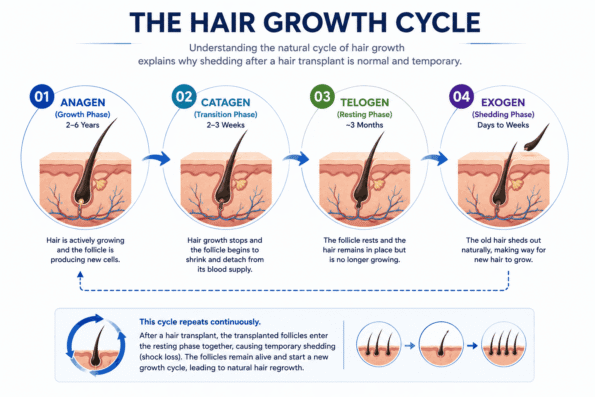
Every hair follicle, transplanted or natural, cycles through four phases:
- Anagen (growth phase): The active phase where hair is being produced. This can last 2–6 years for a healthy follicle.
- Catagen (transition phase): A short 2–3 week phase where the follicle stops growing and starts to shrink.
- Telogen (resting phase): The follicle rests for roughly 3 months before releasing the old hair.
- Exogen (shedding phase): The hair strand falls out, making way for a new growth cycle.
When you get a hair transplant, moving the follicles into their new location pushes many of them into this resting phase together. This is why transplanted hair often falls out around the 3–4 week mark, in a fairly short window rather than gradually, it’s called shock loss, and it does not mean the transplant has failed. The root itself stays alive under the skin; what falls out is just the old hair shaft, clearing the way for the next growth cycle to begin from the same follicle.
Week by Week: What Happens in the First Month
The first month has nothing to do with “growth” yet, it’s entirely about healing and protecting the grafts you just received.
Days 1–3:
This is the most fragile window. Grafts haven’t anchored into the scalp yet, so any friction, pressure, or scratching can dislodge one before it’s had the chance to establish its own blood supply. Mild redness, swelling, and light oozing around the recipient area are normal here and settle on their own.
Days 4–7:
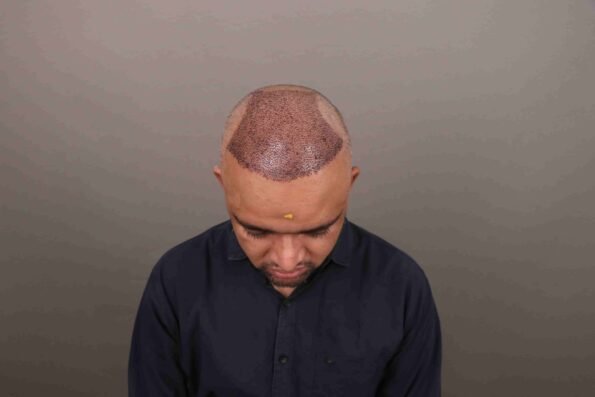
Small scabs form around each individual graft as the tiny wounds seal shut. This often worries patients into thinking grafts are falling out, they’re not. The scab is simply protecting the graft underneath while it settles in. Scabs typically begin loosening naturally toward the end of this window.
Days 7–10:
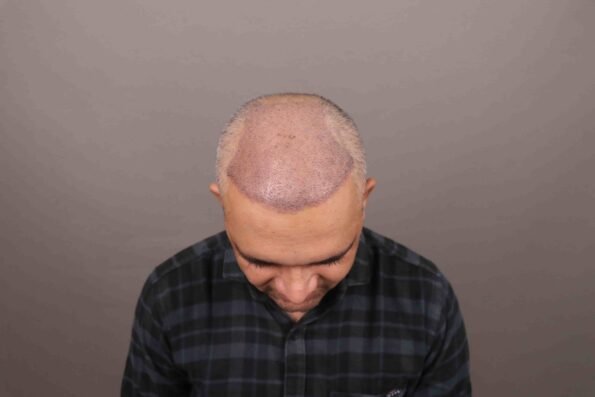
Grafts take roughly 8–10 days to root firmly enough that they’re no longer at risk of dislodging from normal, gentle handling. Your first proper head wash usually happens around Day 7, under your surgeon’s specific guidance, and marks the start of your regular wash routine.

Week 2:
Redness and swelling fade noticeably, and most remaining scabs clear away on their own. Most patients feel comfortable returning to desk-based work by this point, though visible pinkness can still linger for some skin types.
Weeks 3–4:
This is when shock loss sets in, the transplanted hair sheds, sometimes leaving the scalp looking thinner than it did right after surgery, or even than before the procedure. It’s the month patients find hardest emotionally, and it is completely normal. The follicles themselves are intact and simply entering a resting phase before regrowth begins.
Hair Transplant Growth Chart: Month-by-Month
Month 1:
Shedding continues through this month as the follicles settle into their resting phase. It’s common to feel like the transplant “isn’t working” here; this is the most psychologically difficult stretch of the whole timeline, precisely because nothing visible is improving yet while hair is actively falling out.
Month 2–3:
Often called the “quiet phase.” From the outside, very little seems to change: no new hair, no dramatic shift. But under the skin, the follicles are transitioning out of their resting phase and preparing to start producing hair again. This is the stretch where patience matters most, because the biology is working even though the mirror doesn’t show it yet.

Month 3–4:
The first real sign of progress. Fine, soft, often lightly pigmented hairs start breaking through the scalp, but unevenly, since each follicle runs on its own independent clock. Some patches will look further along than others; that patchiness is expected, not a sign that certain grafts failed. Density at this stage is typically only around 10–20%, so don’t judge your hairline shape yet.
Month 5:
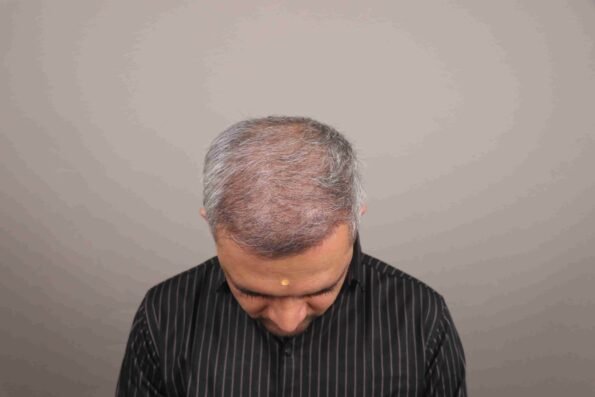
Growth becomes more consistent across the scalp, and coverage starts evening out. Hair strands begin thickening slightly and density moves up to roughly 40–50%. This is usually the first month where progress feels measurable from the previous check-in rather than just “maybe a little different.”
Month 6:
A genuine turning point for most patients, density reaches around 50–60%, and for the first time, the hairline starts taking the shape it was designed for. This is often the month people around you start noticing a difference without being told. Hair is still finer than its final texture, but the transformation starts to feel real.

Month 7–9:
Significant thickening happens here. The fine hairs that emerged around Month 4 gain both length and calibre, blending increasingly with your native hair. Density typically sits around 60–75% during this stretch, and the overall look starts to mature month over month rather than jumping in visible leaps.

Month 10–12:
Most patients reach close to their final density and hairline shape in the frontal and mid-scalp zones by now, typically 85–95%. This is the point where it’s finally fair to judge your overall result for those areas. If your transplant included crown work, though, don’t evaluate that zone yet, it’s still catching up (more on this below).
Month 12–15:
The crown and mid-scalp areas finish maturing, and density settles into its final, permanent state. For most patients, this is the true end point of the hair transplant growth timeline.

Quick Reference Table
| Timeline | Approx. Density | What's Happening |
|---|---|---|
|
Month 1
|
—
|
Shedding phase; follicles resting under the skin
|
|
Month 2–3
|
—
|
Quiet phase; follicles preparing to regrow
|
|
Month 3–4
|
~10–20%
|
First fine, patchy regrowth
|
|
Month 5
|
~40–50%
|
Growth evens out and thickens
|
|
Month 6
|
~50–60%
|
Hairline shape becomes visible to others
|
|
Month 7–9
|
~60–75%
|
Significant thickening and maturation
|
|
Month 10–12
|
~85–95%
|
Near-final results (frontal & mid-scalp)
|
|
Month 12–15
|
Final result
|
Crown completes; density stabilises
|
These percentages are averages we see across patients, not a promise of your specific outcome. Your donor density, graft count, and how well you stick to aftercare all shape where you’ll actually land, which is exactly why a proper in-person consultation beats any generic chart you find online.
According to the International Society of Hair Restoration Surgery (ISHRS) 2022 Practice Census, the average time for patients to reach “satisfactory” results is around 10.2 months post-procedure, nearly a year. This is one of the reasons judging your progress too early, at Month 3 or 4, can be misleading: most patients are genuinely just getting started at that stage.
Why density can dip slightly after Month 12
Some patients notice their hair looks marginally less dense a few months after hitting peak fullness around Month 10–12. This is normal: not every transplanted follicle stays in the active growth phase forever, a small percentage naturally cycles into a resting phase again, just like your native hair does. This settles into your true, permanent density by around Month 15, and it is not a sign of graft loss or transplant failure.
Wondering if your own progress matches this chart?
Crown vs Hairline: Why the Timeline Isn't the Same Everywhere
One thing most patients don’t realise until after their procedure: the crown and the hairline don’t grow at the same speed.
The frontal hairline typically shows visible growth earlier because it has better blood supply and the follicles are easier to place at precise angles. The crown, on the other hand, has comparatively lower blood circulation, which means transplanted grafts there take longer to settle in and mature, often needing the full 12 to 15 months, and sometimes longer, to show their final density.
If your transplant included crown coverage, don’t be discouraged if your hairline looks great at Month 9 while the crown still seems to be catching up, that gap is expected, not a warning sign. Judging crown results too early is one of the most common reasons patients feel disappointed when, in reality, their hair is right on schedule.
Expert Insight “The single biggest driver of patient anxiety we see isn’t the transplant itself, it’s timing. Patients who evaluate their crown at Month 6 using hairline-style expectations almost always think something has gone wrong, when in fact nothing has. I tell every patient before surgery: give the crown the full 12 to 15 months before you judge it. That one piece of expectation-setting prevents most of the unnecessary worry we see in follow-ups.”
— Dr. Chintan Bhavsar, Co-Founder & Chief Surgeon, HairFree HairGrow
More Grafts Doesn't Mean Faster Growth
A common question we get: “I got 4,000 grafts, so shouldn’t my hair grow faster than someone who got 2,000?”
Not quite. Every graft, regardless of how many you received, goes through the exact same biological growth cycle: shedding, rest, regrowth, thickening. A higher graft count affects how much coverage and density you’ll ultimately have, not how quickly the hair grows.
Two people transplanted on the same day, one with 2,000 grafts, one with 4,000, will generally follow a similar month-by-month timeline. The difference shows up in fullness at the end, not in speed along the way.
So how many actual hairs will you end up with?
This confuses a lot of first-time patients: a “graft” isn’t the same as a single hair. A graft is a naturally-occurring follicular unit that your body groups together, and each one usually holds anywhere from 1 to 4 strands, not just one. For most Indian and Asian scalps, that works out to an average of roughly 2 to 2.5 strands per unit.
Do the maths on a 3,000-graft session and you’re looking at somewhere between 6,000 and 7,500 individual hairs by the time everything matures, though your own number will depend on your donor hair’s thickness and how densely packed your follicular units naturally are. That’s something we assess properly during your in-person consultation, not something a chart can tell you in advance.
A Note for Indian Hair Types
Most growth charts you’ll find online are written for a global, largely Western or Turkish patient base, and hair growth rate does vary somewhat by hair type. Asian and Indian hair tends to grow slightly faster in terms of length per month compared to some other ethnicities, though it’s often finer in individual strand thickness, which is why density milestones (not just visible length) are the more reliable way to judge your progress if you have Indian hair.
This is also why donor density assessment during your consultation matters more than any generic online chart; it’s specific to your own scalp and hair characteristics.
Factors That Can Affect Your Personal Timeline
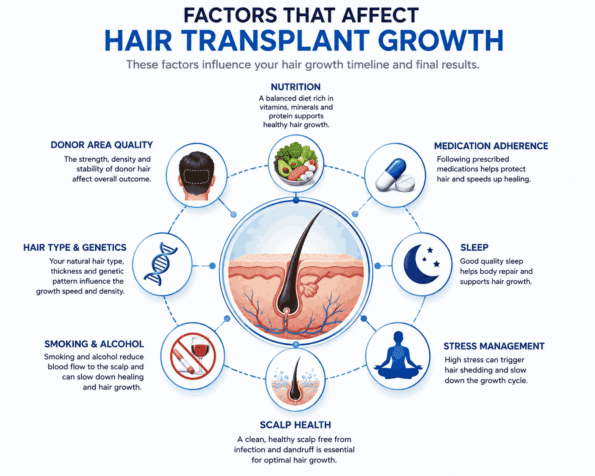
While the general hair transplant growth chart applies to most patients, a few factors can speed up or slow down your specific results:
- Aftercare and medication adherence: Following your surgeon’s instructions on washing, medication (such as minoxidil or finasteride, if prescribed), and scalp protection directly impacts how well grafts survive and grow.
- Nutrition: A diet with adequate protein, iron, biotin, and vitamin D supports healthy hair growth.
- Smoking and alcohol: Both can affect blood circulation to the scalp, which may slow down graft recovery.
- Stress and sleep: Poor sleep and high stress are known to worsen shedding and can make progress feel slower than it actually is.
- Scalp inflammation: Conditions like dandruff or folliculitis, if left unmanaged, can interfere with a calm healing environment.
- Hair type and texture: Naturally curlier or coarser hair can sometimes appear fuller sooner, even if the underlying growth rate is similar.
- Donor area quality: The density and health of the hair taken from your donor area plays a role in how the transplanted grafts perform.
If PRP or GFC therapy is something you’re considering alongside your transplant, it’s worth raising during your consultation, it can support graft health through the growth phase.
How to Track Your Progress the Right Way
Daily mirror-checking can be misleading, growth is gradual, and day-to-day changes are hard to notice. Instead:
- Take a photo every 2 weeks, using the same lighting, angle, and distance each time.
- Compare month-to-month, not day-to-day, comparing Week 2 photos to someone else’s Month 10 photos is a common way patients scare themselves unnecessarily.
- Avoid comparing your timeline to random “hair transplant growth chart” images online, every patient’s graft count, hair type, and donor density are different.
It’s a small habit, but it gives you an honest, personal record of your progress instead of relying on memory or comparing yourself to strangers online.
When to Actually Worry (vs When It's Just the Timeline)
Most concerns during the growth phase are simply part of the normal hair transplant growth timeline. That said, it’s worth reaching out to your surgeon, not waiting it out, if you notice:
- Redness, pus, or unusual pain persisting beyond the initial healing period, or getting worse instead of gradually improving
- Absolutely no signs of new growth by Month 5–6
- Patchy bald spots in the recipient area that show no change over several months
Most of the time these turn out to have a simple explanation. But self-diagnosing from an article isn’t a substitute for having your surgeon actually look at your scalp.
Still Unsure If Your Growth Is on Track?
Watching your hair go through shock loss and a slow regrowth phase can feel stressful, especially when you’re not sure if what you’re seeing is normal for your specific case. No online chart, including this one, can replace an actual look at your scalp, your graft count, and how your healing is progressing.
At HairFree HairGrow, our team can review your current stage against your personal treatment plan and tell you exactly where you stand.
Frequently Asked Questions
-
1. How long does it take for hair to grow after a hair transplant?
Most patients see initial growth around Month 3–4, noticeable density by Month 6, and final results between Month 10 and Month 15.
-
2. Is it normal to have no visible growth 3 months after a hair transplant?
Yes. Months 2–3 are often described as the "quiet phase," where follicles are recovering under the skin before visible growth begins around Month 3–4.
-
3. Why did my transplanted hair fall out after the procedure?
This is called shock loss, and it typically happens 2–4 weeks after surgery. The visible hair sheds, but the follicle remains alive under the scalp and will produce new hair during the regrowth phase.
-
4. Why is my crown growing slower than my hairline?
The crown has comparatively lower blood circulation than the frontal hairline, so it generally takes longer, often the full 12–15 months, to reach final density.
-
5. How long do 4,000 grafts take to grow?
4,000 grafts follow the same timeline as any transplant: shedding at 2–4 weeks, initial growth at Month 3–4, visible density by Month 6, and final results at 10–15 months. Graft count changes how much coverage you get, not how fast it grows.
-
6. How many hairs are in 3,000 grafts?
Each graft typically contains 1–4 hairs, averaging around 2–2.5 hairs per graft. 3,000 grafts usually yield approximately 6,000–7,500 individual hairs at full maturity.
-
7. When will I see the final results of my hair transplant?
Most patients reach their final result between Month 10 and Month 15, though crown areas may take slightly longer to fully mature.