
Quick Answer
AI hairline design is increasingly used in hair transplants to help surgeons study scalp patterns, facial proportions, and hair growth direction before the hairline is drawn. It doesn’t replace the surgeon. It supports the planning stage. The actual hairline design still remains a hands-on decision, made by an experienced surgeon during the procedure.
Introduction
For years, the hardest part of any hair transplant was never the extraction or the implantation. It was the few centimetres at the very front of the scalp — the hairline.
Get it wrong, and even a technically perfect transplant looks unnatural. Get it right, and it becomes the difference between a result that “looks like a transplant” and one that simply looks like hair.
That’s exactly why hairline design has always been treated as equal parts science and art. And it’s also why the recent conversation around AI hairline design has caught so much attention, patients want to know whether technology can actually make this notoriously difficult step more predictable.
What Is AI Hairline Design?
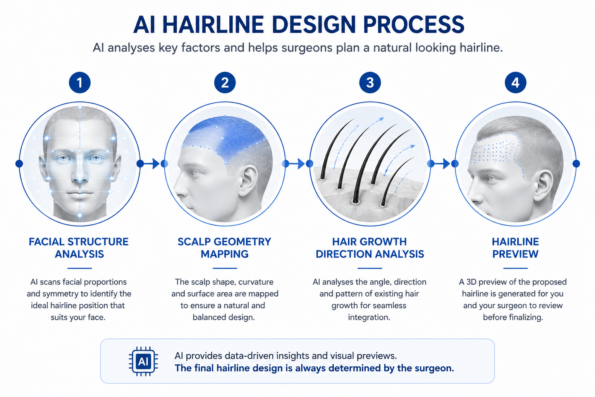
AI hairline design refers to the use of computer vision and machine learning tools to analyse a patient’s facial structure, scalp geometry, and existing hair growth pattern before a hair transplant is planned. The software maps proportions and suggests reference points for the hairline, but it doesn’t draw the final design. That decision is still made by the surgeon, based on clinical judgment, during consultation and surgery.
Can AI Replace Hair Transplant Surgeons?
No. AI-assisted tools can measure facial proportions, map scalp patterns, and simulate a hairline preview, but they cannot judge how a design should be adjusted for a patient’s age, ethnicity, scar tissue, or future hair loss.
Surgery itself, including Follicular Unit Extraction (FUE), recipient site creation, and graft placement, remains entirely surgeon-led. The ISHRS’s own position on robotics and FUE harvesting devices is that these tools are extensions of the operator’s hand, not independent decision-makers, and must be used by a licensed, trained physician.
Is AI Hairline Design Safe?
Yes, when it’s used the way it’s intended, as a planning and imaging aid, not a substitute for surgical judgment. The scanning and mapping process itself is non-invasive (typically photographs, 3D imaging, or digital trichoscopy of the scalp). The safety of the actual procedure still depends entirely on the surgeon’s skill, sterile technique, and experience, exactly as it would without any AI involvement.
Why Hairline Design Has Always Been the Hardest Part
A hairline is never a straight, solid edge. A natural one is irregular, slightly uneven, and made up of finer, single hair follicles that gradually thicken as they move back on the scalp.
Surgeons have traditionally relied on years of visual experience to judge this. They study face shape, age, bone structure, and the direction in which existing hair grows, then translate all of that into a design that will still look right ten or twenty years later.
The challenge is that no two faces age the same way. A hairline that looks natural on a 25-year-old can look artificial and “too young” on a patient in their forties. This is where a lot of poorly planned transplants go wrong, not because of technique, but because of design judgment made without enough data.
Wondering whether AI-assisted planning is right for your hair transplant?
See how your hairline could look before surgery, based on your own facial features, hair loss pattern, and long-term goals.
How AI Is Entering Hairline Planning
This is the gap that AI hairline design technology is starting to address, not in the surgery itself, but in the planning stage before it.
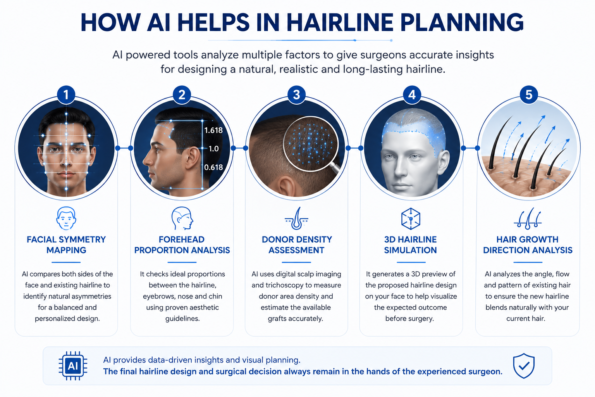
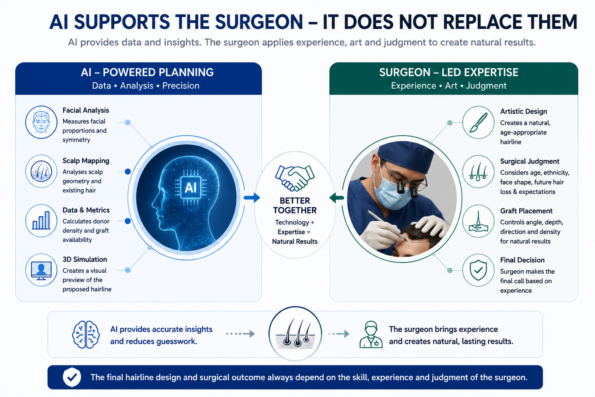
AI helps by:
- Mapping facial symmetry – comparing both sides of the face and existing hairline position to spot natural asymmetries a design should account for
- Measuring forehead proportions – checking hairline-to-eyebrow and nose-to-chin ratios against established aesthetic guidelines
- Assessing donor density – using digital scalp imaging and trichoscopy to estimate how many grafts are realistically available
- Simulating the hairline – generating a 3D preview of a proposed design on the patient’s own face, before anything is finalised
- Analysing growth direction – studying the angle and density of native hair, since a new hairline has to blend with what’s already there
None of this is about drawing the hairline automatically. It’s about giving the surgeon more structured information before they draw it.
AI Supports the Surgeon - It Does Not Replace Them
This is the point that gets lost in a lot of the excitement around AI hairline design, and it’s worth being direct about it: no software designs a hairline on its own, and no clinic should be claiming otherwise.
What AI-assisted tools actually do is reduce guesswork at the planning stage. They give the surgeon a data-backed starting reference, proportions, symmetry, growth direction, instead of relying purely on visual estimation.
But the final decision still comes down to surgical judgment. Where a hairline sits, how irregular the edge should be, how it’s shaped around the temples, how it’s adjusted for a patient’s age and future hair loss pattern, that’s experience, not software.
Think of it the way a good architect uses software to model a building before construction begins. The software helps visualise and plan. It doesn’t replace the architect’s understanding of the site, the materials, or the client’s needs. Hairline design works the same way, AI as a planning aid, the surgeon as the decision-maker.
“AI-assisted mapping gives us useful reference points, but a hairline still has to be judged in the room, on the day, looking at the patient’s actual face and hair. That part hasn’t changed, and I don’t think it should.”
Dr. Kiran Chotaliya, Hair Transplant Surgeon, HFHG
AI vs Human Surgeon: What Each One Actually Does
| Table Header | AI | Human Surgeon |
|---|---|---|
|
Role |
Measures
|
Judges |
|
Output |
Calculates proportions and density
|
Personalises the design to the patient
|
|
Contribution
|
Suggests reference points
|
Decides the final hairline
|
|
Involvement in surgery
|
None, planning stage only
|
Full, from marking to graft placement
|
Traditional Planning vs AI-Assisted Planning
| Aspect | Traditional Planning | AI-Assisted Planning |
|---|---|---|
|
Facial proportion analysis
|
Visual assessment by surgeon
|
Software-supported mapping alongside surgeon review
|
|
Hairline preview
|
Verbal description, sketches
|
3D hairline simulation on patient’s own face (where available)
|
|
Donor area assessment
|
Manual visual inspection
|
Supported by digital scalp imaging in some clinics
|
|
Final design decision
|
Surgeon |
Surgeon (AI does not make this call)
|
|
Execution during surgery
|
Fully manual, surgeon-led
|
Fully manual, surgeon-led, AI’s role ends at planning
|
This is also where terms like robotic hair transplant often get confused with AI planning tools. Robotic systems, where used, assist with graft extraction, a separate stage from hairline design. The two are frequently mentioned together in industry coverage, but they solve different problems.
Every hairline should be unique to the individual.
Speak with our specialists to see how factors like face shape, donor availability, and future hair loss are evaluated before creating a personalized hairline design.
What Does Research Say About AI in Hair Transplant Planning?
The hair restoration industry’s own professional body, the International Society of Hair Restoration Surgery (ISHRS), has been actively examining this technology, AI applications and digital trichoscopy featured in its recent World Congress programming and continuing education content.
Independent academic reviews, including a widely cited 2021 analysis in Dermatologic Therapy, have looked specifically at where AI shows promise in hair and scalp assessment, while noting that clinicians need to understand both the benefits and the current limitations of these tools.
The consistent takeaway across this research: AI currently assists with facial mapping, scalp imaging, and decision support, but clinical outcomes still depend primarily on surgeon expertise. No published research or professional body currently treats AI as a substitute for a trained surgeon’s judgment.
Benefits of AI Hairline Design
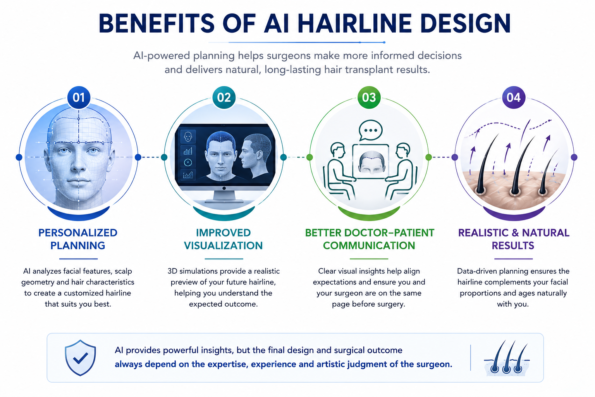
- Better visualisation – patients see a design mapped to their own face, not a generic example
- Improved communication – a data-backed starting point makes consultations more concrete and less reliant on verbal description alone
- More personalised planning – proportion and density data specific to the patient, rather than a template applied across everyone
- Better expectation management – donor limitations become visible during planning, not after the surgery is already done
Limitations of AI Hairline Design
Balanced information builds trust, so it’s worth being upfront about what this technology can’t do:
- Depends on image quality – poor scans or lighting can affect how accurate the mapping is
- Cannot predict future hair loss perfectly – genetics and hair loss progression still involve real uncertainty
- Doesn’t replace surgical judgment – the final design and every decision made during surgery stays with the surgeon
- Not available at every clinic – adoption varies, and not all “AI-powered” claims mean the same level of technology
Who Is AI Hairline Design Suitable For?
AI-assisted planning is generally used for patients with:
- A receding hairline
- Frontal baldness
- A revision or corrective transplant, where precise donor planning matters more
- Younger patients, where long-term ageing of the hairline needs extra consideration
- Female hairline reconstruction, which typically needs a different proportion and density approach than male hairlines
What a Well-Planned Hairline Actually Looks Like
Regardless of what tools are used to plan it, a natural hairline generally shares a few consistent features:
- A soft, irregular transition zone rather than a hard, straight edge
- Finer, single hair follicles placed at the very front, gradually increasing in density further back
- A shape adjusted to the individual’s face, not a generic template copied across patients
- Design that accounts for future hair loss, so the hairline still looks appropriate years later, not just immediately after healing
Choosing the Right Hairline for Your Face
One thing hasn’t changed, and likely won’t: a hairline still needs to be designed for the individual, not copied from a celebrity photo or a friend’s result.
Good hairline design for face shape takes into account bone structure, hair density, age, and the pattern of hair loss, factors that influence what will actually look right, regardless of which planning tools a clinic uses.
For patients researching AI hair transplant options in India, this is really the question worth asking at consultation: not just whether a clinic uses AI, but how the surgeon uses that input to make face-appropriate decisions.
Conclusion
Strip away the buzzwords, and AI hairline design turns out to be a planning tool, not a replacement for the surgeon. It measures proportions, maps growth direction, and removes some of the guesswork that used to sit entirely on visual estimation.
But the decisions that actually make a hairline look natural, where the edge softens, how much irregularity to add, what suits a specific face at a specific age, are still made by a person, in the room, looking at you. That balance, of data-backed planning and hands-on surgical judgment, is what real hairline artistry looks like today.
Thinking about a hair transplant?
Book a consultation with Hairfree Hairgrow to discuss your AI-assisted hairline design, graft requirements, and treatment options with our experts.
FAQs
-
1. How does AI help hair transplant planning?
AI-assisted tools help by mapping facial proportions, analysing hair growth direction, and in some cases generating a 3D preview of a proposed hairline. This gives the surgeon more structured reference points before finalising the design, though the decision itself stays with the surgeon.
-
2. Is AI actually used in hair transplants in India?
Some clinics are beginning to use AI-assisted tools for scalp mapping, facial analysis, and hairline simulation during the planning stage. It supports pre-procedure decision-making but does not perform the surgery or replace the surgeon's judgment.
-
3. Does AI design the hairline automatically?
No. AI tools can analyse facial proportions and suggest reference points, but the final hairline design and its execution during surgery remain entirely the surgeon's decision.
-
4. Is AI hairline design worth it?
For patients who want a clearer, data-backed preview of their design and more concrete consultations, it adds real value. It's not essential for a good result; experienced surgeons produced natural hairlines long before this technology existed, but it does reduce guesswork.
-
5. Does AI improve hair transplant success?
It can improve planning accuracy, particularly graft angle and density decisions, which are linked to natural-looking outcomes. Success still depends primarily on surgical technique and aftercare.
-
6. Can AI predict future hair loss?
AI tools can flag risk patterns based on current scalp data, but hair loss progression involves genetic and hormonal factors that can't be predicted with full accuracy by any method, AI included.
-
7. Does AI increase hair transplant cost?
Not typically. At clinics that have adopted it, AI-assisted mapping is usually included as part of the standard consultation rather than charged as a separate add-on.
-
8. What is considered the best hairline design technique right now?
There isn't a single universal technique. The best approach combines an irregular, face-appropriate hairline shape with finer grafts at the front, adjusted for the patient's age and future hair loss pattern. AI-assisted planning increasingly supports this process, but the underlying principles of good hairline design haven't fundamentally changed.
-
9. Why is hairline design considered the hardest part of a hair transplant?
Because it has to look natural both immediately after healing and years later as a patient ages. It requires balancing face shape, growth direction, and future hair loss, something that depends heavily on surgical experience.
-
10. Can I see my hairline before the surgery happens?
Some AI-assisted simulation tools allow a preview of a proposed hairline design on the patient's own face, though availability depends on the specific clinic and technology in use.
-
11. What should I actually look for in a clinic when it comes to hairline design?
Ask how the hairline will be planned, who makes the final design decision, and whether the surgeon has experience adjusting designs for face shape and long-term hair loss, regardless of what planning technology is used.