

Quick Answer
A mature hairline usually refers to a normal change in the hairline as it develops from a youthful to a more adult pattern. A receding hairline, on the other hand, keeps moving backward and may be accompanied by thinner or finer hairs around the temples and frontal scalp.
The problem is that they can look very similar at first.
You may notice that your forehead looks a little larger, the corners of your hairline have moved back, or your hairline has started to form an M-shape. That does not automatically mean you are going bald. What matters more is whether the change has stabilised or is continuing to progress.
Mature Hairline vs Receding Hairline: What Is the Difference?
The simplest way to understand the mature hairline vs receding hairline difference is to look at progression.
A mature hairline may shift and then remain fairly stable. A receding hairline continues to change, often with increasing temple recession and changes in hair density or thickness.
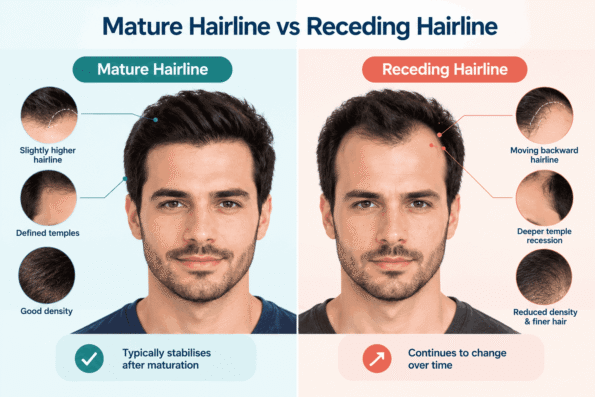
| Sign | Mature Hairline | Receding Hairline |
|---|---|---|
|
Movement
|
Usually settles after maturation
|
Continues to move backward
|
|
Temples
|
May become slightly more defined
|
Often become progressively deeper
|
|
Density
|
Generally maintained
|
May gradually decrease
|
|
Hair thickness
|
Usually fairly consistent
|
Hairs may become finer
|
|
Progression
|
Little change after settling
|
Noticeable change over time
|
|
Crown |
Usually unaffected by the hairline change
|
May also thin with pattern hair loss
|
|
Old photos
|
Similar hairline after maturation
|
Progressive change becomes visible
|
Expert Opinion
“The shape of the hairline alone is not enough to determine whether someone has hair loss. When assessing a patient, we look at the history of change, hair density, hair calibre and the overall pattern of thinning rather than judging the hairline from one photograph.”
Dr. Richa Sanmukhani
M.D. Skin – V.D. Dermatologist & Hair Transplant Surgeon
What Is a Mature Hairline?
A mature hairline is a normal change in the position and shape of the hairline as a person moves from adolescence into adulthood. It may sit slightly higher than a teenage hairline and can become more defined around the temples.
There is no single shape that every mature hairline follows. Research on normal hairline maturation shows that hairlines change with age and that there is considerable variation in their shape and development.
A mature hairline may:
- Sit slightly higher than your teenage hairline
- Become less rounded
- Show some change around the temples
- Develop a mild M-shape
- Remain relatively stable after the change
The key word here is stable. A hairline that changed once and then stayed in roughly the same position is different from one that continues to move backward year after year.
What Is a Receding Hairline?
A receding hairline is a hairline that progressively moves backward, often starting around the temples and frontal scalp.
In men, this can be an early sign of male pattern hair loss, also known as androgenetic alopecia. The American Academy of Dermatology identifies a receding hairline as one of the common signs of hereditary hair loss in men.
The change can be gradual enough that you may not notice it from one month to the next. Looking at photographs taken over a longer period often makes the progression easier to see.
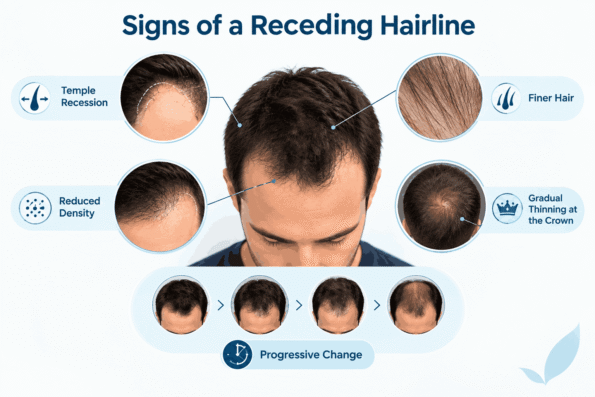
A receding hairline may also involve:
- Deeper temple recession
- Reduced density near the frontal hairline
- Finer hairs behind the hairline
- Gradual thinning at the top or crown
- Continued change over time
How Can You Tell If Your Hairline Is Maturing or Receding?
The best way to tell if your hairline is receding is to look for a pattern of change over time rather than focusing only on its current shape.
1. Compare Older Photos
Old photographs can be surprisingly useful.
Take photos from several months or years apart and compare the temples, centre of the hairline and the hair immediately behind it. Try to use similar lighting and camera angles.
If the hairline looks broadly similar over a long period, that is different from seeing a gradual backward shift.
2. Look at the Temples
Temple shape varies naturally from one person to another.
The question is not simply whether your temples are high. Look at whether they are becoming deeper over time and whether the hair around them is becoming less dense.
3. Check the Hair Behind the Hairline
This is an easy detail to overlook.
Hair can appear thinner even when the front edge of the hairline has not moved dramatically. In androgenetic alopecia, affected follicles can gradually produce finer hairs, a process known as miniaturisation.
So don’t only ask:
“Has my hairline moved?”
Also ask:
“Do the hairs behind my hairline look as thick as they used to?”
4. Look at the Crown and Mid-Scalp
Hairline changes are easier to interpret when you look at the whole scalp.
If you are also seeing thinning around the crown or mid-scalp, it may point toward a broader pattern of hair loss rather than simple hairline maturation.
5. Track the Change Over Time
This is one of the most useful things you can do.
Checking your hairline in the mirror every day can make tiny changes feel significant. Instead, take clear photographs occasionally and compare them under similar conditions.
A mature hairline may change and then settle. Progressive hair loss continues to change.
Not sure whether your temples are naturally maturing or actually receding?
It can be difficult to judge your own hairline because small changes are easy to miss, especially when you see it every day.
Does an M-Shaped Hairline Mean You Are Going Bald?
No. An M-shaped hairline does not automatically mean you are going bald.
Some people naturally have a more angular hairline, while others develop an M-shape as their youthful hairline matures.
What matters is whether the M-shape continues to deepen and whether other signs of hair loss appear alongside it.
Pay attention to:
- Progressive temple recession
- Thinning behind the hairline
- Finer hair strands
- Reduced frontal density
- Crown or mid-scalp thinning
- Noticeable changes in older photographs
An M-shape is therefore something to observe, not a diagnosis by itself.
Does a Mature Hairline Mean You Are Balding?
No. A mature hairline does not mean that you are balding.
A normal mature hairline can sit higher than your teenage hairline without indicating progressive hair loss.
The concern starts when the hairline continues to recede or when there are other changes such as miniaturisation and reduced density.
It is also possible to have a mature hairline and develop hereditary hair loss later. These are not mutually exclusive.
At What Age Does a Hairline Mature?
There is no exact age when everyone’s hairline matures.
Hairlines change during adolescence and adulthood, but the timing, amount of change and final shape vary between individuals. Research on normal hairline maturation also describes considerable variation between people.
So instead of relying on a rule such as “your hairline should mature by this age,” look at how your own hairline behaves over time.
Can a Mature Hairline Become a Receding Hairline?
Yes. A person can have a mature hairline and later develop progressive hair loss.
For example, someone may experience a normal change in their hairline during early adulthood and then have very little change for several years. If hereditary hair loss develops later, the temples may begin receding again.
This is why stability matters so much.
A useful question is not just:
“Is my hairline mature?”
It is:
“Has my hairline remained stable, or is it continuing to change?”
What Causes a Receding Hairline?
The most common cause of a receding hairline in men is androgenetic alopecia, or male pattern hair loss.
Male androgenetic alopecia affects around 30% to 50% of men by age 50, according to a medical review.
Genetics play an important role. In susceptible follicles, androgen-related changes can cause progressive miniaturisation, making individual hairs thinner and shorter over time.
However, not every receding-looking hairline is caused by male pattern hair loss.
Other conditions can affect the frontal hairline too. For example, repeated tension from tight hairstyles can cause traction alopecia, while frontal fibrosing alopecia can also begin with a receding hairline.
That is why identifying the cause matters before deciding what treatment is appropriate.
What Are the Early Signs of a Receding Hairline?
Common early signs of receding hairline include progressive changes rather than one isolated feature.
You may notice:
- Temples gradually moving backward
- Increasing forehead exposure compared with older photos
- Thinning around the frontal corners
- Finer hairs behind the hairline
- Reduced density around the temples
- A hairline that keeps changing over the years
- Hairline recession along with crown or mid-scalp thinning
The American Academy of Dermatology notes that a receding hairline that becomes increasingly visible over time can be a sign of hair loss.
How Do Doctors Check Whether a Hairline Is Receding?
Doctors look at more than the position of the hairline.
During an assessment, they may consider:
- When you first noticed the change
- Whether the hairline has continued to move
- Family history of hair loss
- Hair density across different areas
- Individual hair thickness
- The pattern of thinning
- Scalp condition
- Other symptoms
- Previous photographs
- Trichoscopy or other scalp examination when appropriate
The distinction is important because different causes of hair loss can require different approaches. The AAD also recommends getting the cause identified so that treatment can be matched to the condition.
Your hairline may look different, but that doesn’t tell you why it is changing.
A proper evaluation can help identify the pattern and give you a clearer idea of what to do next.
What Is Miniaturisation and Why Does It Matter?
Miniaturisation means that a hair follicle starts producing progressively finer and shorter hairs.
In male pattern hair loss, this can make the frontal scalp look less dense even before the hairline has moved significantly.
This is why someone may feel that their hairline “looks thinner” even though the actual position of the hairline has changed very little.
Hair thickness and density can therefore provide useful information when assessing early hair loss.
How Common Is Male Pattern Hair Loss in India?
Male pattern hair loss is also common among Indian men.
In a population-based study of 1,005 Indian men aged 30 to 49, researchers found androgenetic alopecia in 58% of participants. The prevalence also increased with age within the study group.
This does not mean that every Indian man with a changing hairline has male pattern hair loss. It simply shows why progressive hairline changes are worth assessing rather than automatically dismissing them as normal maturation.
When Should You See a Dermatologist About a Receding Hairline?
You should consider seeing a dermatologist if your receding hairline is clearly progressing, your hair is becoming noticeably thinner, or you are unsure what is causing the change.
It is particularly worth getting checked if you notice:
- Rapid or unusual hair loss
- Progressive temple recession
- Thinning at the crown or mid-scalp
- Noticeably finer hairs around the hairline
- Patchy hair loss
- Scalp redness, pain, scaling or persistent itching
- Eyebrow loss along with frontal hairline changes
- Hair loss after a significant illness or medication change
Some types of hair loss can look similar at first, so identifying the cause is an important part of choosing the right treatment.
Can a Receding Hairline Be Treated?
A receding hairline can often be managed, but the right treatment depends on the cause and how advanced the hair loss is.
For androgenetic alopecia, treatment may focus on slowing further loss and maintaining or improving existing hair. Depending on the diagnosis, options can include medical treatment and, for suitable candidates, hair restoration procedures.
The American Academy of Dermatology notes that treatment for male pattern hair loss can reduce further hair loss and that some men experience regrowth. It also notes that treatment tends to work better when started after hair loss is first noticed.
A hair transplant may be considered for appropriate candidates when the hairline has already receded and there is enough suitable donor hair. The decision should be based on the current pattern of loss and the expected progression, not simply on wanting a lower hairline.
Expert Opinion
“The goal should not be to lower every receding hairline. First, we need to understand why the hairline has changed, whether the loss is still progressing and what the long-term hair pattern may look like. Treatment should be planned around those factors.”
Expert opinion should be reviewed and attributed to the HFHG medical expert before publication.
A receding hairline can make you think about treatment before you even know how much hair you may lose in the future.
Mature Hairline vs Receding Hairline: The Bottom Line
The easiest way to understand the mature hairline vs receding hairline difference is to look at what happens over time.
A mature hairline may shift slightly as part of normal development and then remain relatively stable. A receding hairline continues to progress and may be accompanied by finer hairs, reduced density or thinning elsewhere on the scalp.
An M-shaped hairline by itself does not prove that you are going bald.
If you’re unsure, compare older photographs, pay attention to changes in hair thickness and density, and consider a professional assessment if the pattern continues to change.
Frequently Asked Questions
-
1. Is a mature hairline the same as a receding hairline?
No. A mature hairline generally refers to a normal change that becomes relatively stable, while a receding hairline continues to move backward and may be associated with progressive hair loss.
-
2. What does a mature hairline look like?
A mature hairline is usually slightly higher and less rounded than a youthful hairline. The temples may become more defined, but the exact shape varies between people.
-
3. How can I tell if my hairline is receding?
Look for progressive change over time. Compare older photographs and check whether your temples are moving backward, density is decreasing or hairs behind the hairline are becoming finer.
-
4. Can an M-shaped hairline be normal?
Yes. An M-shaped hairline can be a normal variation or part of hairline maturation. It becomes more concerning when the shape continues to deepen or is accompanied by thinning.
-
5. Does a mature hairline mean I will go bald?
No. A mature hairline does not mean you will develop baldness. However, hereditary hair loss can develop later, so continued progression is more important than the initial shape.
-
6. Can a mature hairline become a receding hairline?
Yes. A person can have a stable mature hairline and later develop androgenetic alopecia or another form of hair loss. Continued changes should therefore be assessed based on the overall pattern.
-
7. Can a receding hairline grow back?
It depends on the cause and how advanced the hair loss is. Some types of hair loss respond to treatment, while long-standing follicle miniaturisation or permanent follicle damage may limit regrowth.
-
8. When should I see a doctor for a receding hairline?
If your hairline is progressively changing, your hair is becoming noticeably thinner, or you have other symptoms such as scalp irritation or patchy hair loss, a dermatologist can help identify the cause and discuss suitable options.