
Quick Answer
Graft survival typically runs 90% to 95% at a well-run clinic, but true “success” also depends on how natural the result looks and whether you are happy with it.
If you have spent even ten minutes researching hair transplants, you have run into the same confusing situation everyone else does. One clinic says 95%. Another says 99%. A forum post somewhere says theirs failed completely. So which number do you actually go by?
Here is the straightforward answer: a hair transplant success rate is not one number, it is three. Once you know what each of those three numbers measures, you can judge any clinic, including ours, on what it is actually claiming rather than on a single headline percentage.
Why "Success Rate" Means Different Things to Different Clinics
This is the part almost nobody explains clearly, and it is why the numbers seem to contradict each other. When a clinic says “99% success,” the question worth asking is: 99% of what?
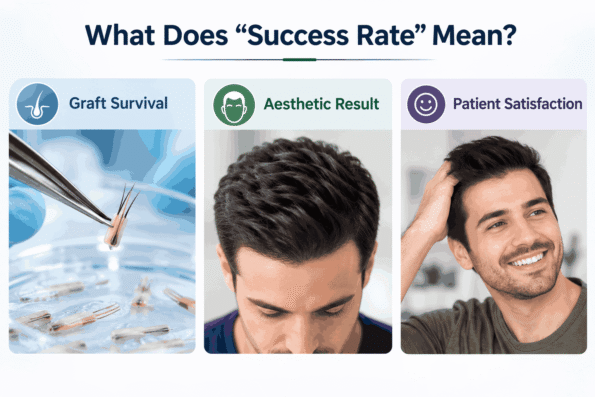
There are three separate things hiding under that one word.
- Graft survival rate. This is the biological number: out of every 100 hair follicles moved from the donor area, how many actually survive and grow. Clinics quote this one most often because it is usually the highest figure available.
- Aesthetic result. A graft can survive and still look wrong. A hairline placed at the wrong angle, uneven density, a hairline that does not suit the face shape, these are aesthetic shortfalls even when the biology worked fine. This depends on the surgeon’s judgment as much as technical skill.
- Patient satisfaction. This is the number that patients care about most day to day, and it is the hardest one to reduce to a percentage. It covers whether the result matched expectations, whether the growth timeline felt manageable, and whether the patient would recommend the clinic.
A clinic that only ever talks about the first number is not lying, but it is not giving you the full picture either. It is worth asking about all three before booking anything.
“In years of doing this, I have never met a patient who cared about the survival percentage on paper. They care about seeing a natural hairline in the mirror at month nine. That is the number we actually operate around.”
— Dr. Richa Sanmukhani, M.D. Skin – V.D. Dermatologist & Hair Transplant Surgeon
Confused by every clinic quoting a different success percentage?
Get a straight answer on what a realistic outcome looks like for your specific hair loss, no sales pitch.
Graft Survival Rate: The Real Number
Let’s deal with the number everyone actually wants: what is a realistic graft survival rate?
Across reputable clinics using modern techniques, graft survival typically falls between 90% and 95% of grafts placed. This is the figure most people mean when they ask about hair transplant success rate. Clinics with especially tight protocols sometimes report figures closer to 95% to 98%. A flat 100% guarantee, offered with no caveats, is not a realistic claim in a surgical procedure. Even skilled surgeons lose a small percentage of grafts. That is expected biology, not automatically a warning sign.
What tends to affect this number:
- Out-of-body time. The longer a follicle sits outside the scalp before implantation, the more it dries out, which can reduce its chance of survival. This is why the handling process between extraction and implantation matters as much as the extraction itself.
- Graft handling and storage. How grafts are kept, including temperature control, is generally considered to affect how many survive, though this varies by clinic protocol.
- Punch and implantation tool quality. Blunter or cruder tools are more likely to damage follicles during extraction or insertion. Finer, purpose-built tools are designed to reduce that risk.
- Surgeon experience. A surgeon who has performed the procedure many times is generally better able to extract cleanly without transecting follicles.
Success Rate by Technique: FUE, FUT, Sapphire FUE and BIG FUE
The technique used affects the process, though outcomes still depend heavily on how carefully it is executed.
FUT (strip method)
Grafts are harvested from a strip of scalp and dissected under a microscope. Survival rates are generally in a similar range to standard FUE, but it leaves a linear scar and is chosen less often today for that reason.
Standard FUE
Individual follicles are extracted one at a time with a punch tool, generally landing in the 90% to 95% range covered above when done well. It is the most widely used technique globally because it leaves no linear scar and recovery is faster.
Sapphire FUE
A variation of FUE that uses sapphire-tipped blades to create the recipient sites, producing smaller, more precise incisions than standard blades. This can support faster healing of the incision sites themselves, but graft survival still depends primarily on surgical technique, graft handling, and donor quality rather than the blade alone.
BIG FUE
Biological Implantation of Graft is HairFree & HairGrow’s own hair transplant protocol, developed with particular attention to out-of-body time:
- Recipient slits are pre-made with a fine sapphire blade before extraction begins
- Grafts are held in a chilled hypothermosol solution during handling
- Implantation uses a specialised KEEP implanter
This is our clinic’s approach to graft handling rather than a claim that it universally outperforms every other technique. As with any method, results still depend on the surgeon performing it and on the patient’s own donor quality and hair loss pattern.
The takeaway across all of these: the technique’s name matters less than how precisely it is carried out. Ask your clinic which technique they use, why, and what their own track record with it looks like.
Factors That Affect Your Personal Success Rate
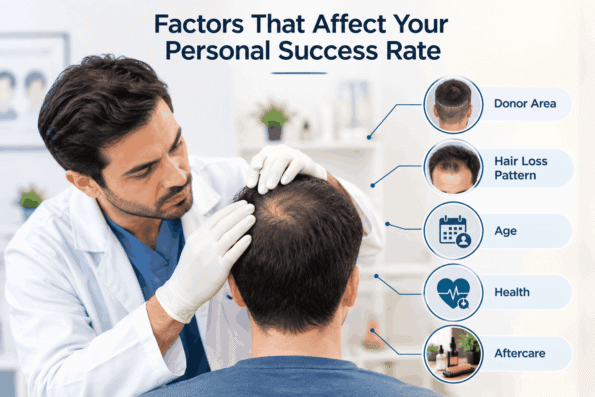
Published averages are a starting point, not a guarantee. Your actual outcome depends on factors specific to you.
- Donor area quality: Thick, healthy donor hair at the back and sides of the scalp gives more to work with. Thin or already-depleted donor areas limit what is realistically achievable.
- Extent and pattern of hair loss: Your Norwood or Ludwig grade affects how many grafts you need and how achievable full density is in one session.
- Age: Younger patients with actively progressing hair loss need a plan that accounts for future loss, not just the current bald patch, otherwise a transplant that looks complete today can look patchy again within a few years.
- Underlying health conditions: Uncontrolled diabetes, certain autoimmune conditions, or active scalp conditions can affect graft survival regardless of surgical skill. This is especially relevant for hair transplants in scarring alopecia cases, where success rates tend to run lower and depend heavily on disease stability.
- Aftercare adherence: Sleeping position, sun exposure, avoiding strenuous exercise for the recommended window, and taking prescribed medication all affect how well grafts settle in the first two weeks.
Not sure if your hair loss pattern or health profile makes you a good candidate?
Our surgeons assess donor quality, Norwood grade, and medical history before recommending any plan.
When Will You Actually Know If It Worked?
This is the question that causes the most unnecessary worry, so here is the general timeline.
- Weeks 2 to 4: Transplanted hair sheds. This is normal and does not mean the hair transplant failed. The follicle stays in place under the skin.
- Months 3 to 4: New, fine growth starts to appear.
- Months 6 to 9: Hair thickens and starts looking closer to natural texture.
- Months 9 to 12: Most patients see close to their final density and coverage, and this is also roughly when you can judge how long the results are likely to last.
- Beyond 12 months: Some patients, particularly those who had larger procedures, may continue to see gradual thickening for several more months.
Judging a transplant before month six generally means judging it too early.
Red Flags: When a "Success Rate" Claim Needs a Second Look
Since you are already comparing clinics, here are a few things worth questioning.
- A flat “100% guaranteed” promise with no explanation of what is being measured. Surgical outcomes vary by nature, so an unqualified guarantee is worth asking more about.
- No mention of graft survival timelines. If a clinic cannot tell you roughly when to expect results, it is worth asking how closely they track outcomes.
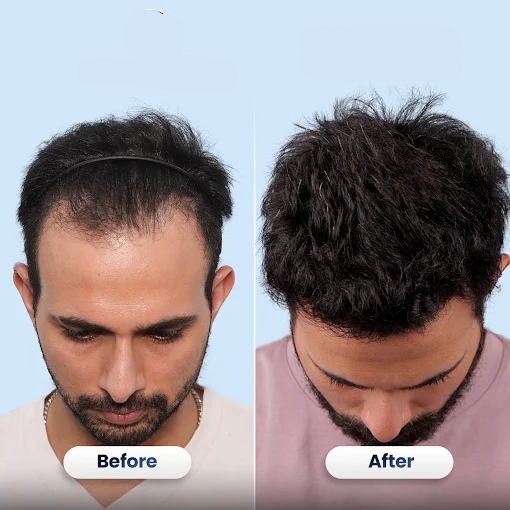
- Before-and-after photos with no context. Ask if these are the same surgeon’s actual patients, and whether the hair type and Norwood grade shown are similar to yours.
- No named surgeon or credentials attached to the claim. A success rate is only as credible as the person and clinic standing behind it.
- Unwillingness to discuss revision cases. Occasional touch-up or revision cases are a normal part of surgical practice at most clinics. It is reasonable to ask how a clinic handles them.
How HairFree & HairGrow Approaches Outcomes
We operate across 13 clinics in India and Bangladesh, and every one of our surgical teams follows the same BIG FUE protocol, the same graft handling standards, and the same aftercare guidance, regardless of which city you walk into.
Our surgeons track healing and growth through scheduled follow-ups at the key milestones outlined above, so if something is not progressing the way it should, we catch it early rather than at the twelve-month mark.
If you are trying to figure out what a realistic outcome looks like for your specific hair loss pattern, that conversation is best had directly with one of our surgeons. It works out cheaper than fixing a rushed job elsewhere, as we cover in our guide to getting a successful hair transplant on a budget.
Frequently Asked Questions
-
1. What is a good hair transplant success rate?
A graft survival rate of 90% to 95% is generally considered good at an experienced clinic. Claims of a flat 100% with no caveats are worth questioning rather than taking at face value.
-
2. Do hair transplants really work?
Yes, for the right candidate. Outcomes depend on donor hair quality, surgeon skill, technique, and how well aftercare instructions are followed. It is not a universal fix for every type of hair loss.
-
3. How do I know if my hair transplant was successful?
Look for steady, consistent growth between months 6 and 12, natural density that matches the rest of your hair, and a hairline that suits your face. Shedding in the first month is normal and not a sign of failure.
-
4. What percentage of hair transplants fail completely?
Complete failure is uncommon at a reputable, surgeon-led clinic, though exact figures vary and are not consistently tracked industry-wide. Partial underperformance, such as patchy density in one area, is more common than total failure and is usually correctable.
-
5. Does age affect hair transplant success rate?
Age itself is not the deciding factor, donor hair quality and the stability of your hair loss pattern matter more. Younger patients with actively progressing hair loss need a plan that accounts for future thinning, not just current baldness.
-
6. Can a failed or poorly done hair transplant be fixed?
In most cases, yes. Corrective or revision hair transplants are common, provided there is enough remaining donor hair to work with. This needs a detailed individual assessment first.
-
7. Which technique has the best success rate, FUE, FUT, or BIG FUE?
All modern techniques generally fall in a similar graft survival range when performed well. BIG FUE is HairFree & HairGrow's own protocol, designed around reducing graft handling and out-of-body time, rather than a claim of outperforming every other technique.
-
8. Is the hair transplant success rate in India different from other countries?
Not because of geography itself. What varies is the individual surgeon's experience and the clinic's protocols, not the country. India has a large number of high-volume, experienced hair transplant surgeons, which is part of why it draws patients internationally.
Sources
- International Society of Hair Restoration Surgery (ISHRS) — professional body publishing practice census data and clinical standards for hair restoration surgeons: https://www.ishrs.org/
- Comparative graft survival study of follicular unit excision, Dermatologic Surgery: https://www.ovid.com/jnls/dermatologicsurgery/abstract/10.1097/dss.0000000000002878
- Kim et al., condition of hair follicles produced by different FUE punching methods, Journal of Cosmetic Dermatology, 2024: https://www.ncbi.nlm.nih.gov/pmc/articles/PMC11626316/
- Follicular unit hair transplantation for postsurgical scalp scar deformity (graft survival in scarred tissue), PMC: https://www.ncbi.nlm.nih.gov/pmc/articles/PMC6535862/
- Stem cell therapy prior to follicular unit hair transplantation on scarred tissue, PMC: https://www.ncbi.nlm.nih.gov/pmc/articles/PMC11407486/