
Quick Answer
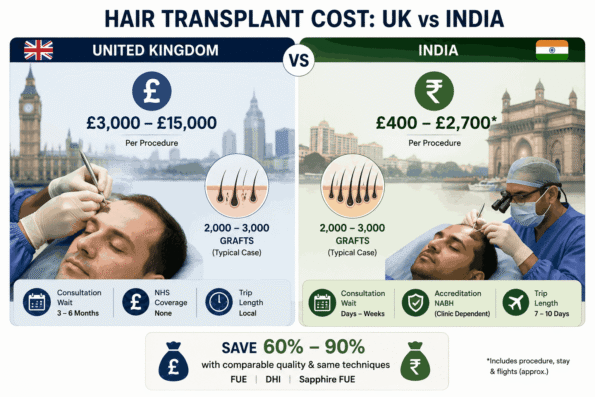
- UK cost: £3,000 to £15,000
- India cost: £400 to £2,700, flights and stay included
- NHS cover: None, it’s classed as cosmetic
- UK wait time: 3 to 6 months for a consultation
- India wait time: Days to a few weeks
- Trip length: 7 to 10 days in India
The gap is real, and it comes down to running costs, not skill. Keep reading for the full picture.
A UK hair transplant quote can easily cross £10,000. That single number sends most people straight to Google, searching for a cheaper way to fix the same problem.
India is where that search usually lands. This guide gives you the real numbers, the real risks, and the real process, so you can decide with facts instead of guesswork.
If you’re comparing a hair transplant in UK vs India, the difference goes beyond the price. Surgeon experience, clinic standards, travel, recovery and aftercare can all influence where you decide to have the procedure.
Why Does a Hair Transplant Cost So Much in the UK?
Short answer: the NHS doesn’t fund it, and UK clinic overheads are high.
Here’s what drives the price up:
- No NHS support. Hair loss is treated as cosmetic, so you pay 100% out of pocket.
- No insurance either. Most private health plans exclude it for the same reason.
- High overhead. Rent, staff wages and compliance costs in cities like London and Manchester get passed straight to you.
- Long waitlists. Well-reviewed clinics are booking 3 to 6 months out, and hair loss doesn’t wait.
More UK patients are responding to this by travelling abroad. Over 500,000 Brits left the country for treatment last year, a jump of nearly 50% in two years, and India sits among the top five destinations for it.
Hair Transplant Cost: UK vs India
| Factors | United Kingdom | India |
|---|---|---|
|
Average cost
|
£3,000 – £15,000
|
£400 – £2,700
|
|
NHS coverage
|
None |
N/A
|
|
Consultation wait
|
3–6 months
|
Days to weeks
|
|
Common techniques
|
FUE, FUT
|
FUE, DHI, Sapphire FUE
|
|
Trip length
|
Local
|
7–10 days
|
|
Regulator |
CQC |
NABH (clinic-dependent)
|
The India range is wide because pricing is graft-based, not a flat fee. Here’s how it breaks down by technique:
| Technique | Cost per graft (INR) | Cost per graft (approx. GBP) |
|---|---|---|
|
FUT |
₹20 – ₹50
|
£0.15 – £0.38
|
|
FUE
|
₹30 – ₹90
|
£0.23 – £0.69
|
|
Sapphire FUE
|
₹55 – ₹130
|
£0.42 – £1.00
|
|
Content |
Content |
Content |
A typical case needs 2,000 to 3,000 grafts, which is why most patients land in the ₹80,000 to ₹2,10,000 range (roughly £600 to £1,600) for the procedure itself, before flights and stay. Larger cases (4,000+ grafts) or premium Direct Follicular Implantation packages can push the total closer to ₹3,50,000 (around £2,700).
Even at the higher end of that range, most patients still save 60 to 80% compared to UK pricing. At the lower end, the saving is closer to 90%.
Want a more accurate estimate based on your hair loss and graft requirement?
Get a personalised hair transplant cost assessment from HairFree HairGrow.
Why Is a Hair Transplant So Much Cheaper in India?
Lower cost of running a clinic, not lower quality. That’s the real answer.
- Real estate and rent. Clinic space in Ahmedabad or Surat costs a fraction of what it does in London.
- Staff costs. Skilled medical staff salaries in India are significantly lower than UK equivalents, without a gap in training.
- Currency conversion. The pound’s exchange rate against the rupee stretches a UK patient’s budget further on the ground.
- Higher patient volume. Clinics performing transplants daily spread their equipment and facility costs across far more procedures, so each patient pays less.
- No insurance middleman. UK private clinics often price in insurance administration and compliance costs that Indian clinics don’t carry in the same way.
Expert opinion:
“Patients often assume a lower price means a lower standard of care. In reality, the price difference reflects operating costs, not surgical skill. Our surgeons train to the same international standards, many hold ISHRS fellowships, and we perform a far higher volume of procedures each year than most UK clinics. That volume is what sharpens a surgeon’s skill, not the price tag.”
Dr. Chintan Bhavsar, Co-Founder & Chief Surgeon, HairFree HairGrow
Still comparing clinics?
Speak with our team to understand the procedure, surgeon involvement, safety standards and what your treatment plan may involve.
Are Indian Surgeons Actually Qualified?
Yes, the leading ones are, and often more experienced than you’d expect.
What to check for:
- Fellowship credentials. Look for ISHRS affiliation, the same standard recognised in the UK and US.
- Training background. Top surgeons in India train at well-regarded medical institutions and specialise almost entirely in hair restoration.
- Case volume. Surgeons doing several transplants a week develop a level of hairline judgment that’s hard to match on a lower caseload.
- Doctor-led, not technician-led. This is the single biggest quality marker, ask directly who performs your procedure.
At HairFree HairGrow, doctors including Dr. Chintan Bhavsar, Dr. Kiran Chotaliya, Dr. Jinkal Kunjadiya and other qualified doctors lead every procedure themselves, across all 13 of our clinics. Nothing gets handed off to a technician.
Is It Safe to Get a Hair Transplant in India?
Yes, if you choose the right clinic. Quality varies a lot across India, so this step matters.
Before booking anywhere, ask:
- Is a qualified doctor performing the procedure, start to finish?
- What accreditation does the clinic hold, NABH or equivalent?
- Can they show verifiable results, not just curated before-and-afters?
- What’s the plan if a complication comes up after you’ve flown home?
A clinic that answers all four clearly is worth trusting. One that dodges even one of them is a clinic to skip.
Not sure what questions to ask?
and we’ll walk you through our accreditation and safety process directly.
What Does the Trip Actually Look Like?
Simpler than most people expect. Here’s the full timeline:
| Stage | What happens | Timing |
|---|---|---|
|
Consultation
|
Video call to assess hair loss, confirm technique and price
|
2–4 weeks before travel
|
|
Visa
|
Medical e-visa, applied online
|
Processed in a few working days
|
|
Flight |
UK to Mumbai, Delhi or Ahmedabad
|
8–9 hours, direct routes available
|
|
Procedure
|
FUE/Direct Follicular Implantation transplant, usually single-day
|
Day 1–2 of your trip
|
|
Recovery in India
|
Initial healing, follow-up check
|
Days 3–7
|
|
Return |
Fly home
|
Day 7–10
|
|
Aftercare |
Photo/video check-ins with your surgeon |
Ongoing for several months
|
It's Not Just About the Money
Cost is the headline, but two other things push UK patients toward India just as much:
- Speed. A receding hairline doesn’t pause for a 6-month UK waitlist. India can often get you from enquiry to procedure in weeks.
- Specialisation. Indian clinics see high volumes of international patients from the UK, US, Australia and the Middle East, so the entire process is built around travelling patients, not adjusted for them as an afterthought.
Making Your Decision
When comparing a hair transplant in UK vs India, cost is usually the first difference people notice. But the final decision should also consider the surgeon, clinic standards, treatment plan, travel arrangements and long-term aftercare.
What the numbers show clearly:
- India offers qualified, high-volume surgeons
- At a fraction of UK pricing
- With far shorter wait times
- Without cutting corners, as long as you vet the clinic
HairFree HairGrow has treated patients from the UK, US, Australia and the Middle East across 13 clinics in India, with every procedure planned and led by our own doctors.
If you’re considering a hair transplant in India from the UK, you can discuss your hair loss, graft requirements, and travel plan with the HairFree HairGrow team before deciding.
Frequently Asked Questions
-
1. Is it safe to get a hair transplant in India as a UK patient?
Yes, if you choose a doctor-led, accredited clinic. Confirm the surgeon's credentials and their aftercare process before booking.
-
2. How much does a hair transplant cost in India compared to the UK?
UK: £3,000–£15,000. India: £400–£2,000, including flights and stay.
-
3. How long do I need to stay in India?
7 to 10 days. The procedure itself is usually one day, the rest is recovery and a follow-up check.
-
4. Does the NHS cover hair transplants?
No. It's classified as cosmetic, so it's not covered by the NHS or most private insurance.
-
5. Will I get follow-up care once I'm back in the UK?
Yes, at a reputable clinic. Expect photo and video check-ins with your surgeon for several months.
-
6. Do I need a visa?
Yes, a medical e-visa, applied online and usually processed within a few working days.
-
7. How do I check if a clinic in India is genuinely qualified?
Confirm doctor-led procedures, NABH accreditation, verifiable results, and a clear complications policy.
Sources
Lorem ipsum dolor sit amet, consectetur adipiscing elit. Ut elit tellus, luctus nec
- Record numbers of Brits seeking healthcare abroad — 523,000 patients in 2024, NHS waiting list at 7.41 million — LBC, citing ONS data
- Record numbers give up on NHS to seek healthcare abroad — coverage of the same ONS figures, with destination country breakdown (Turkey, Poland, Romania, Portugal, India, Italy)
- ISHRS Fellowship Training Program — International Society of Hair Restoration Surgery
- About ISHRS — ISHRS mission and accreditation standards
- NABH — Who We Are — National Accreditation Board for Hospitals & Healthcare Providers, official site
- Care Quality Commission (CQC) — UK’s independent regulator for health and social care
ullamcorper mattis, pulvinar dapibus leo.