
Quick Answer
Castor oil for hair improves scalp health and reduces hair breakage, thanks to its high ricinoleic acid content (≈90%), which supports blood circulation and has anti-inflammatory properties. However, there is no strong clinical evidence that castor oil regrows hair or reverses androgenetic alopecia.
What Is Castor Oil? The Science Behind It
Castor oil is a vegetable oil extracted from the seeds of the Ricinus communis plant, grown widely across tropical regions including India. It has been used in Ayurvedic and traditional medicine for centuries, for skin, hair, and digestive health.
What makes castor oil unique for hair is its exceptionally high concentration of ricinoleic acid, a rare omega-9 fatty acid that makes up approximately 90% of castor oil’s composition. Ricinoleic acid is believed to activate the prostaglandin E2 (PGE2) receptor, which plays a role in hair growth signalling in dermal papilla cells (Johnstone & Albert, 2002).
In addition, castor oil is rich in:
- Vitamin E – a powerful antioxidant that protects hair follicles
- Omega-6 fatty acids – support moisture retention and scalp nourishment
- Antimicrobial and antifungal compounds – help maintain a clean, healthy scalp
Benefits of Castor Oil for Hair: What the Evidence Says
Let’s be clear upfront: the research on castor oil for hair growth is promising but limited. A 2022 review of plant oils found only weak clinical evidence that castor oil directly increases hair growth in humans. However, its benefits for scalp health and hair quality are well-supported, and those benefits matter.
1. Improves Scalp Blood Circulation
Ricinoleic acid has been shown to improve microcirculation in the scalp. Better blood flow means more oxygen and nutrients reaching hair follicles, creating an environment where hair can grow optimally. This is why castor oil for hair growth remains one of the most searched home remedies in India.
2. Reduces Hair Breakage and Strengthens Strands
Castor oil’s thick viscosity coats the hair shaft, locking in moisture and significantly reducing hair breakage. For those with dry, brittle, or chemically treated hair, regular use can make hair appear noticeably thicker and fuller, not because new hair is growing, but because less hair is snapping off.
3. Supports Scalp Health and Fights Infections
Castor oil’s natural antibacterial and antifungal properties help combat scalp infections, dandruff, and folliculitis, conditions that can worsen hair fall. A healthy scalp is the foundation of healthy hair growth. This benefit has the strongest scientific backing among all castor oil claims.
4. Moisturises and Conditions the Hair Shaft
Rich in fatty acids, castor oil for hair acts as a deep conditioner that penetrates the hair shaft, restoring moisture balance. It is particularly effective for people with dry, coarse, or heat-damaged hair, a common concern among Indian hair types, especially after salon treatments.
5. May Help Eyebrows and Eyelashes
This is where castor oil has arguably its strongest evidence: regular application to eyebrows and eyelashes appears to improve thickness and density. Many dermatologists recommend it as a safe, natural option for sparse brows.
Expert Insight
Castor oil is a valuable part of a scalp care routine, it improves the environment in which hair grows. But it is important for patients to understand that if the underlying cause of their hair loss is androgenic alopecia or a medical condition, castor oil alone will not stop or reverse the process. Early intervention with clinically proven treatments gives far better outcomes.
Dr. Shridevi Lakhe, Hair Transplant Surgeon, HairFree HairGrow
How to Use Castor Oil for Hair: Step-by-Step Guide
The how to apply castor oil for hair growth question is one of the most searched queries, and how you use it matters as much as whether you use it. Castor oil’s thick consistency can clog follicles if overused or applied incorrectly.
The Right Mixing Ratio
Castor oil is very thick and can be difficult to rinse out when used alone. Always mix it with a lighter carrier oil for best results:
- Castor oil + Coconut oil (1:2 ratio), best for dry, damaged hair and hair fall control
- Castor oil + Rosemary oil (1:2 ratio + 5 drops rosemary essential oil), best for hair regrowth and thinning concerns
- Castor oil + Jojoba oil (1:2 ratio), best for oily scalp types
Application Method
Follow this method for maximum benefit:
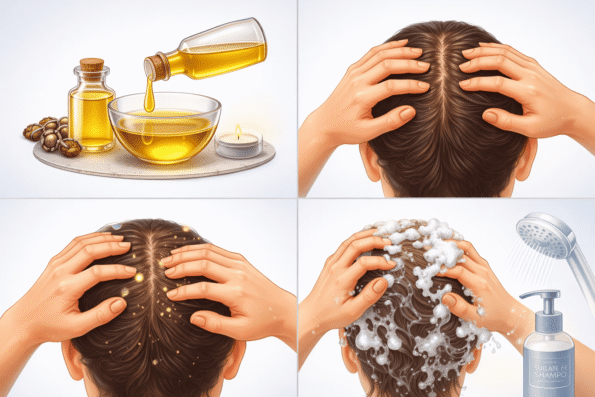
- Start with a clean, slightly damp scalp
- Gently warm the oil blend (do not microwave; warm it in a bowl of hot water)
- Section your hair and apply directly to the scalp, not just the hair lengths
- Massage in gentle circular motions for 5–10 minutes to boost absorption
- Leave on for minimum 1–2 hours, or overnight for deeper nourishment
- Wash out with a clarifying or gentle sulphate-free shampoo (castor oil is heavy, you may need to shampoo twice)
Frequency of Use
Castor oil for hair works best when used 2–3 times per week. Daily use is not recommended as it can lead to product build-up and may clog hair follicles, counterproductive to hair health.
Important: Do a Patch Test First
Apply a small amount of diluted castor oil to the inner forearm. Wait 24 hours. If you notice redness, itching, or swelling, discontinue use. Castor oil allergies are rare but possible.
Castor Oil vs Other Hair Oils: Which Is Right for You?
Not all hair oils are equal. Here is how castor oil compares to other popular options for hair growth in India:
| Oil | Evidence Level | Best For | Texture | India Availability | Treats AGA? |
|---|---|---|---|---|---|
|
Castor Oil
|
Low–Moderate
|
Scalp health, breakage
|
Very thick
|
✓ Easily available
|
✗ No
|
|
Rosemary Oil
|
High (Grade A)
|
DHT-related thinning
|
Light
|
✓ Available
|
Partial
|
|
Coconut Oil
|
Moderate
|
Protein loss, damage
|
Medium
|
✓ Widely available
|
✗ No
|
|
Bhringraj Oil
|
Low (traditional)
|
Hair strength, greying
|
Medium
|
✓ Available
|
✗ No
|
Key takeaway: Rosemary oil has the strongest clinical evidence for androgenic alopecia (hair loss from DHT). Castor oil is best used in combination with rosemary oil or coconut oil for a comprehensive approach to hair loss control.
Side Effects and Precautions: When to Be Careful
While castor oil for hair is generally safe, there are important precautions to keep in mind:
- Follicle clogging: Applying too much castor oil too frequently can block hair follicles. Always dilute and wash out thoroughly.
- Allergic reactions: Though rare, some people may experience itching, redness, or scalp irritation. Always patch test.
- Difficult removal: Castor oil’s thick consistency makes it hard to rinse. Use a clarifying shampoo and consider two wash cycles.
- Active scalp infections: If you have an open scalp wound or active fungal infection, avoid applying castor oil until the condition is treated.
- Not for post-transplant scalp: Do not apply castor oil immediately after a hair transplant; this is discussed in detail in the next section.
When Castor Oil Is Not Enough for Hair Loss
The honest truth about castor oil and hair loss
Castor oil for hair loss can support scalp health and reduce breakage, but it cannot reverse androgenic alopecia (male or female pattern baldness). If your hair loss is caused by genetics, hormones (DHT), or medical conditions, no topical oil, however potent, can restore lost follicles.
Here’s how to assess your situation:
- Castor oil is helpful if your hair fall is caused by scalp dryness, product build-up, mild dandruff, or general hair fragility
- Castor oil is NOT enough if you notice a receding hairline, thinning at the crown, patches of hair loss, or significant hair loss that has been worsening over months or years
Understanding the Norwood Scale
If your hair loss is at Norwood Scale 3 or above, meaning visible recession at the temples or a bald spot at the crown, clinical intervention is likely necessary. At this stage, waiting and relying on home remedies often allows further follicle miniaturisation, making future hair transplant surgery more extensive and costly.
When to See a Hair Specialist
At HairFree HairGrow, our specialists assess each patient’s hair loss using trichoscopic analysis and scalp imaging before recommending any treatment. If the cause is genetic or hormonal, we offer clinically proven solutions, including:
- BIG FUE (Body and Integrated Graft FUE) – HFHG’s signature high-density technique
- Bio FUE – combining FUE with biological growth factors for enhanced graft survival
- I-FUE – intelligent follicular unit extraction with precision implantation
- PRP and GFC therapy – non-surgical options for early-stage thinning
- Minoxidil and prescription treatments – clinically proven to slow hair loss
Book hair loss consultation with our specialist surgeons today. No obligation. Just expert answers.
Call | WhatsApp | Visit your nearest HairFree HairGrow clinic
Can You Use Castor Oil After a Hair Transplant?
This is one of the most commonly asked questions by our patients. The short answer: not immediately. After a hair transplant, the transplanted grafts are extremely fragile in the first two weeks.
Applying heavy oils like castor oil too early can:
- Dislodge newly placed grafts before they anchor
- Create a moisture environment that increases infection risk
- Interfere with scab formation, which is part of the natural healing process
Post-Transplant Timeline for Castor Oil Use:
| Phase | Timeframe | Castor Oil Status |
|---|---|---|
|
Critical healing
|
Days 1–14
|
❌ Not allowed, grafts are settling
|
|
Scab shedding
|
Weeks 2–4
|
❌ Still avoid, scalp is fragile
|
|
Stabilisation
|
Month 1–3
|
⚠️ Only if surgeon gives go-ahead
|
|
Full recovery
|
Month 4+
|
✅ Generally safe, consult surgeon first
|
Always follow the post-operative care instructions given by your surgeon. Every patient’s recovery is different. For personalised guidance, reach out to your treating doctor at HairFree HairGrow before introducing any new product to your post-transplant routine.
Conclusion: Use Castor Oil Wisely - Know Its Limits
Castor oil for hair is not a myth, but it is also not a miracle. When used correctly and consistently, it can meaningfully improve scalp health, reduce hair breakage, and support overall hair quality. For people dealing with seasonal hair fall, dry scalp, or early-stage thinning driven by lifestyle factors, it is a worthwhile addition to your routine.
But if your hair loss is genetic, hormonal, or progressive, it is time to move beyond home remedies. The sooner you seek a specialist assessment, the more options and better outcomes are available to you.
Ready to Get Real Answers About Your Hair Loss?
At HairFree HairGrow, our specialist hair surgeons offer easy consultations to assess your hair loss type, stage, and the most effective treatment path.
13+ clinics across Surat, Ahmedabad, Pune (Pimple Gurav), Pune Kharadi, Hyderabad, Kolkata, Bangalore, Bhopal, Delhi (Gurugram), Nagpur, Mumbai, Vapi (Silvassa)
FAQ
-
1. Does castor oil actually regrow hair?
Castor oil does not directly stimulate new hair follicle growth. There are no high-quality clinical trials proving that castor oil increases hair growth speed or density. What it does is improve scalp health and reduce hair breakage, which can make hair appear thicker over time.
-
2. Can I use castor oil for hair daily?
Daily use is not recommended. Castor oil's thick consistency can lead to product build-up and may block hair follicles if not properly washed out. Using it 2–3 times per week, diluted with a lighter carrier oil, is the ideal frequency for most hair types.
-
3. Is castor oil effective for male pattern baldness?
No. Male pattern baldness (androgenic alopecia) is caused by genetic DHT sensitivity that miniaturises hair follicles over time. Castor oil cannot block DHT or reverse follicle miniaturisation. For male pattern baldness, dermatologist-approved treatments, including FUE hair transplant, minoxidil, or finasteride, are the evidence-backed options.
-
4. Is castor oil better than minoxidil for hair growth?
No. Minoxidil is a clinically proven, FDA-approved topical treatment for androgenic alopecia with decades of robust human trial data. Castor oil has no comparable clinical evidence for hair regrowth. Castor oil can complement a hair care routine, but it is not a substitute for medical treatment in cases of progressive hair loss.
-
5. How long does castor oil take to show results?
For scalp health improvements and reduced breakage, most people notice a difference within 4–6 weeks of regular use. However, if your goal is hair regrowth from genetic hair loss, castor oil will not produce the results you are looking for, regardless of how long you use it.
-
6. Can I use castor oil after a hair transplant?
Not immediately. Castor oil should be avoided for at least the first 4 weeks after a hair transplant, and introduced only with your surgeon's approval after grafts have fully settled (typically month 4 onwards).
-
7. Which is better, castor oil or rosemary oil for hair growth?
Rosemary oil has significantly stronger clinical evidence. A 2015 study in SKINmed showed rosemary oil matched 2% minoxidil results after six months of daily scalp application. Castor oil's evidence base is much thinner.