
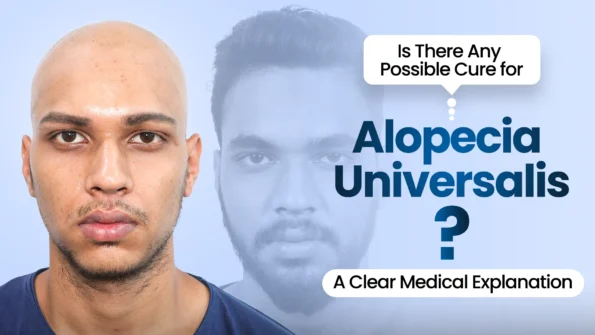
Most patients who come with complete scalp and body hair loss ask the same question first: Is alopecia universalis curable? At present, medical science does not have a confirmed cure for alopecia universalis, but treatment options have improved.
Some patients do experience hair regrowth when the right therapies are used early and monitored carefully. Hairfree & Hairgrow treats many such cases in India and follows a structured, medically guided approach because this condition behaves like a long-term immune disorder, not a temporary hair problem.
What Is Alopecia Universalis?
Alopecia universalis is the most advanced form of autoimmune hair loss, where the body’s immune system attacks all hair follicles on the scalp and the entire body. Unlike regular hair fall, this condition causes complete loss of scalp hair, eyebrows, eyelashes, beard and body hair.
The follicles are not dead, but they stop producing hair because immune cells block their growth cycle. The condition can appear suddenly or develop from alopecia areata or alopecia totalis. Because the disease comes from the immune system, treatment focuses on controlling immunity rather than stimulating hair growth from the outside.
What Really Causes Alopecia Universalis?
Alopecia universalis is an autoimmune condition. The body’s immune system starts attacking its own hair follicles. These follicles stop producing hair, even though they are not destroyed.
There is usually a combination of factors:
- Family history of autoimmune issues
- Overactive immune cells around the follicles
- Changes in the JAK-STAT signalling pathway
- Sometimes a sudden trigger, like illness or stress
Doctors know the biological process quite clearly, but the exact reason why the immune system starts this attack is still being studied. This is why treating this condition is challenging.
Current Medical Options Used for Treatment
Older methods such as steroid creams, light therapy or irritant lotions rarely work for complete hair loss. They may help small patches, but not the total loss. Modern treatment focuses on calming the immune reaction and helping the follicles restart their growth cycle.
At Hairfree & Hairgrow, doctors check each patient’s condition carefully. The number of years without hair, scalp condition under dermoscopy, and other medical issues all influence the choice of therapy.
How JAK Inhibitors Help Some Patients
In the last few years, medicines called JAK inhibitors have changed how doctors manage this condition. These medicines stop the immune signals that attack the hair follicles.
Large studies have shown:
- Many patients start showing hair regrowth after 12–24 weeks
- Some patients achieve good scalp coverage
- The medicine works better when the follicles are still alive
However, JAK inhibitors are not suitable for everyone. They require proper monitoring and are used only under medical supervision. At Hairfree & Hairgrow, these medicines are used carefully, and only when the patient’s condition allows safe use.
What Hair Regrowth Can Patients Expect?
Not every patient responds the same way. Some experience noticeable hair growth, while others show only mild improvement. Studies show that about 30–40% of alopecia universalis patients may see good regrowth with targeted therapy.
Regrowth patterns vary:
- Some see growth on the scalp first
- Some get eyebrows and beard hair earlier
- Some need longer treatment to see any change
Stopping treatment usually leads to relapse, which is why long-term planning is important. Hairfree & Hairgrow explain these possibilities clearly before starting therapy.
New Treatment Options Being Studied (2025)
Several new medicines are being tested globally. They aim to control the immune system more precisely. Some examples include:
- New JAK1-selective medicines
- Small molecules targeting inflammation in the follicle area
- Combination therapies
These are still in early stages. While early reports show hope, none of them can be called a breakthrough yet. Hairfree & Hairgrow keeps track of new studies and adjusts treatment advice when reliable clinical evidence becomes available.
Do Natural Remedies Help in Any Way?
Many patients in India try oils, supplements, herbal treatments or ayurvedic medicines. These remedies may improve general health, but they cannot stop the immune attack that causes alopecia universalis. Natural remedies do not harm in most cases, but they should never replace medical treatment for this condition.
What We Know from Clinical Trials
Here is a simple summary of what scientific trials show:
Treatment Type | What Studies Show | Current Use |
JAK inhibitors | Best results so far for severe alopecia | Used in selected patients |
Selective JAK1 medicines | Working in early tests | Still experimental |
Biologic medicines | Being tested for immune control | Not standard treatment yet |
These trials show improvement in many cases, but not a permanent fix.
Can There Be a Permanent Cure?
Right now, no medicine can promise permanent and complete recovery without ongoing treatment. The immune system becomes active again when the medicine is stopped, and hair loss may return.
Doctors treat alopecia universalis the same way they treat long-term autoimmune illnesses. The goal is:
- Control the immune attack
- Help the follicle stay active
- Support long-term hair maintenance
Hairfree & Hairgrow designs long-term plans for each patient to maintain their results as best as possible.
How Hairfree & Hairgrow Helps Patients With AU
When a patient comes to Hairfree & Hairgrow with alopecia universalis, the evaluation is detailed.
Doctors check:
- Scalp with dermoscopy
- Overall health and blood markers
- Duration of the condition
- Other autoimmune problems
- Previous treatments
Based on this, a personalised treatment plan is prepared. Regular follow-ups are scheduled every few weeks.
The clinic uses modern tools, medical imaging, and updated research guidelines. Because AU requires long-term follow-up, the clinic guides patients through every stage instead of providing temporary solutions.
Common Questions Doctors Consider Before Choosing a Treatment
- How long has the patient been without hair?
- Are the follicles still visible under dermoscopy?
- Is the disease active or has it stabilised?
- Are other autoimmune conditions present?
- Can the patient safely use systemic medicines?
These factors help predict whether the patient may respond well.
Understanding Where Today’s Treatments Stand
The field has advanced, but limitations still exist. JAK inhibitors work for many, but not all. Natural remedies cannot reverse autoimmune activity. New research brings hope, but it is too early to rely on it. Patients must know the truth clearly.
Hairfree & Hairgrow offers scientifically guided care, realistic timelines, and ongoing monitoring to help patients make informed decisions.
Conclusion
Research on alopecia universalis is moving forward faster than before. Several medicines show good results for some patients. But complete, permanent recovery without treatment is still not possible today.
With proper diagnosis, early treatment, and long-term care, many patients can regain hair and maintain it for years. Hairfree & Hairgrow works with this goal in mind: stable results, safe treatment, and clear guidance based on medical evidence.
Written By
MD (Skin & VD)
Dr. Richa Sanmukhani is a trusted hair restoration specialist with expertise in Alopecia Universalis. She provides evidence-based diagnosis, advanced treatment options, and personalized care to help patients manage severe hair loss and support long-term scalp health. Her guidance ensures informed decisions and effective recovery.
Disclaimer
We’ve made all possible efforts to ensure that the information provided here is accurate, up-to-date and complete, however, it should not be treated as a substitute for professional medical advice, diagnosis or treatment. See Detailed Disclaimers Here.