

Hair loss is a problem that affects millions of people worldwide, both men and women. Traditional hair transplant surgery has helped many people, but one major limitation still remains the limited donor hair supply.
This is why technologies like hair cloning, hair multiplication, and regenerative hair restoration are getting so much attention.
But the real question is, how real are these technologies? Are they available right now? And what does science actually say about them?
In this guide, we will cover all of this based on verified research and current medical knowledge without any hype.
What Is Hair Cloning? (And How Does It Work?)
Hair cloning also known as hair multiplication, is an advanced approach to hair restoration. Its goal is not to move existing follicles from one place to another, but to create completely new hair follicles.
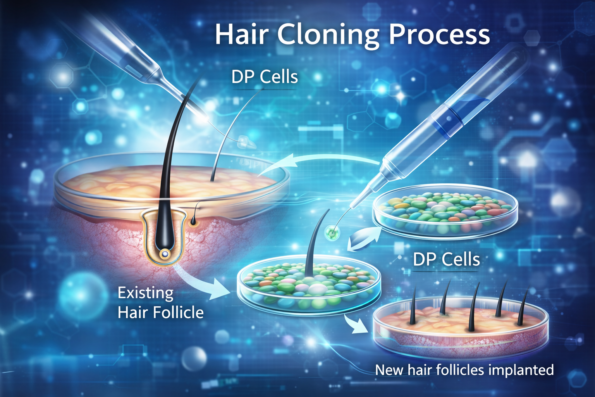
The entire process depends on a special type of cells called Dermal Papilla (DP) cells, which are located at the base of every hair follicle and control the hair growth cycle.
The step-by-step process works like this:
- Healthy follicles are taken from the patient’s scalp (usually from the back side).
- The dermal papilla cells inside those follicles are separated and placed in a special growth medium in a laboratory, where they multiply into thousands or even millions of cells.
- These newly multiplied cells are then re-implanted into thinning or balding areas.
- Ideally, these new follicles settle into the scalp and start producing permanent, natural hair.
This is different from a traditional transplant because, in that procedure, only existing follicles are moved. In hair cloning, new follicles are created, which means the limitation of donor hair could potentially be eliminated. For patients with advanced hair loss, this could be a true game-changer.
Hair Cloning vs. Hair Multiplication — Is There Any Difference?
These two terms are often used for the same concept, and from a patient’s point of view, there is no major difference. Still, technically:
Hair Cloning: New follicle cells are created in a laboratory with the help of stem cells outside the body, in a controlled environment.
Hair Multiplication: A single follicle is divided into multiple parts, and each part is expected to grow after being placed into the balding area.
The goal of both is the same more hair follicles than nature originally provided, and better coverage than a traditional transplant. For practical purposes, they can be considered the same concept.
February 2026 Breakthrough
In February 2026, researchers at Japan’s RIKEN Institute identified the missing third cell type required for lab-grown hair follicles – PDGFRα⁺ CD34⁺ Sca1⁺ mesenchymal cells. These act as “cellular conductors” that coordinate the entire follicle formation process, achieving 100% efficient follicle growth in lab conditions for the first time.
What this means for patients: This is a genuine scientific milestone, but lab results still need years of human trials and regulatory approvals before any treatment reaches clinics. The 5–10 year timeline may now accelerate, but hair cloning remains unavailable in 2026.
Dr. Chintan Bhavsar, M.D. (Skin & V.D.), Hairfree & Hairgrow: At Hairfree & Hairgrow, we closely follow global research in regenerative hair science. “The February 2026 discovery answers a question researchers struggled with for over a decade. But patients who need results today should not wait – proven surgical options like BIG FUE and Direct Follicular Implantation remain the most reliable path to permanent hair restoration.”
Still confused about which hair treatment is right for you?
Get a personalised assessment from our hair specialists – based on your hair loss stage, donor density, and long-term goals.
Hair Cloning vs. Traditional Hair Transplant: Key Differences
To understand why hair cloning is so significant, it is important to first look at current transplant surgery and its limitations.
Surgical Options Available Today
Modern hair transplant surgery is highly effective. However, it follows one core principle: redistribution moving the hair you already have. There are three main surgical techniques:
1. FUE (Follicular Unit Extraction)
- Individual follicles are removed one by one from the donor area.
- They are implanted into the balding area.
- Minimally invasive no linear scar.
- Natural-looking, permanent results.
2. FUT (Follicular Unit Transplantation)
- A strip of tissue is removed from the donor area.
- It is divided into individual follicular units and transplanted.
- A larger area can be covered in one session.
- A thin linear scar remains at the harvest site.
3. Sapphire Method
- A refined FUE technique, a specialized implanter pen is used.
- More precise, deeper incisions minimal root damage.
- Leading clinics report a 98%+ success rate.
- Shorter recovery time and denser results.
All three methods are proven and effective. However, one limitation is common to all: once the donor hair is exhausted, the options are also exhausted. Hair cloning removes this ceiling.
Quick Comparison: Hair Transplant vs. Hair Cloning
| Feature | Hair Transplant (FUE/Direct Follicular Implantation) | Hair Cloning |
|---|---|---|
|
Availability |
Widely available now |
Not yet available (2026) |
|
Method |
Moves existing follicles |
Creates new follicles |
|
Results |
Proven & predictable |
Still in clinical research |
|
Donor Supply |
Limited by your own hair |
Theoretically unlimited |
|
Cost |
$2,800–$4,500 (Turkey) |
Unknown likely high |
|
Recovery |
7–10 days |
Unknown |
Regenerative Medicine in Hair Restoration: What Is Available Now?
Hair cloning is a part of regenerative medicine, where the body’s own biological systems are used to heal and regenerate tissue. Two regenerative treatments are currently being used in clinics:
For a complete breakdown of pricing, graft calculations, and city-wise variations, read our detailed guide on hair transplant cost in India to understand what affects the final procedure cost.
1. Platelet-Rich Plasma (PRP) Therapy
PRP therapy is currently the most established regenerative hair treatment available. The process works like this:
- A small amount of your blood is taken and processed to concentrate the platelets and growth factors.
- This platelet-rich plasma is injected into the scalp.
- The growth factors improve follicle health, increase blood flow, and reduce inflammation.
- It encourages hair follicles to enter the active growth phase.
PRP is minimally invasive, uses your own biology no foreign substance, and has a solid clinical track record. It works well on its own for early-stage thinning and is even more effective when combined with surgical transplants.
2. Stem Cell Hair Therapy
Stem cells are undifferentiated cells that can develop into multiple different cell types. In hair restoration:
- Stem cells are harvested from the patient’s fat tissue or bone marrow.
- After being injected into the scalp, they release growth factors that improve the scalp environment.
- They can reactivate dormant follicles.
- Best results are seen in early-stage or diffuse hair loss.
One important point: stem cell hair therapy is not hair cloning. It does not create new follicles it supports and reactivates existing ones. Still, especially after a transplant, it is a useful tool.
Is Hair Cloning Available Right Now? (Direct Answer)
No. As of 2026, hair cloning is not commercially available anywhere in the world. Turkey, the USA, Japan, Germany no clinic offers an FDA- or EMA-approved hair cloning procedure.
It is still in the research and clinical trial phase. Why hasn’t it been launched yet? There are several key reasons:
Technical Difficulties: Replicating the exact cellular environment that follicles require is extremely complex. In the wrong growth medium, follicle cells lose their structure and stop functioning. Only a small number of germinative cells survive after reimplantation.
Inconsistent Results: Hair density, growth direction, and texture vary unpredictably. Completely natural-looking results are not yet reliable.
Immune Response Risk: The body’s immune system may reject reimplanted cloned follicles. Developing safe immune tolerance methods is a key research focus.
Long-Term Safety Unknown: There is no large-scale, long-term patient data available yet. Regulatory bodies like the FDA and EMA require this data for approval.
Scalability Challenges: Growing millions of follicle cells consistently and cost-effectively is a manufacturing hurdle. Success in the lab does not always translate into clinical-scale production.
Most experts estimate that hair cloning is still 5–10 years away from mainstream availability. Research by biotech firms in Japan, the UK, and the US is accelerating and the data so far is encouraging.
Is Hair Cloning Available Right Now?
Hair cloning isn’t available yet, but your hair loss doesn’t have to wait for it.
When Will Hair Cloning Be Available in India?
For Indian patients specifically, there is an additional layer of process before any new cellular therapy can be offered. Even after international approval, India’s CDSCO (Central Drugs Standard Control Organisation) conducts its own independent review and approval process. This typically adds 2–4 years to the international timeline.
Realistic India-specific timeline:
| Phase | Expected Timeline |
|---|---|
|
Global clinical trials complete
|
2029–2031
|
|
FDA/EMA approval (international)
|
2031–2033
|
|
CDSCO review and India approval
|
2033–2036
|
|
Available at Indian clinics
|
2034–2037 (estimated)
|
This is not pessimism; it is the standard regulatory process that protects patients from undertested procedures.
What should Indian patients with advanced hair loss do right now?
If you are at Norwood Grade 5, 6, or 7, where donor hair is limited, waiting for hair cloning is not a practical strategy. The best approach is a thorough consultation with an experienced trichologist to evaluate your current donor density, scalp laxity, and whether a staged transplant plan (possibly combined with SMP for density illusion in areas with limited donor coverage) is the right path.
At Hairfree & Hairgrow, our clinics across Surat, Ahmedabad, Mumbai, Delhi, Pune, Hyderabad, Bangalore, Kolkata, Nagpur, Bhopal, and Vapi offer free consultations for exactly this kind of personalised assessment.
Why Can Hair Cloning Change Everything?
Despite current limitations, the potential upside of hair cloning is very large:
Unlimited Donor Supply: For patients with advanced hair loss (Norwood Scale 6 or 7), the biggest barrier is running out of donor hair. Hair cloning could completely eliminate this problem, making full restoration possible for almost anyone, regardless of how much hair they have left.
Completely Natural Results: Since cloned follicles come from your own cells, the resulting hair looks, grows, and feels exactly like your natural hair no artificial texture, no visible difference.
Addressing the Root Cause: Current transplants redistribute existing hair. Hair cloning regenerates what has been lost this is a fundamentally different and much more powerful approach.
Potentially Less Invasive: As the technology matures, hair cloning could reduce or even eliminate the need for large surgical sessions making restoration more accessible for more people.
What should Indian patients with advanced hair loss do right now?
Running low on donor hair and unsure what’s still possible? Send us your photos and our doctors will tell you honestly.
Best Hair Restoration Options Available Today
There is no need to wait for hair cloning. Proven, effective options are available right now, both surgical and non-surgical.
Surgical Treatments
FUE Hair Transplant — Gold standard. Permanent, natural results, no linear scar. The best option for most patients.
Sapphire Method — The most precise FUE variant. 98%+ success rate. Minimal damage to hair roots.
FUT Transplant — Best for covering large areas. Excellent density. Leaves a thin linear scar.
Hair Transplants in Turkey — World-class results at significantly lower cost ($2,800–$4,500 vs. $15,000+ in the West).
Non-Surgical Treatments
Finasteride (Oral) — FDA-approved. Blocks the DHT hormone that slows hair loss and promotes regrowth. Most effective for male pattern baldness.
Minoxidil (Topical) — Improves scalp blood flow and stimulates growth. Available for both men and women.
PRP Therapy — Uses growth factors from your own blood to stimulate follicle health. A good option for early-stage hair loss.
Stem Cell Hair Therapy — Regenerative injections that reactivate dormant follicles. Works well alongside transplants.
Low-Level Laser Therapy (LLLT) — Stimulates cellular activity using specific light wavelengths. Can also be used at home.
Scalp Micropigmentation (SMP) — A non-surgical cosmetic option. Creates the illusion of a close-shaved head. Suitable for Norwood 6–7 patients.
you can also explore our detailed guide on the top 10 hair transplant clinic in India to compare experience, techniques, and patient results before making a decision.
When Will Hair Cloning Become Mainstream?
Hair restoration experts and researchers estimate that commercially available, clinically approved hair cloning is still at least 5–10 years away. The science is promising, but the journey from promising lab results to a safe, scalable, regulated clinical treatment takes time.
The most significant research is currently happening in:
Japan — Research groups have demonstrated follicle generation in animal models using cultured DP cells.
United Kingdom — Biotech firms are working on scalable follicle multiplication and implantation methods.
United States — Several firms are conducting regulated clinical trials under strict approval pathways guided by the U.S. Food and Drug Administration.
No one knows the exact timeline yet. However, it is clear that research is moving faster than ever before, and clinical data is continuously improving.
Final Thoughts
Hair cloning and hair multiplication point toward a promising future in hair restoration with unlimited donor supply and advanced regeneration.
But the reality in 2026 is:
- Hair cloning is not yet commercially available.
- It is still in the experimental and clinical research phase.
- Traditional hair transplant surgery remains the gold standard.
- Regenerative therapies like PRP and stem cell treatments provide supportive benefits.
Science is evolving slowly and carefully, as it should. If you want hair restoration today, safe and effective options are already available. And in the coming years, regenerative medicine may take hair restoration to an entirely new level.
At Hairfree & Hairgrow Clinic, our expert team uses advanced techniques such as FUE, Direct Follicular Implantation, and regenerative hair treatments to deliver natural-looking, permanent results.
With 12+ branches across Surat, Ahmedabad, Pune (Pimple Gurav), Pune Kharadi, Hyderabad, Kolkata, Bangalore, Bhopal, Delhi (Gurugram), Nagpur, Mumbai, Vapi (Silvassa), and Bangladesh, we make expert hair restoration accessible wherever you are.
With 15+ years of experience and multiple centers across India, we focus on safe procedures, high graft survival, and personalized care.
There is no need to wait for future technologies like hair cloning; proven and effective solutions are already available.
FAQ
-
1. Is Hair Cloning Available in India in 2026?
No. Hair cloning is not commercially available in India or anywhere in the world. It remains in the research phase, and India-specific CDSCO approval will add further time. Availability at Indian clinics is realistically estimated after 2034.
-
2. When Will Hair Cloning Be Available in India?
Global availability is estimated around 2031–2033. For India, CDSCO approval adds 2–4 more years, making it realistically available after 2034. For now, BIG FUE, Direct Follicular Implantation, and Stem Cell FUE are the best proven options available.
-
3. What Is the February 2026 Hair Cloning Breakthrough?
Researchers at Japan's RIKEN Institute identified the third cell type needed for 100% efficient lab-grown follicles. It is a major scientific step, but it does not mean hair cloning is available; human trials and regulatory approvals are still years away.
-
4. I Am a Norwood Grade 6 Patient - Should I Wait for Hair Cloning?
No. Hair cloning is not expected at Indian clinics before 2034, which is still 8 or more years away. A consultation with our specialists at Hairfree & Hairgrow can help plan the best combination of treatments for your current hair loss stage.
-
5. Is Hair Cloning Better Than a Hair Transplant?
Not comparable right now. Hair transplant is proven, available, and permanent. Hair cloning is still experimental with no approved procedure anywhere in the world.
-
6. What Is the Difference Between Hair Cloning and PRP Therapy?
PRP uses growth factors from your own blood to stimulate existing follicles, available now. Hair cloning would create entirely new follicles from cultured cells, still experimental. PRP is a treatment; hair cloning is a future technology.
-
7. Can Stem Cell Therapy Replace a Hair Transplant?
No. Stem cell therapy reactivates dormant follicles but does not create new ones. At Hairfree & Hairgrow, we offer Stem Cell FUE, combining surgery with stem cell therapy for better graft survival and faster recovery.
-
8. What Regenerative Hair Treatments Are Currently Available at Hairfree & Hairgrow?
We offer PRP Therapy, GFC Therapy, Stem Cell FUE, and Mesotherapy across our clinics in Surat, Ahmedabad, Mumbai, Pune, Delhi, Hyderabad, Bangalore, Kolkata, Nagpur, Bhopal, and Vapi.