
Medically Reviewed by Dr. Kiran Chotaliya, Trichologist, HairFree HairGrow
Quick Answer
Can Hard Water and Hair fall Cause Baldness? No. Hard water does not damage the hair follicle, which is what causes permanent baldness. It weakens the hair shaft itself, leading to breakage that looks like hair fall but is structurally different from pattern baldness.
What Is Hard Water?
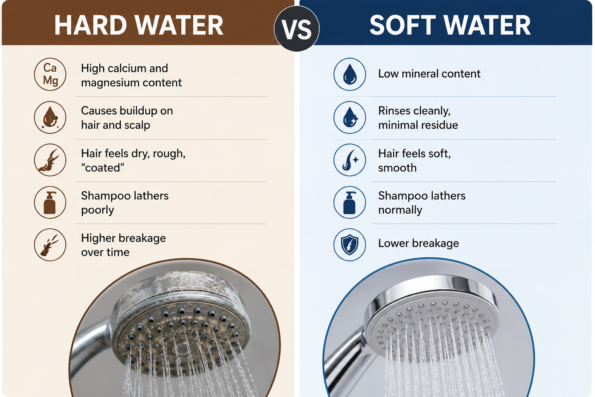
Hard water is water that carries a high concentration of dissolved minerals, mainly calcium and magnesium, picked up as it passes through soil, rock, and old pipelines. You’ve probably seen its effects already: white, chalky marks on your kettle, weak lather from your soap, or a dry, “coated” feeling on your skin after a shower.
Hard water is broadly classified into two types:
- Temporary hardness – caused by dissolved bicarbonate minerals (calcium and magnesium bicarbonate), which can be reduced by boiling.
- Permanent hardness – caused by calcium sulfate, calcium chloride, magnesium sulfate, or magnesium chloride, which cannot be removed by boiling and needs filtration or softening.
Does Boiling Remove Hard Water?
Only partially. Boiling removes temporary hardness caused by dissolved bicarbonates, but it has no effect on permanent hardness from sulfates and chlorides. For most Indian households, a filter or softener is needed alongside boiling.
In India, hard water is a widespread issue, cities like Bangalore, Pune, Chennai, Delhi, and Kolkata all report significant mineral content in municipal and borewell water supply, which is one reason hard water and hair fall complaints are so common across urban India.
| Hard Water | Soft Water |
|---|---|
|
High calcium and magnesium content
|
Low mineral content
|
|
Causes buildup on hair and scalp
|
Rinses cleanly, minimal residue
|
|
Hair feels dry, rough, “coated”
|
Hair feels soft, smooth
|
|
Shampoo lathers poorly
|
Shampoo lathers normally
|
|
Higher breakage over time
|
Lower breakage
|
Does Hard Water Actually Cause Hair Fall? What the Science Says
This is where most articles get it wrong, either overclaiming that hard water “causes baldness,” or dismissing the connection entirely. The truth sits in between.
A study published in the National Center for Biotechnology Information (NCBI/PMC) examined the effects of hard water on hair over a 30-day period, comparing hair strands washed in hard water against strands washed in distilled water. Researchers compared the tensile strength and elasticity of hair strands washed in hard water versus distilled water over a period of 30 days.
Hair washed in hard water consistently showed lower tensile strength and elasticity than hair washed in distilled water. Visible calcium buildup on the strands further confirmed that repeated exposure to hard water physically weakens the hair shaft.
However, it’s important to understand the mechanism:
- Hard water doesn’t attack the hair follicle the way genetic (androgenetic alopecia) or hormonal hair loss does.
- Instead, it coats the hair in a mineral film that blocks moisture absorption, making strands dry, brittle, and prone to breakage.
- Many people first notice this not as thinning, but as a sudden change in texture, hair that suddenly feels rough right after washing, tangles more, and takes visibly more effort to comb through, even with conditioner. This breakage often looks and feels like hair fall, you’ll find more strands in your hairbrush, shower drain, or pillow.
- In some cases, mineral buildup can clog scalp pores, encourage bacterial or fungal growth, and worsen dandruff or scalp irritation, which indirectly increases shedding.
So the accurate way to put it: hard water is a contributing and aggravating factor for hair fall, not a primary medical cause of baldness. If your hair fall continues even after switching to soft water, the underlying cause is likely something else, genetics, hormones, nutritional deficiency, or a scalp condition, and needs a professional diagnosis.
| Myth | Fact |
|---|---|
|
Hard water causes baldness
|
false
|
|
Hard water causes hair breakage
|
true |
|
Hard water kills hair follicles
|
false |
|
Hard water worsens existing hair loss
|
true |
Signs Your Hair Fall Might Be Caused by Hard Water
If you’re wondering whether your water quality is behind your hair troubles, look for these signs:
- Hair feels rough, straw-like, or tangles more easily after washing
- Increased hair fall specifically during brushing or shampooing
- Hair looks dull, flat, and lacks natural shine
- Shampoo doesn’t lather properly, and you need more product than usual
- Scalp feels dry, tight, itchy, or flaky
- Hair feels “coated” or heavy even right after washing
- Visible mineral buildup or white residue on your scalp near the hairline
If most of these apply to you, especially if the symptoms started after you moved to a new city or changed your water source, hard water is likely playing a role.
Why Hard Water and Hair Fall Is a Bigger Problem in Indian Cities
Water hardness varies significantly across India due to differences in groundwater geology, borewell dependency, and aging municipal pipe infrastructure. Patients at our hair transplant clinics in Pune, Bangalore, Kolkata, and Surat frequently report hard water as one of the environmental stressors behind their hair fall, alongside pollution and lifestyle factors.
- In Pune, patients dealing with hair thinning often cite the combination of hard water, pollution, and long working hours as contributing factors
- In Bangalore, poor water supply quality has been linked to noticeably increased hair fall and dullness among long-term residents
- In Kolkata, mineral-heavy water supply is a known factor that makes hair brittle over time
- In Surat, humidity combined with hard water creates a particularly tough environment for hair health
If you live in one of these cities and are already dealing with hair fall, it’s worth getting a proper scalp and hair assessment rather than assuming it’s “just the water.”
How to Prevent and Treat Hard Water Hair Fall
The good news: hard water and hair fall is largely reversible once you address the root exposure. Here’s what actually works:
- Use a clarifying shampoo weekly
Clarifying shampoos are formulated to strip mineral buildup that regular shampoos can’t remove. Use once a week, overuse can dry out hair further. - Install a shower filter or water softener
A basic shower filter reduces mineral content before water touches your hair. For a more permanent fix, a whole-home water softener using ion-exchange resin removes hardness at the source. - Try a diluted apple cider vinegar rinse
An ACV rinse (1 part vinegar to 3-4 parts water) after shampooing helps dissolve mineral deposits and restore your hair’s natural pH balance. - Deep condition regularly
Hard water strips moisture, so a weekly hydrating hair mask helps rebuild the moisture barrier that mineral buildup damages. - Rinse with filtered or RO water when possible
Even a final rinse with filtered or RO water after washing with tap water can meaningfully cut down mineral exposure. - Oil your scalp before washing
A pre-wash oiling routine (coconut or almond oil) creates a light protective barrier that reduces how much mineral residue penetrates the hair shaft.
Can RO Water Help With Hair Fall?
Yes, indirectly. RO or filtered water has fewer dissolved minerals, so rinsing with it reduces buildup on the hair shaft and can improve texture. It won’t reverse hair loss caused by genetics or hormones, only the portion of hair fall linked to water quality.
When Hard Water Is Probably NOT the Cause of Your Hair Fall
Hard water is a real contributing factor, but it isn’t the explanation for every case of hair fall. If any of the following apply to you, hard water is unlikely to be the primary driver, and it’s worth getting evaluated directly:
- You have a family history of male or female pattern baldness
- You notice a receding hairline or widening parting rather than overall breakage
- You’ve been diagnosed with a thyroid disorder or PCOS
- Your hair fall started after pregnancy or childbirth (postpartum hair loss)
- You have a known iron or nutritional deficiency
- You have an autoimmune condition affecting hair or skin
In these situations, fixing your water quality may still help hair texture, but it will not resolve the underlying cause of shedding. A trichologist can help you tell the two apart.
When to See a Doctor Instead of Just Fixing Your Water
Hard water management is a good first step, but it’s not the answer for everyone. You should consult a trichologist or dermatologist if:
- Hair fall continues even after 6-8 weeks of using filtered/soft water and clarifying routines
- You notice a receding hairline, thinning crown, or widening parting, signs of pattern hair loss unrelated to water quality
- You experience sudden, excessive shedding (handfuls of hair) rather than gradual breakage
- Your scalp shows persistent redness, pain, or scaling despite home care
- Hair fall is accompanied by other symptoms like fatigue, weight changes, or irregular periods (which can point to thyroid or hormonal causes)
At this stage, hard water is likely not your only problem, and a proper diagnosis, through scalp analysis, pull tests, or blood work, is necessary before starting any treatment.
How HairFree HairGrow Can Help
If your hair fall hasn’t improved despite fixing your water routine, our trichologists can help identify the actual root cause, whether it’s a scalp condition, nutritional deficiency, hormonal imbalance, or early-stage pattern hair loss. Depending on the diagnosis, treatment options range from medical therapy and PRP (Platelet-Rich Plasma) to advanced procedures like BIG FUE, Bio FUE, or I-FUE hair transplant for more advanced hair loss.
Our doctors across Pune, Bangalore, Kolkata, Surat, and 10+ other locations in India regularly treat patients dealing with environmental hair damage combined with underlying hair loss conditions, offering a combined approach rather than a one-size-fits-all fix.
Key Takeaways
Hard water does not directly cause baldness
– Mineral deposits weaken the hair shaft, not the follicle
– This shows up as dryness and breakage that resembles hair fall
– Shower filters, clarifying shampoo, and RO rinses reduce the damage
– Persistent hair fall after fixing water quality needs a professional evaluation
Frequently Asked Questions
-
1. Can hard water cause hair loss?
Not directly. Hard water weakens and dries out hair, leading to breakage and increased shedding, but it does not damage hair follicles the way genetic or hormonal hair loss does. If hair fall persists after fixing your water source, consult a trichologist.
-
2. Is hard water hair fall reversible?
Yes, in most cases. If your hair follicles aren't damaged, healthy growth typically resumes once you reduce mineral exposure through filters, clarifying shampoos, and proper hair care.
-
3. How do I know if my hair fall is because of hard water?
Look for dryness, dullness, tangling, poor shampoo lather, and increased breakage that started after a change in your water source or city. If hair fall is sudden or severe, it's likely not just water-related.
-
4. What is the best shampoo for hard water hair fall?
A clarifying shampoo used once a week, combined with a regular hydrating shampoo for other washes, works best for managing hard water buildup without over-drying your hair.
-
5. Does RO or filtered water stop hair fall?
Using RO or filtered water to rinse your hair reduces mineral buildup and can noticeably improve hair texture and reduce breakage-related hair fall, but it won't resolve hair loss caused by genetics or hormonal factors.
-
6. Can hard water cause dandruff or an itchy scalp?
Yes, indirectly. Mineral buildup can clog scalp pores and disrupt the scalp's natural balance, which can worsen dandruff, flaking, and itchiness in people who are already prone to them.
-
7. Does hard water affect colored or chemically treated hair more?
Yes. Colored and chemically treated hair has a more porous, already-weakened cuticle, so it absorbs more mineral deposits from hard water and shows dryness and breakage faster than untreated hair.