

Medically Reviewed by Dr. Jinkal Kunjadiya, Hair Transplant Specialist, HairFree HairGrow Surat
Quick Answer:
Can Grade 3 baldness be treated with a hair transplant?
Yes. Norwood Grade 3 is one of the most suitable stages for hair transplant surgery. The donor area is still strong, results are achievable in a single session, and natural density is visible within 9–12 months.
Wondering if Grade 3 baldness hair transplant is right for you? Read Rohan Bagdawala’s real journey, from his first consultation at HairFree HairGrow Surat to his 12-month hair transplant results.
What Is Grade 3 Baldness?
If your temples are slowly receding and your forehead feels wider every month, you might be at Norwood Grade 3 hair loss.
The Norwood Scale is a medical classification system used worldwide to measure male pattern baldness. It goes from Grade 1 (no visible loss) to Grade 7 (severe baldness). Grade 3 is the stage where:
- The hairline visibly recedes at both temples
- The hairline shape starts forming an “M”, “U”, or “V”
- In some cases, early thinning begins at the crown as well
That crown involvement variation is called Grade 3A or Norwood 3 Vertex, and it’s slightly more complex than standard Grade 3.
Rohan’s case was Grade 3A, temple recession combined with early crown thinning. Both areas needed to be addressed in the same session.
Patient Profile: Rohan Bagdawala
| Detail | Information |
|---|---|
|
Patient Name
|
Rohan Bagdawala
|
|
City |
Surat, Gujarat
|
|
Hair Loss Grade
|
Norwood 3A
|
|
Areas Treated
|
Front, Hairline, Temples
|
|
Procedure Date
|
7 October 2025
|
|
Clinic |
HairFree HairGrow, Surat
|
|
Doctor |
Dr. Jinkal Kunjadiya
|
|
Technique
|
Bio-FUE
|
|
Total Grafts
|
3,405
|
|
Sessions
|
Single Session
|
Rohan's Story: Why He Decided to Act
Rohan had been noticing his hairline shifting for a while. It started at the temples, a little recession here, a little thinning there. Then came the crown. What began as something easy to ignore slowly became something he couldn’t stop noticing in photos and mirrors.
Like most people, Rohan first tried the usual options, oils, shampoos, over-the-counter products. But Grade 3 hair loss doesn’t respond to surface-level treatments. By this stage, the follicles affected by DHT are too weak to recover on their own.
When Rohan visited HairFree HairGrow’s Surat clinic, Dr. Jinkal Kunjadiya conducted a thorough assessment and confirmed that Bio-FUE hair transplant could fully restore his hairline and temple coverage in a single session.
Pre-Procedure Assessment: What Dr. Jinkal Kunjadiya Evaluated
Before any procedure, a detailed assessment is non-negotiable, especially for Grade 3A baldness hair transplant where multiple zones are involved.
Dr. Jinkal evaluated:
- Donor area density – the occipital region (back of the scalp) was healthy and strong
- Recipient zone mapping – front zone, hairline, and both temples were marked
- Grade confirmation – NW-3A with frontal and temple recession plus early crown thinning
- Graft count – 3,405 grafts required for full natural coverage across all three zones
- Technique selection – Bio-FUE, for its superior graft survival rate and faster healing
- Hairline design – planned according to Rohan’s facial structure, age, and natural growth pattern
The hairline design step is often underestimated, but it determines how natural the final result looks. A well-designed hairline for a Grade 3 patient should look age-appropriate, not artificially low.
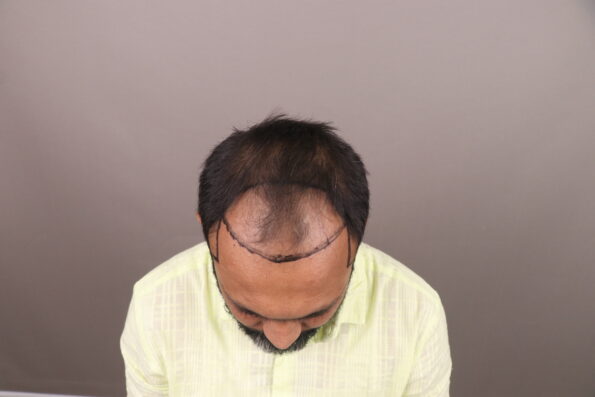
Grade 3 Baldness Hair Transplant: How Bio-FUE Works
Date: 7 October 2025 | HairFree HairGrow, Surat
Bio-FUE is HairFree HairGrow’s advanced FUE hair transplant technique. Here’s what makes it different from standard FUE:
In standard FUE, follicular units are extracted one by one from the donor area and stored briefly before implantation. In Bio-FUE, the extracted grafts are preserved in a special biocompatible solution during this waiting period, this significantly improves graft survival rate and reduces follicle trauma.
Step-by-step, here’s what happened on Rohan’s procedure day:
Step 1
Extraction: 3,405 follicular units were carefully extracted from the donor area using micro-punch tools. No cuts, no stitches, no linear scar.
Step 2
Graft Preparation: Follicles were sorted by unit size (1-hair, 2-hair, 3-hair grafts) and preserved in the Bio solution to maintain viability.
Step 3
Recipient Site Creation: Dr. Jinkal Kunjadiya created tiny recipient sites at precise angles and directions, mimicking the natural hair growth pattern across the front, hairline, and temples.
Step 4
Implantation: All 3,405 grafts were placed carefully into the recipient sites. The session was completed under local anaesthesia; Rohan remained comfortable throughout.
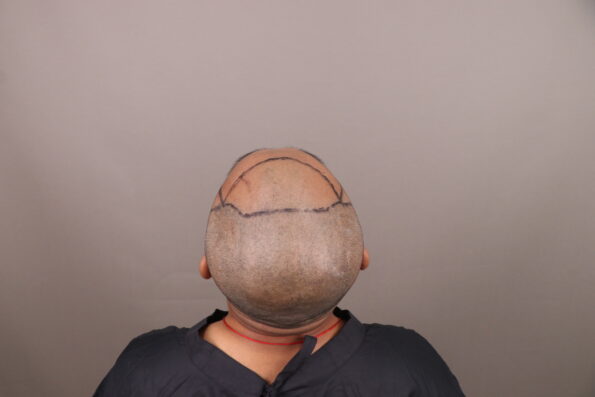
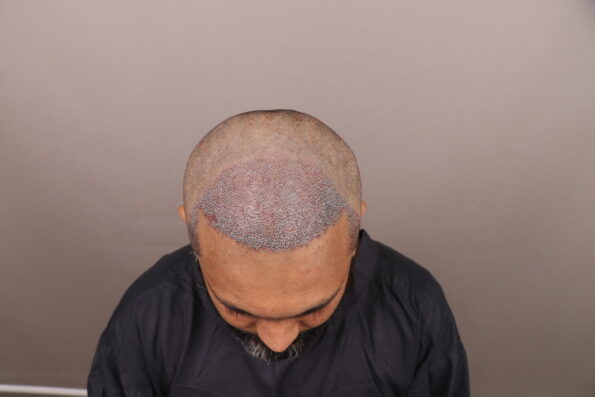
Month-by-Month Recovery and Growth Timeline
What actually happens after a hair transplant for Grade 3 baldness? When does growth start? What does the healing look like?
Rohan’s journey is fully documented, from Day 1 to Month 12.
Day 7 - Early Healing
Mild swelling and redness are normal in the first few days. By Day 7, scabs around the transplanted area start to fall off naturally. The donor area begins to heal. The transplanted grafts are settling into place.
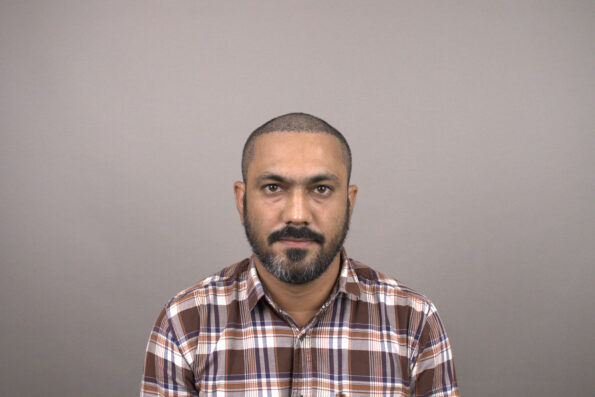
1 Month 7 Days - Shock Loss Phase
This is the stage that worries most patients, and it shouldn’t. Shock loss (temporary shedding of transplanted hair) is a completely normal part of the hair transplant recovery process. The follicle is anchoring itself beneath the scalp; the hair shaft sheds temporarily before new growth begins.
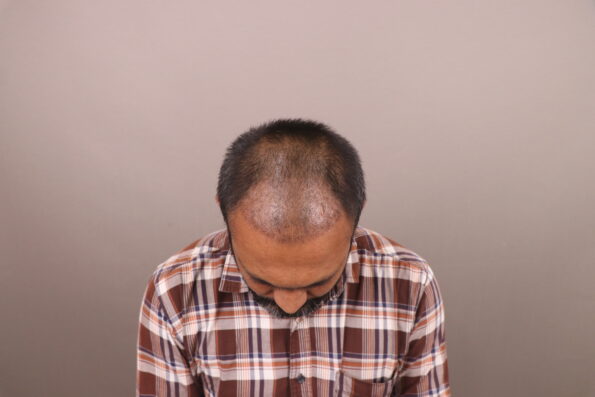
2 Months 7 Days - The Waiting Phase
The follicles are in a dormant phase. Nothing dramatic is visible on the surface, but growth is actively happening underneath. This is the most important time to stay patient and follow post-care instructions.

3 Months - First Signs of New Growth
The moment patients wait for. Fine, thin new hairs begin to emerge, first at the temples, then along the hairline. The texture is soft at this stage but the growth is real and consistent.
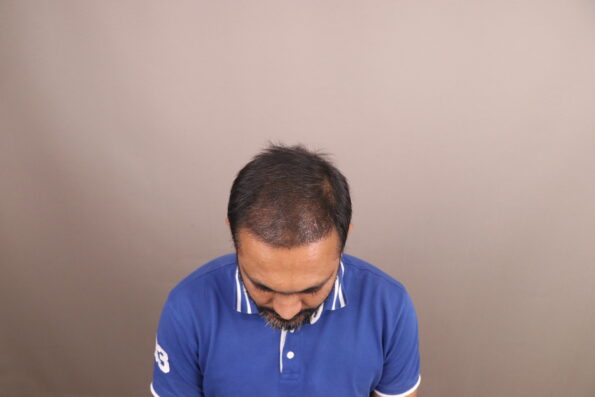
4 Months - Density Building
Hair density is visibly improving. The hairline shape is becoming clear. Hairs are still maturing but the coverage improvement over the baseline is clearly noticeable.
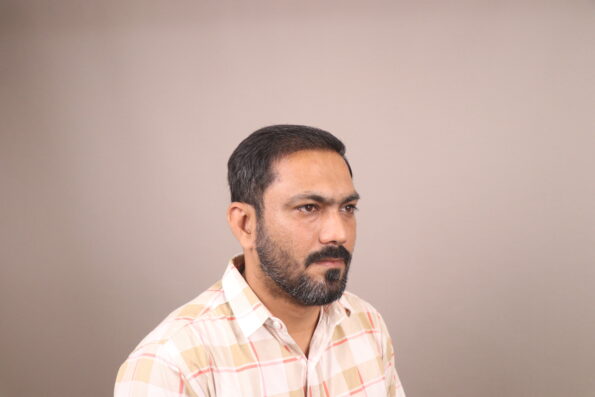
5 Months - Accelerated Growth
Growth rate increases significantly at this stage. The front zone and temples show strong coverage. Most patients at this point can confidently say the hair transplant is working.

7 Months - Texture Matures
Hair transitions from fine new growth to mature, normal-textured hair. Styling becomes possible. Most patients feel confident enough to go without any concealment products at this point.

10 Months - Near-Final Result
All three zones, front, hairline, and temples, show strong, natural coverage. The quality of Dr. Jinkal Kunjadiya’s hairline design is fully visible at this stage. Graft survival has been excellent.
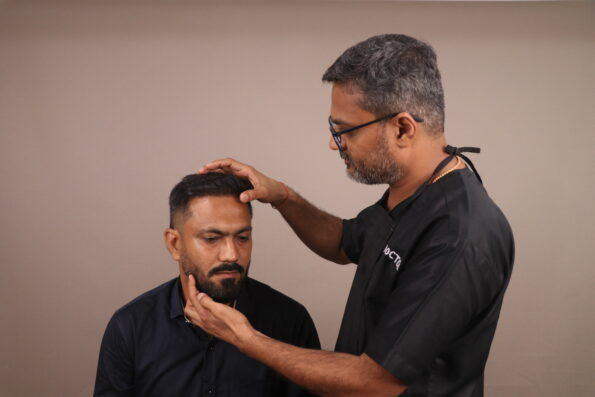
12 Months - Final Result ✅
One full year. 3,405 grafts have done their job. Rohan’s hairline is restored, temples are covered, and the overall transformation is complete.

Hair Transplant Cost for Grade 3 Baldness in India
Transparency matters. Here’s a breakdown of what Grade 3A hair transplant cost in India looks like:
| Component | Details |
|---|---|
|
Hair Loss Grade
|
Norwood 3A
|
|
Total Grafts
|
3,405
|
|
Technique
|
Bio-FUE
|
|
Sessions
|
1
|
|
Estimated Cost Range
|
₹60,000 and ₹1,50,000
|
Why was Rohan’s graft count on the higher side for Grade 3?
Because Grade 3A involves three zones- front, hairline, and temples- instead of just the hairline. More area to cover means more grafts. This is important to understand when comparing grade 3 baldness hair transplant cost estimates online; the graft count drives the cost, not just the grade.
Factors that affect cost:
- Total graft count
- Technique used (Bio-FUE, BIG FUE, I-FUE)
- Clinic location and doctor’s experience
- Any additional treatments like PRP
For a personalised graft estimate and cost breakdown
About Dr. Jinkal Kunjadiya - HairFree HairGrow Surat
Rohan’s procedure was performed by Dr. Jinkal Kunjadiya, M.B.B.S., D.D.V (Skin – V.D). Dermatologist & Hair Transplant Surgeon at HairFree HairGrow’s Surat centre. Dr. Jinkal Kunjadiya specialises in Bio-FUE, BIG FUE, and I-FUE techniques and has successfully treated patients across Grade 2 to Grade 6 baldness patterns.
About HairFree HairGrow: With 13+ clinics across Surat, Ahmedabad, Pune (Pimple Gurav), Pune Kharadi, Hyderabad, Kolkata, Bangalore, Bhopal, Delhi (Gurugram), Nagpur, Mumbai, Vapi (Silvassa), and Bangladesh. HairFree HairGrow is one of India’s most trusted names in hair transplant and hair restoration. Thousands of patients have successfully restored their hairlines through HFHG’s proprietary techniques.
One Thing Worth Knowing Before You Decide
A grade 3 baldness hair transplant is a medical procedure, and results depend on two things equally: the surgeon’s skill, and the patient’s commitment to aftercare.
Rohan followed his post-operative care plan, attended all follow-up visits, and stayed patient through the waiting phases. His 12-month result reflects both Dr. Jinkal Kunjadiya’s precision and Rohan’s consistency.
If you’re dealing with Grade 3 baldness, whether it’s just the temples or the crown too, the earlier you get assessed, the more straightforward your treatment plan will be.
Frequently Asked Questions About Grade 3 Hair Transplant
-
1. How many grafts are needed for Grade 3 baldness?
For standard Norwood Grade 3, 1,800 to 2,500 grafts are typically sufficient. For Grade 3A, where the crown is also involved, the count can range from 2,500 to 3,500 grafts. Rohan's procedure required 3,405 grafts to cover the front, hairline, and both temples in a single session.
-
2. Is Grade 3 the right time to get a hair transplant?
Yes, Grade 3 is considered an ideal stage for hair transplant surgery. The donor area is still dense and healthy, full coverage is achievable in one session, and the results look completely natural. Waiting longer risks further progression, making the case more complex.
-
3. What is the difference between Bio-FUE and regular FUE?
In standard FUE hair transplant, grafts are stored briefly at room temperature between extraction and implantation. In Bio-FUE, grafts are preserved in a special biocompatible solution that maintains follicle health and improves graft survival rate. This is HairFree HairGrow's advanced technique that gives consistently better results.
-
4. When do results show after a Grade 3 baldness hair transplant?
First new hairs appear around Month 3. Significant density improvement is visible by Month 6. The final hair transplant result is typically complete between 9 and 12 months post-procedure. Rohan's 12-month photos show exactly what this timeline looks like.
-
5. Can Grade 3 baldness be treated without surgery?
Medications like minoxidil and finasteride can slow further hair loss and are often recommended alongside surgery. However, they cannot restore hair that has already been lost. For permanent restoration of a receded hairline and temples at Grade 3, hair transplant surgery remains the most effective solution.
-
6. Is one session enough for Grade 3 baldness?
In most cases, yes. Rohan's complete procedure, 3,405 grafts across front, hairline, and temples, was completed in a single session at HairFree HairGrow Surat.
-
7. What does post-operative care involve after a hair transplant?
Dr. Jinkal Kunjadiya provided Rohan with detailed post-op instructions covering washing technique, sleep position, activities to avoid (gym, swimming, direct sun exposure), and prescribed medications. Most patients resume normal daily activities within 7 to 10 days of the procedure.