
Quick answer: FUE vs DHI Hair Transplant: Neither is universally better. FUE is ideal for large areas and higher grafts, while DHI works best for small, targeted areas.
These days, even 25-year-olds are noticing a receding hairline, and by 45, it’s a whole different story. When someone starts researching hair transplant options, the very first question is almost always the same: “Is FUE hair transplant better or DHI hair transplant?”
Search on Google, watch YouTube videos, or visit different clinics, you’ll keep hearing terms like DHI, FUE, Micro FUE everywhere. Many times, it feels like DHI hair transplant is some new, advanced technology, while FUE sounds like an old technique. But the reality is a bit different, boss.
In this blog, we’ll explain FUE vs DHI hair transplant from a doctor’s perspective without any marketing drama or fake claims. Just the truth, exactly how things actually work in a real clinic.
FUE vs DHI: Comprehensive Comparison
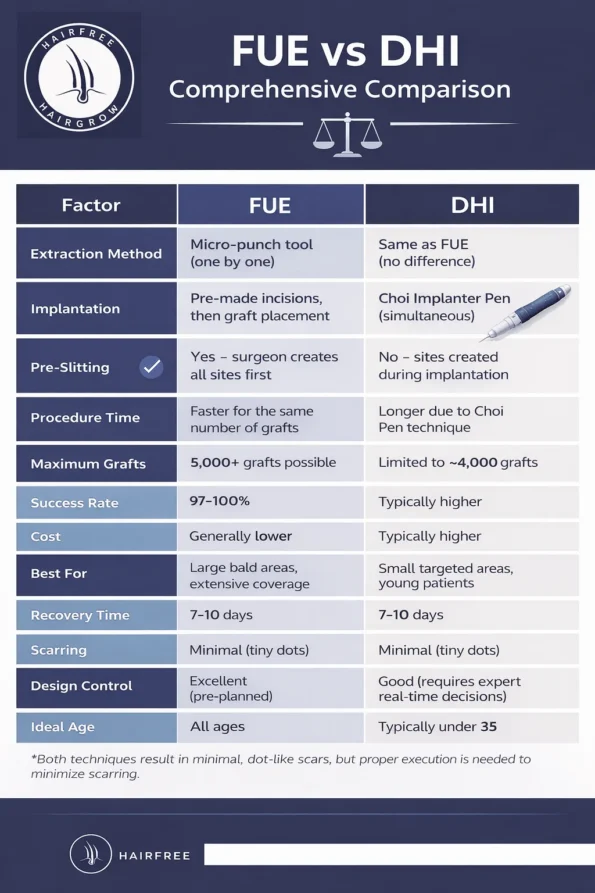
Choosing the best hair transplant method depends on your specific needs.
FUE or DHI still unsure what suits you?
What is FUE Hair Transplant?
In the FUE hair transplant procedure, the surgeon uses a specialized micro-punch tool, usually less than 1mm in size. With this, follicular units are carefully extracted; each unit contains 1–4 hair follicles. These tiny circular incisions heal quickly, and scarring is minimal, almost invisible.
After extraction, the surgeon creates recipient sites in the bald areas. These precise incisions decide how your new hair will grow its angle, direction, and density. This pre-slitting phase allows the surgeon to plan everything properly, hairline symmetry, natural flow, and appropriate density.
Finally, the harvested follicles are carefully implanted into these prepared sites. Nowadays, many modern FUE hair transplant surgeons perform simultaneous harvesting and implantation, so the follicles spend minimal time outside the body.
Key Advantages of FUE
- Natural-looking results with success rates of 97–100%
- Minimal scarring – barely noticeable, even with very short hair
- Complete hairline control – pre-slitting allows precise design
- Larger coverage area – can transplant 5,000+ grafts in a single session
- Shorter procedure time compared to DHI
- Cost-effective – generally less expensive than DHI (FUE hair transplant cost typically ranges from Rs. 50 to 80 per graft)
- Fast recovery – most patients return to normal activities within a week
These advantages are not just marketing claims. After performing 200+ procedures, I can confidently say that FUE hair transplant results are consistently good when the proper technique is followed.
What is DHI Hair Transplant?
DHI, or Direct Hair Implantation, is basically an advanced variation of the FUE technique, not a completely different procedure. The main difference lies in the implantation method. In the DHI hair transplant technique, follicle extraction is exactly the same as FUE, but a specialized tool called the Choi Implanter Pen is used for implantation.
DHI Benefits and Limitations
Benefits:
- Machine-assisted implantation for accurate placement
- Creates the channel and implants simultaneously
- Less handling of grafts during implantation
- Good for targeted areas with existing hair
Limitations:
- Time-consuming – longer procedure time than FUE
- Limited to around 4,000 grafts per session
- Higher cost than traditional FUE (DHI hair transplant cost in India is typically 30–40% more)
- Less control over design – real-time decisions instead of pre-planned design
- Requires exceptional skill for consistency
The average success rate of DHI is around 95%, which is comparable to traditional FUE. So, DHI vs FUE – which is better? Let’s understand this in detail.
Key Differences Between FUE and DHI Hair Transplant
Extraction Method: The Same Foundation
There should be no confusion here, both FUE and DHI use the exact same extraction technique. Individual follicular units are harvested one by one from the donor area using a micro-punch tool. At this stage, there is absolutely no difference between the two methods.
Implantation Process: Where They Diverge
Traditional FUE Approach:
In FUE, the surgeon first creates all recipient sites using a blade or needle. The exact placement, angle, and direction of each future hair are decided in advance. This pre-slitting approach gives complete design control before any follicles are implanted.
Its advantages include:
- Complete design control and planning
- Consistent angles across all incisions
- Accurate graft counting
- Team efficiency – simultaneous harvesting and implantation
DHI Approach:
In DHI, there is no pre-slitting phase. The Choi Implanter Pen creates the incision and places the follicle at the same time. The surgeon must make real-time decisions for angle and placement for every single follicle.
Challenges include:
- Maintaining consistency across thousands of placements
- Judging proper spacing without pre-marked sites
- Risk of follicle damage through the implanter device
Potential disturbance to existing nearby hair
Time Outside the Body: A Common Misconception
A common argument in favor of DHI is that follicles spend less time outside the body. But in reality, modern FUE hair transplant surgeons also use simultaneous extraction and implantation, with multiple team members working in coordination. This provides the benefits of pre-slitting while keeping graft storage time minimal.
Precision and Control
Hair transplantation is not just a technical procedure, it’s an art form. Pre-slitting in FUE offers several major advantages:
- Perfect symmetry through measurement and adjustment
- Consistent density with uniform spacing
- Optimal hairline design
- Accurate graft count transparency
- Reduced risk of errors
In DHI, maintaining consistent angles and density throughout the procedure can be more challenging, as every insertion requires real-time judgment.
Coverage Area and Graft Numbers
FUE Advantages:
- Can handle 5,000–7,000 grafts in mega sessions
- Ideal for advanced stages of hair loss
- Better for large crown areas and full scalp coverage
If you want to see hair transplant patient results, check this patient’s 5000-graft hair transplant journey.
DHI Limitations:
- Generally limited to 4,000 grafts
- Best suited for early-stage hair loss
- Ideal only for targeted areas
- Time constraints make large sessions impractical
If you need extensive coverage, you may also consider FUE vs FUT hair transplant, although FUT involves a linear scar, which FUE does not.
Recovery Time and Results of FUE and DHI Hair Transplant
FUE vs DHI Hair Transplant offers similar recovery timelines and final outcomes. Despite marketing claims, clinical evidence shows no significant difference in results.
FUE Hair Transplant Recovery Time (Both Techniques):
- Days 1–3: Redness and mild swelling
- Days 4–7: Return to most normal activities
- Days 10–14: Transplanted hair sheds (normal process, don’t panic)
- Months 3–4: New hair growth begins
- Months 6–8: Noticeable improvement
- Months 10–12: Final results fully visible
FUE hair transplant side effects are minimal mostly temporary swelling, mild discomfort, and initial shedding. Serious complications are rare when an experienced surgeon performs the procedure.
FUE vs DHI: Which Hair Transplant Technique Is Right for You?
The honest truth? Neither technique is universally superior. The “better” option depends on your specific situation extent of hair loss, age, budget, and most importantly, the surgeon’s expertise.
Choose FUE if you
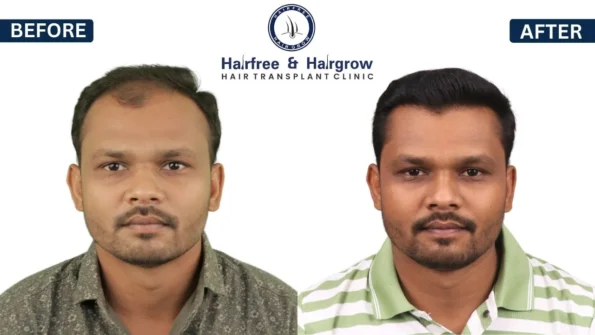
- Have significant hair loss needing extensive coverage
- Need more than 4,000 grafts in one session
- Want a more cost-effective option
- Prefer a shorter overall procedure time
- Value pre-planned, carefully designed results
Are over 35 years old with progressive balding
Choose DHI if you
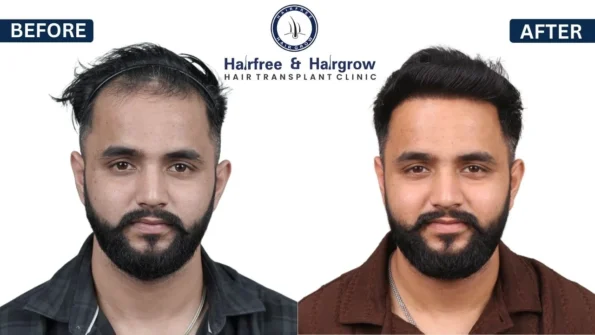
- Have mild to moderate hair loss in specific areas
- Need fewer than 4,000 grafts
- Are younger (typically under 35) with localized thinning
- Want to add density between existing hair
- Don’t mind a longer procedure time
- Have a higher budget
FUE vs DHI Hair Transplant Cost Comparison
Cost Factor | FUE | DHI |
Per Graft Cost | ₹20–40 per graft | ₹30–60 per graft |
Small Session (1,000 grafts) | ₹20,000–40,000 | ₹30,000–60,000 |
Medium Session (2,500 grafts) | ₹50,000–1,00,000 | ₹75,000–1,50,000 |
These are approximate ranges and may vary depending on the city, clinic reputation, surgeon’s experience, technology used, and whether the procedure is doctor-led or technician-led.
In India, the cost of FUE hair transplant is generally more affordable compared to Western countries. However, choosing a quality, safe, and experienced surgeon should always be the top priority, not just the low cost.
Not sure what your treatment will actually cost? Get your exact quote Book a free consultation today.
Important Questions to Ask Before Choosing a Hair Transplant Surgeon
During your consultation, make sure to ask these important questions:
- “How many FUE and DHI procedures have you personally performed?”
- “Can I see before-and-after photos of patients with a similar hair loss pattern?”
- “Which technique do you recommend for my case, and why?”
- “What is your graft survival rate with each technique?”
- “Do you perform the entire procedure yourself, or does your team assist?”
- “What happens if I’m not satisfied with the results?”
These questions will help you identify the right surgeon one who is transparent and sets realistic expectations.
Final Thoughts
The debate between FUE vs DHI hair transplant is mostly created by confusion and marketing. From a scientific and practical point of view:
- DHI is simply an implantation style within the FUE technique
- Results do not depend on the technique name, but on planning, design, and execution
- For natural, dense, and long-term results, a doctor-led approach is the most important factor
If you ask the right questions and avoid being influenced by marketing terms, you can make a much better decision. Whether you choose the FUE hair transplant procedure or the DHI hair transplant technique, make sure you select an experienced surgeon who communicates transparently.
Still wondering which technique is right for you? With 30+ expert doctors and 1,00,000+ satisfied clients, HairFree HairGrow knows exactly what your hair needs.
The right technique. The right surgeon. The right results.
FAQs
1. Which is better: FUE or DHI hair transplant?
Neither FUE nor DHI hair transplant is universally better. Both techniques use the same extraction method. The final result depends more on the surgeon’s skill, planning, and hairline design rather than the technique name. FUE is usually better for large bald areas, while DHI works well for small, targeted areas.
2. Is DHI hair transplant more advanced than FUE?
No, DHI is not a completely different or more advanced technique. It is only an implantation method within the FUE technique. Extraction in both FUE and DHI is exactly the same. DHI mainly uses a Choi Implanter Pen for implantation.
3. What is the success rate of FUE vs DHI hair transplant?
The success rate of FUE hair transplant is around 97–100%, while DHI hair transplant has an average success rate of around 95%. When performed by an experienced surgeon, both techniques deliver natural and permanent results.
4. Is DHI hair transplant more expensive than FUE in India?
Yes, in most cases, DHI hair transplant cost in India is 30–40% higher than FUE hair transplant cost. This is due to longer procedure time, specialized tools, and higher technical skill requirements. However, higher cost does not always mean better results.
5. How many grafts can be transplanted in FUE and DHI?
With FUE hair transplant, 5,000–7,000 grafts can be transplanted in a single session, making it ideal for advanced hair loss. DHI hair transplant is usually limited to around 4,000 grafts, which makes it more suitable for early-stage or localized hair thinning.