
When Saif Ali Khan entered Bollywood in the early 1990s, hair loss was the last thing people associated with him. He was young, stylish, and carried a relaxed charm that made him instantly recognisable. During that era, conversations about receding hairlines were rare, especially when actors preferred longer, carefree hairstyles.
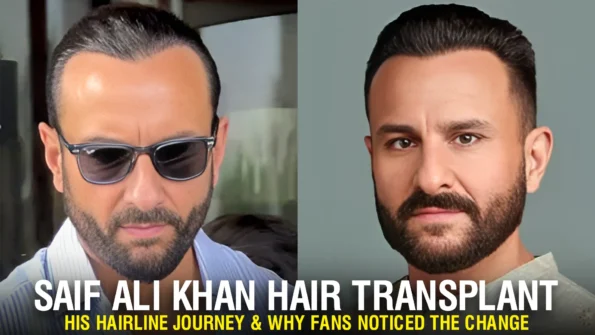
Fast forward a few decades, and Saif Ali Khan hair transplant has become one of the most searched celebrity hair topics online. Not because Saif ever publicly confirmed anything, but because his hairline transformation over the years has been difficult to ignore.
This article looks closely at his hair journey—purely based on public appearances and visible changes—without assumptions or exaggerated claims.
Saif Ali Khan’s Early Hairline Years
In films like Parampara, Main Khiladi Tu Anari, Hum Saath Saath Hain, and later Dil Chahta Hai, Saif often wore his hair long. This wasn’t just a fashion choice—it also made it harder to analyse his hairline.
Longer hairstyles naturally conceal early thinning, especially around the temples. At that time, his hair looked dense, healthy, and natural. There were no visible signs that raised questions or triggered speculation.
Simply put, there was nothing unusual to notice.
When Did Saif Ali Khan’s Hair Loss Become Noticeable?
Around the late 2000s, particularly near 2008, subtle changes began to appear. His frontal hairline looked slightly more recessed, and the density was not the same as before.
This phase is extremely common. Many men experience gradual thinning in their late 30s or early 40s due to hormonal changes. Saif’s hair loss did not look sudden or aggressive—it appeared slow and evenly spread.
Because it wasn’t dramatic, it could still be managed with careful styling, lighting, and camera angles.
Can Hairstyling Alone Hide Hair Thinning?
In the years that followed, Saif experimented with various looks—short haircuts, textured styles, and role-specific appearances. In many films and web series, his hairline was not clearly visible at all.
Good styling can definitely help mask thinning hair to an extent. The right haircut and angles can create the illusion of density. However, styling has limits.
Once the frontal hairline begins to lose noticeable density, it eventually becomes visible—especially on high-definition screens.
Why People Started Talking About Saif Ali Khan Hair Transplant
By the late 2010s and early 2020s, Saif Ali Khan’s hairline began to look noticeably sharper and more structured. In several public appearances, the front appeared fuller and better defined than it had in earlier years.
This is where speculation about a Saif Ali Khan hair transplant gained momentum.
The key detail was that the hairline didn’t just look styled—it looked intentionally designed. The density appeared improved, and the shape looked consistent rather than random.
Most importantly, it did not look exaggerated or unnatural.
Why His Hairline Looks Natural, Not “Fake”
One reason Saif’s current hairline works so well is balance. It isn’t unusually straight, and it doesn’t sit too low on his forehead. Instead, it matches his age, face structure, and overall personality.
A mature, well-proportioned hairline almost always looks better than a dramatic one. In Saif’s case, the result blends in so naturally that many people don’t notice it immediately—they simply feel that he looks refreshed.
That subtlety is often the biggest sign of a thoughtful hair restoration approach.
How Face Shape Plays an Important Role
Saif Ali Khan has an oval face shape, which allows flexibility in hairline design. Slight recession at the temples with a clean frontal outline complements his facial structure.
This highlights an important lesson for anyone inspired by celebrity transformations: copying someone else’s hairline rarely works. Hair restoration should always suit individual face shape, age, and hair characteristics—not trends.
What Saif Ali Khan’s Hair Journey Teaches Men
Saif Ali Khan’s hair transformation reflects what many men experience:
- Hair thinning happens gradually
- Styling works only up to a point
- Subtle solutions age better than dramatic ones
If he did opt for hair restoration at some stage, it suggests a practical mindset—choosing what works without turning it into a public announcement.
Final Thoughts
Whether Saif Ali Khan confirms it or not, his hair journey feels relatable. Gradual thinning, attempts to manage it through styling, and eventually choosing a more lasting solution—these are experiences many men share.
The reason people talk about Saif Ali Khan hair transplant isn’t because the change looks shocking. It’s because it looks normal.
And in the world of cosmetic changes, looking normal is often the biggest compliment.
When done thoughtfully, hair restoration doesn’t change who you are—it simply helps you look like yourself again, without the distraction.
FAQs – Saif Ali Khan Hair Transplant
Did Saif Ali Khan ever confirm a hair transplant?
No. Saif Ali Khan has never publicly confirmed undergoing a hair transplant. All discussions are based solely on visible changes in his hairline over the years.
At what age did Saif Ali Khan start losing hair?
Based on public appearances, subtle thinning became noticeable in his late 30s, which is a common age for male pattern hair loss.
Can hairstyling alone restore hair density?
Styling can temporarily hide thinning but cannot restore lost density permanently. Once frontal recession progresses, styling alone has limitations.
Does a natural-looking hairline always mean a hair transplant?
Not necessarily. However, a sudden improvement in hairline structure and density is often difficult to achieve through styling alone.
Legal Disclaimer: This study is intended for informational purposes only and does not constitute medical advice. The information provided is based on publicly available data and does not involve any direct consultation or diagnosis by our clinic. We are not at all involved in hair transplant of these celebrities. The results of hair transplant procedures can vary greatly depending on individual circumstances, and the experiences of the cricketers mentioned in this study should not be seen as a guarantee of specific results. We strongly recommend consulting with a qualified healthcare professional before making any decision regarding hair transplant procedures. Our clinic disclaims any liability for the decisions you make based on this information.
