
Quick Answer: Malassezia folliculitis, often called fungal acne, occurs when yeast overgrows in hair follicles, causing itchy bumps that resemble acne. It is diagnosed through examination and treated with antifungal medication.
Malassez ia folliculitis, often mistaken for acne, is a skin condition caused by an overgrowth of yeast called Malassezia. This yeast normally lives on everyone’s skin, but under certain conditions, it can multiply and invade hair follicles, leading to inflammation and pimples.
What is Malassezia Folliculitis?
Malassezia folliculitis is often referred to as “fungal acne” because of how closely it can resemble regular breakouts. It’s also known by its older medical name, Pityrosporum folliculitis. It’s a skin issue that looks like breakouts. It happens when a type of yeast called Malassezia, which normally lives on your skin, infects your hair follicles.
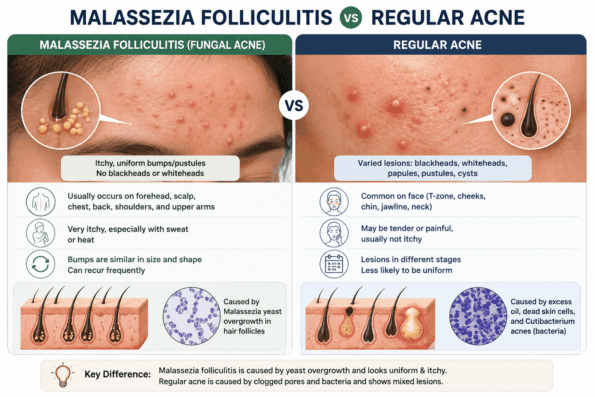
People with this problem might mistake it for regular acne. But here’s the key difference: Pityrosporum folliculitis doesn’t have the typical whiteheads or blackheads you see in acne. It’s also often really itchy, unlike acne.
If you have this issue, you might also notice dandruff, which is linked to the same yeast. Luckily, both problems are treated in a similar way, using antifungal medications and sometimes a special shampoo like ketoconazole 2 percent.
So, if you’re dealing with itchy breakouts that aren’t quite like regular acne, it could be Malassezia folliculitis. In that case, antifungals and a good medicated shampoo might be the solution for you.
From Dr. Shridevi Lakhe (MBBS, DDV):
“The number one mistake I see is patients treating this as regular acne for months before coming in. If your ‘acne’ is itchy and the bumps all look the same size, that’s usually your first clue it might be fungal, not bacterial. A quick skin scraping settles it in minutes.”
Where Does Malassezia Folliculitis Appear on the Body?
This condition tends to show up in areas where your skin produces more oil, since that’s where the yeast thrives. The most common spots are:
- Forehead and hairline
- Face, especially the T-zone
- Scalp (particularly near the hairline)
- Chest and upper back
- Shoulders and upper arms
If you’re noticing itchy bumps specifically along your hairline or scalp, it’s worth getting it checked, since this is one of the more common areas for it to appear.
What Are the Symptoms of Malassezia Folliculitis?
Malassezia folliculitis is typically found on the upper trunk, which is:
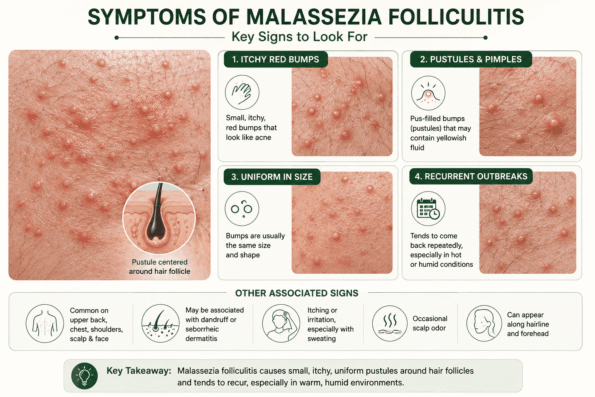
Itchy Red Bumps
One of the hallmark symptoms is the presence of itchy, red bumps on the skin, resembling traditional acne but with a distinct texture.
Pustules and Pimples
Pustules and pimples, often containing a yellowish fluid, are common manifestations of Malassezia Folliculitis.
Recurrent Outbreaks
Unlike typical acne, Malassezia Folliculitis tends to recur, and conventional acne treatments may not provide long-term relief.
It tends to happen in areas where your skin is oilier. When you have this condition, you may notice small itchy bumps called pustules on your skin in those affected areas. These pustules are centered around hair follicles. So, if you’re experiencing itchy, bumpy skin in these specific areas, it could be a sign of pityrosporum folliculitis.
What Causes Malassezia Folliculitis?
Malassezia folliculitis happens when too much of a yeast called Malassezia grows in your hair follicles, which are like tiny pockets in your skin where hair grows. This yeast is naturally present on your skin, but when it multiplies too much, it can cause problems.
Certain things can make it more likely for this to happen. Using certain antibiotics on your skin or taking them by mouth can be one reason. Also, if your immune system is not working as well as it should (we call this immunosuppression), that can make you more prone to this issue.
Other factors that can create the right conditions for this yeast to overgrow include:
- Hot, humid weather or heavy sweating
- Naturally oily skin
- Occlusive or greasy skincare products, which may create conditions that can contribute to overgrowth in susceptible individuals
- Taking steroids
- Diabetes
- Having seborrheic dermatitis or dandruff, since it’s linked to the same yeast
How Is Malassezia Folliculitis Diagnosed?
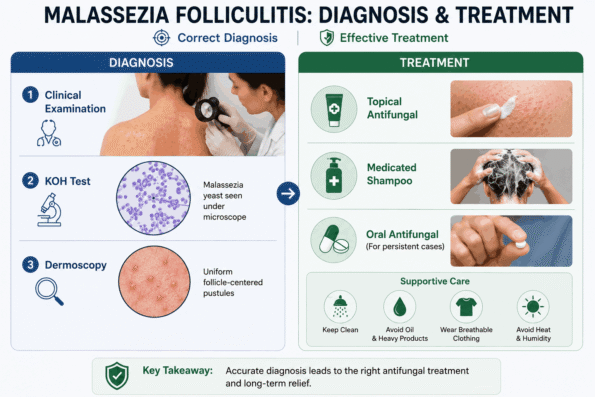
Because it looks so similar to acne, getting an accurate diagnosis matters, since the treatment is completely different. A dermatologist typically diagnoses Malassezia folliculitis by:
- Clinical examination — looking at the pattern of the bumps. Uniform, itchy pustules without blackheads or whiteheads are a strong clue.
- KOH (potassium hydroxide) preparation — a quick, in-clinic skin scraping examined under a microscope to spot the yeast directly. This is one of the most accessible and commonly used tests.
- Dermoscopy — a magnified look at the follicles that can help support the diagnosis.
- Wood’s lamp examination — sometimes used as a supplementary test alongside the above.
- Response to antifungal treatment — if the bumps clearly improve on antifungal therapy, that supports the diagnosis, though it’s usually considered alongside the other findings rather than on its own.
In cases that remain unclear, a biopsy or fungal culture may occasionally be used.
Not sure if it’s acne or something else?
Our dermatology team can help you figure out exactly what’s going on with your skin.
How Do You Treat Malassezia Folliculitis?
When it comes to treating Malassezia folliculitis, here are some ways you can approach it:
1. Home Remedies
To relieve itching, apply a warm compress on the affected area. Soak a hand towel in warm water, squeeze out excess water, and place it on the itchy bumps for relief.
2. Medical Treatments
For mild to localized cases, dermatologists typically start with topical antifungal treatments, such as azole creams (ketoconazole, clotrimazole) or ciclopirox. Your doctor may prescribe antifungal medications like fluconazole, known for effectively fighting yeasts causing the infection. For more widespread, persistent, or severe cases, oral antifungal medication such as itraconazole or fluconazole may be considered under medical supervision. Oral antifungal medication is a quick and effective treatment for Malassezia folliculitis.
3. Over The Counter Treatments
- Medicated shampoo can be used for scalp or beard folliculitis. Apply the shampoo on affected skin areas.
- Shampoos with selenium sulfide have been proven effective against Malassezia folliculitis.
- Ciclopirox-based washes are another option some dermatologists recommend for maintenance.
It’s worth knowing that Malassezia folliculitis can come back even after successful treatment, especially if the underlying triggers (like heavy sweating or occlusive products) aren’t addressed. Some people benefit from periodically using an antifungal wash as a preventive measure, on their doctor’s advice.
The Difference Between Folliculitis and Acne
Folliculitis and acne both make your skin red and bumpy, but there’s a key difference. With folliculitis, the bumps can be itchy, and it might go deeper into your hair follicles. Acne, on the other hand, is mostly about clogged pores and too much oil, and it’s common, especially on oily parts like your face.
While acne likes oily spots, folliculitis doesn’t care and can pop up anywhere. Also, folliculitis isn’t just about one fungus; it could be caused by bacteria or viruses too. This makes it look a lot like acne, so it’s smart to check with a doctor to be sure.
Here's a quick side-by-side comparison:
| Feature | Malassezia Folliculitis (Fungal Acne) | Acne Vulgaris |
|---|---|---|
|
Cause
|
Yeast (Malassezia) overgrowth in follicles
|
Clogged pores, excess oil, bacteria
|
|
Bump appearance
|
Usually uniform in size and shape
|
Mixed, comedones, papules, pustules, sometimes cysts
|
|
Itching |
Common |
Not typical
|
|
Blackheads/Whiteheads
|
Usually absent
|
Often present
|
|
Common areas
|
Chest, back, shoulders, forehead/hairline
|
Face, chest, back
|
|
Treatment
|
Antifungal medication
|
Acne-specific treatment (retinoids, benzoyl peroxide, etc.)
|
So, in a nutshell, if it’s red and bumpy and itches, it might be folliculitis. If it’s more about oil and clogged pores on your face, it’s likely acne. Always good to get a pro’s opinion!
Can Folliculitis Occur After a Hair Transplant?
It’s possible to develop folliculitis around the transplanted or donor area after a hair transplant, since factors like sweating, occlusive dressings, and a course of antibiotics during recovery can all affect the skin around the follicles.
That said, post-transplant bumps shouldn’t automatically be assumed to be Malassezia folliculitis specifically; they can have several possible causes. If you notice persistent itchy or pustular bumps during your recovery, it’s best to have your surgeon or dermatologist take a look rather than self-diagnosing.
Recovering from a transplant and noticed unusual bumps? Don’t wait it out.
When to Consult a Doctor?
If you’re dealing with irritation that lasts more than two weeks or if it’s getting worse, it’s a good idea to see a doctor. If an infection keeps spreading or coming back, it’s time to schedule a doctor’s appointment.
Also, if you have symptoms of Malassezia folliculitis and a fever over 101°F, or if the infected area is very painful, red, swollen, or warm, it’s important to consult a doctor.
If you’ve been treating what you thought was acne and it just isn’t improving, that’s also a good reason to check in with a dermatologist. They can determine whether Malassezia folliculitis, or something else entirely, is behind it.
In simple terms, if things aren’t improving or if they’re getting worse, it’s time to seek expert help. If you’re unsure, it’s always better to consult a doctor for advice.
Persistent bumps deserve a proper diagnosis, not guesswork.
Frequently Asked Questions
-
1. Is Malassezia folliculitis the same as fungal acne?
Yes, "fungal acne" is simply the popular, non-medical name for Malassezia folliculitis. It's not related to fungus in the way athlete's foot is; the cause is an overgrowth of a yeast called Malassezia.
-
2. Can Malassezia folliculitis appear on the face or scalp?
Yes. While it's most common on the chest, back, and shoulders, it frequently appears on the forehead, hairline, and scalp as well.
-
3. How can you tell Malassezia folliculitis apart from regular acne?
The biggest clue is itching combined with uniform-looking bumps and no blackheads or whiteheads. A dermatologist can confirm it with a simple skin scraping test.
-
4. How long does treatment take to work?
Many people see improvement within two to four weeks of starting antifungal treatment, though a doctor will guide the exact duration based on severity.
-
5. Can Malassezia folliculitis come back after treatment?
Yes, it's known to recur, especially if triggers like heavy sweating, humidity, or occlusive skincare products aren't managed.
-
6. Can folliculitis occur after a hair transplant?
It's possible for folliculitis of some kind to develop post-transplant due to sweating, dressings, or antibiotics, but it isn't automatically Malassezia folliculitis. A surgeon or dermatologist should evaluate it directly.
Medical References