
Quick Answer: LLLT (Low-Level Laser Therapy) is a non-invasive light treatment with solid evidence for improving hair density in androgenetic alopecia. Evidence that it speeds up transplanted-graft growth or prevents shock loss is still limited, so how and when to use it after a transplant should be guided by your surgeon.
Somewhere between booking your transplant date and actually walking into the clinic, you probably fell down a YouTube rabbit hole. Laser caps, laser combs, red light helmets that look like something out of a sci-fi film, all promising thicker, faster, denser hair after surgery. Some of what you found was solid science. A lot of it was marketing wearing a lab coat.
So let’s actually sit with the question properly: does LLLT after hair transplant do anything, or is it just an expensive accessory for your recovery? We went through the actual clinical studies, not just the product pages quoting them, to give you a straight answer.
Not sure what your scalp actually needs after surgery?
Our surgeons can map out a recovery plan built around your graft count and healing progress, not a generic checklist.
What Is LLLT?
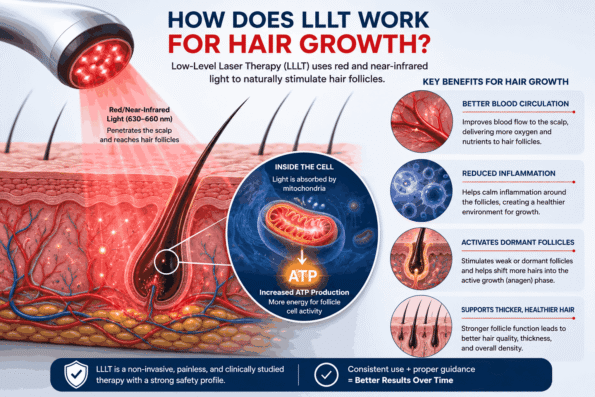
Low-Level Laser Therapy, also called photobiomodulation or red light therapy, uses red and near-infrared light, usually somewhere in the 630 to 660 nm range, to stimulate activity inside skin and hair follicle cells. It sounds high-tech, and in a sense it is, but the concept is simple. Unlike surgical lasers that cut or burn tissue, LLLT devices deliver a low dose of light that cells simply absorb and put to work.
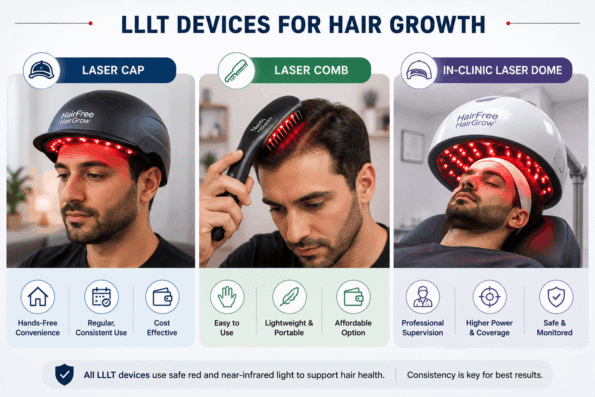
Whether you’re reading about a handheld laser comb, a wearable laser cap, or an in-clinic laser dome, it’s the same underlying technology. The device changes. The biology behind it does not.
How Does LLLT Work for Hair Growth?
Light from an LLLT device penetrates the scalp and reaches the mitochondria, the part of the cell that produces energy. This is thought to boost ATP production, essentially giving follicle cells more fuel to work with. In theory, and increasingly in practice, this leads to:
- Better blood circulation to the scalp, meaning more oxygen and nutrients reaching hair follicles
- Reduced inflammation around the follicles
- Weak or dormant follicles being nudged back into the active growth (anagen) phase
This isn’t a fringe theory. A 2014 review by researchers associated with the Wellman Center for Photomedicine at Massachusetts General Hospital examined the evidence for LLLT in hair loss. The researchers concluded that it “appears to be both safe and effective,” while noting that the ideal wavelength and dosage are still being refined.
Can LLLT Help After a Hair Transplant?
This is where most clinic websites blur two very different questions together. We’d rather not do that to you.
Does LLLT Improve Transplanted Graft Growth?
The honest answer is that direct evidence here is thin, and one small study does not support the idea. Researchers irradiated one set of extracted follicular units with laser light for 20 minutes before transplantation.
They then compared them with a non-irradiated control group in the same patients. At 3 and 6 months, there was no statistically significant difference in growth between the treated and untreated sides.
It’s worth being precise about what this study did and didn’t test. It looked at a single LLLT session applied to grafts before implantation, not repeated LLLT sessions applied to the scalp during post-transplant recovery.
So, it suggests that one pre-surgery laser session does not appear to measurably change graft growth. It does not tell us whether an ongoing laser routine during recovery helps, because that specific approach has not been well studied yet.
Can LLLT Help With Native Hair and Shock Loss?
Shock loss, the temporary shedding of existing hair around or within the transplant area, can occur after surgery. LLLT has stronger evidence for supporting hair density in androgenetic alopecia, including native hair around a transplant. Whether it specifically reduces post-transplant shock loss is still not well established.
The ISHRS describes one surgeon’s experience with twice-weekly office laser sessions starting the day after surgery, where earlier regrowth and reduced shock loss were observed. However, this was a clinician-reported experience from one practice, not a large randomized controlled trial, so it should be viewed as an observation rather than established evidence.
Dr. Chintan Bhavsar explains that LLLT should not be presented as a way to dramatically speed up transplanted-graft growth. Its stronger role is supporting native hair density and maintaining existing hair, rather than acting as a graft-growth accelerator.
Dealing with shock loss anxiety after your transplant?
A guided recovery plan, including the right timing for LLLT, PRP, or minoxidil, can make the healing phase far less stressful.
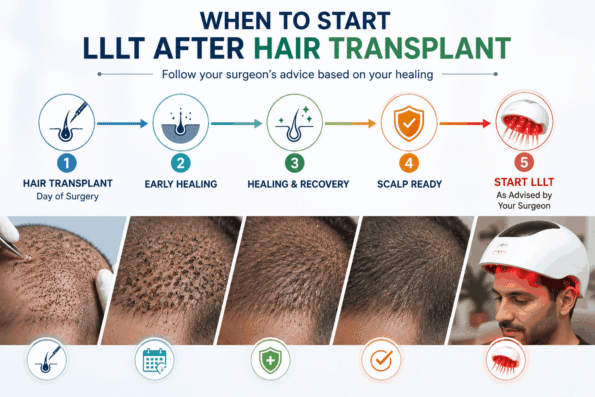
When to Start LLLT After Hair Transplant
There is no universally established start time for LLLT after a hair transplant. Some clinics introduce light-based therapy early in recovery, once the scalp has scabbed over with no open wounds. Others prefer waiting several months, covering the full shedding and initial regrowth phase, before introducing any laser device to the transplanted area.
Because post-transplant protocols vary between clinics and transplant-specific evidence remains limited, this isn’t a question a blog, including this one, should answer for you. Your graft density, the technique used (FUE, Bio-FUE, Sapphire FUE), and how your specific scalp is healing all factor into what’s safe. Ask your surgeon before you start.
Recommended Session Frequency and Duration
LLLT protocols vary by device, wavelength, and power output, so there isn’t one single universal number here. What clinical studies commonly use looks like this:
| Parameter | Typical Study Protocols |
|---|---|
|
Frequency
|
Often 3 sessions per week
|
|
Duration
|
Around 10 to 20 minutes per session
|
|
Treatment period
|
Usually several months before assessing results
|
|
Wavelength
|
Device-dependent, commonly red-light wavelengths around 630 to 660 nm
|
Follow the instructions for your specific device and your surgeon’s post-transplant protocol rather than assuming one fixed schedule applies to every product.
Laser Cap vs Laser Comb vs In-Clinic Laser Dome
| Device | Where It's Used | Pros | Cons |
|---|---|---|---|
|
Laser cap
|
At home
|
Hands-free, covers the full scalp evenly, easier to stay consistent with
|
Higher upfront cost
|
|
Laser comb
|
At home
|
Cheaper entry point
|
Manual and time-consuming, easy to miss patches of scalp
|
|
Laser dome
|
In-clinic
|
Professional-grade output, done under supervision
|
Requires regular clinic visits, less convenient for a weekly routine
|
If you’re trying to stay consistent for several months, which the evidence suggests you need to, a hands-free at-home device tends to win out simply because it removes the friction of remembering and manually covering the scalp.
Is LLLT Safe? Any Side Effects?
Yes, broadly speaking. Some low-level light therapy devices have received FDA clearance for treating androgenetic alopecia. Because LLLT is a non-drug, non-invasive treatment, it doesn’t carry the systemic medication-related effects associated with oral hair-loss drugs. Device-specific side effects such as temporary scalp irritation or discomfort can occur, so it’s worth reading the guidance for your specific device.
What the Research Actually Says
We’d rather hand you the real picture than a sales pitch. The current evidence is more encouraging for general hair loss than for post-transplant recovery.
- A 2014 review found LLLT to be a promising and generally safe treatment for hair loss, while noting that the ideal wavelength and treatment parameters still need refinement.
- A 2026 12-month prospective trial found a 25.6% increase in hair density in people with androgenetic alopecia after 48 weeks of LLLT. However, recent hair-transplant patients were excluded, so this doesn’t establish a benefit for transplanted grafts.
- A randomized trial found LLLT produced results comparable to 5% topical minoxidil in men with androgenetic alopecia, again providing evidence for native hair rather than post-transplant recovery.
- In the small transplant-specific study of 10 patients, a single pre-transplant LLLT session did not significantly improve graft growth.
The takeaway: LLLT has reasonable evidence for androgenetic alopecia and native hair density, but evidence for improving graft survival, accelerating transplanted-hair growth, or preventing shock loss is still limited.
A Note From Our Team
Hair transplant recovery isn’t just about the day of surgery, it’s about everything you do in the months after that protects your investment. If you’re unsure whether LLLT after hair transplant fits into your recovery plan, don’t guess based on what a product page tells you.
Our doctors at HairFree HairGrow can walk you through a recovery plan tailored to your graft count, technique, and scalp condition, so you know exactly what to add and when.
Frequently Asked Questions
-
1. Can LLLT damage my transplanted grafts?
LLLT is designed to deliver low-energy, non-thermal light rather than the tissue-ablating energy used in surgical lasers. That said, post-transplant use should still follow your surgeon's timing and your device's specific instructions, because evidence on the ideal protocol for freshly transplanted grafts is still limited.
-
2. How soon will I see results from LLLT?
Studies measuring LLLT's effect on hair density typically used a minimum of several months of consistent use before showing measurable change, with some trials showing continued improvement well past the 6-month mark. This is a slow, cumulative treatment, not a quick fix, and most of that evidence comes from androgenetic alopecia studies rather than post-transplant patients specifically.
-
3. Is LLLT worth it after an FUE hair transplant?
It's a reasonable, low-risk addition to your post-transplant care, with its strongest evidence in supporting native hair density rather than accelerating transplanted-graft growth. It shouldn't replace the transplant itself or treatments like PRP that your surgeon may recommend specifically for graft support.
-
4. Do I need a doctor's approval before starting LLLT after surgery?
Yes. Protocols vary significantly between clinics and depend on your individual healing progress, so confirm with your surgeon before starting any device-based therapy on the treated area.
-
5. Can I use LLLT together with minoxidil or PRP?
Some studies in androgenetic alopecia suggest combining LLLT with established treatments like minoxidil may offer additional benefit, though this evidence shouldn't automatically be applied to post-transplant recovery. Run your specific combination and timing past your surgeon first.
Sources
- Avci P, Gupta GK, Clark J, Wikonkal N, Hamblin MR. Low-level laser (light) therapy (LLLT) for treatment of hair loss. Lasers Surg Med. 2014. https://pubmed.ncbi.nlm.nih.gov/23970445/
- Low-Level Laser Therapy for Androgenic Alopecia. PMC. https://pmc.ncbi.nlm.nih.gov/articles/PMC4212301/
- The Effect of One Session Low Level Laser Therapy of Extracted Follicular Units on the Outcome of Hair Transplantation. PubMed. https://pubmed.ncbi.nlm.nih.gov/27330694/
- Low-Level Laser Therapy (LLLT) for Hair Loss. International Society of Hair Restoration Surgery (ISHRS). https://ishrs.org/low-level-laser-therapy-hair-loss/
- Low-level light therapy versus topical 5% minoxidil in the management of androgenetic alopecia in males: A randomised controlled trial. ScienceDirect. https://www.sciencedirect.com/science/article/abs/pii/S0377123724000418
- Shin et al. Long-Term Efficacy and Safety of Low-Level Laser Therapy for Androgenetic Alopecia: A 12-Month Prospective Trial. Dermatologic Therapy, 2026. https://onlinelibrary.wiley.com/doi/10.1155/dth/6621458