
Quick Answer
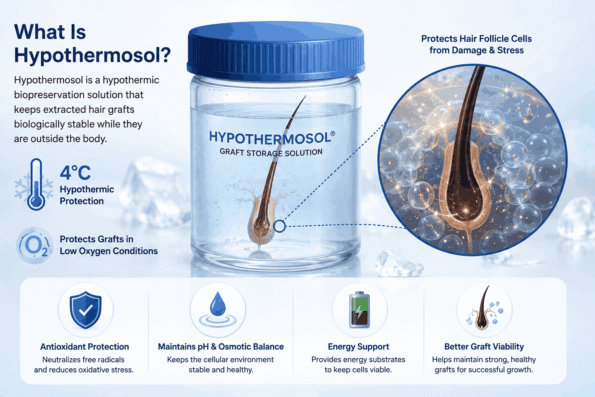
Hypothermosol is a specialised hypothermic graft storage solution used during a hair transplant to keep extracted hair follicles alive and healthy while they wait to be implanted.
If you’ve researched hair transplants even a little, you’ve probably come across terms like FUE, Direct Follicular Implantation, or graft count. But there’s one part of the process that most patients never ask about: what happens to your hair follicles in the gap between extraction and implantation.
This is exactly where the benefits of Hypothermosol solution for hair transplant come in. Hypothermosol is a specialised hypothermic graft storage solution that keeps extracted follicles biologically stable while they wait to be implanted, unlike plain saline, which only prevents them from drying out.
In the sections below, we break down what the research actually shows, why the difference matters, and how HairFree HairGrow builds this into its standard graft-handling protocol.
Key Takeaways
- Hypothermosol is a hypothermic biopreservation solution that keeps hair grafts biologically stable outside the body, unlike plain saline which only prevents drying.
- In the primary published data (a single-patient study by Dr. Jerry Cooley), grafts stored for 5 days at 4°C showed 0% survival in saline, 44% in Hypothermosol alone, and 72% in Hypothermosol combined with liposomal ATP.
- The benefit applies at shorter, real-world storage durations too, not only the extended 5-day study window.
- Hypothermosol works by supplying antioxidants, buffering pH, and providing energy substrates that saline cannot.
- HairFree HairGrow uses a graft chiller with growth factor and Hypothermosol solution as standard protocol across its FUE techniques.
- Patients can and should ask any clinic what holding solution is used for graft storage before choosing where to get treated.
What Is Hypothermosol?
Hypothermosol (also written as HypoThermosol® FRS) is a biopreservation medium originally developed for storing organs and tissues outside the body. It’s engineered to mimic the natural intracellular environment, so cells stay stable even when they’re deprived of blood supply and oxygen.
Because hair follicle grafts face exactly this challenge during a hair transplant, leading surgeons around the world have adopted Hypothermosol as a graft storage solution in place of plain saline.
Once a follicular unit is extracted from the donor area, it has no blood supply of its own. Every minute it spends outside the body, the cells are running on stored energy and are vulnerable to swelling, dehydration, and oxidative damage.
A holding solution’s job is to slow this damage down for as long as possible, and this is exactly where the difference between saline and Hypothermosol becomes clinically significant.
Want to know how your grafts are stored during a transplant?
Ask our team about the process.
Hypothermosol vs Saline: Why the Difference Matters
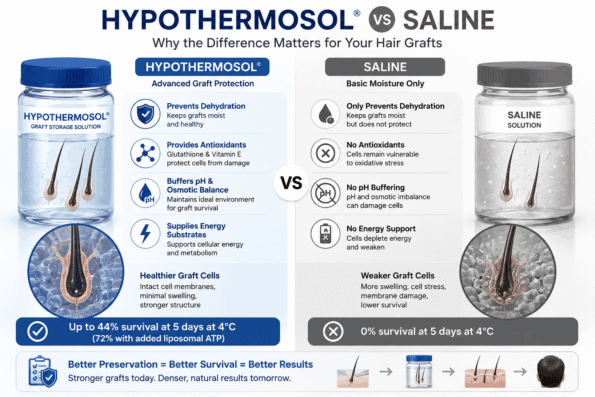
Many clinics, largely for cost reasons, still store grafts in simple saline. Saline keeps follicles moist, but that’s about all it does. It doesn’t replenish energy, doesn’t neutralise free radicals, and doesn’t buffer pH. Hypothermosol was built specifically to do all three.
| Factor | Saline | Hypothermosol |
|---|---|---|
|
Prevents dehydration
|
Yes |
Yes
|
|
Provides antioxidants (glutathione, vitamin E analog)
|
No |
Yes |
|
Buffers pH and osmotic balance
|
No |
Yes |
|
Supplies energy substrates
|
No |
Yes |
|
Graft survival after 5 days at 4°C
|
0%
|
Up to 44% (72% with added ATP)
|
The gap widens the longer grafts stay out of the body, which is exactly the situation in high-density, mega-session transplants of 3,000+ grafts, where a session can run 6–8 hours. In shorter procedures, the difference is smaller, but the biological logic holds regardless of graft count: less cell stress during storage means stronger, healthier regrowth after implantation.
Key Benefits of Hypothermosol in Hair Transplant
1. Significantly higher graft survival
This is the most important, and most measurable, benefit. In the landmark extended-storage study by Dr. Jerry Cooley, published in Hair Transplant Forum International (2014), grafts stored for five days at 4°C showed 0% survival in saline, 44% survival in Hypothermosol alone, and 72% survival in Hypothermosol combined with liposomal ATP.
It’s worth being transparent here: this particular figure comes from a single-patient study, and no standard hair transplant involves five days of out-of-body storage. Hence, these numbers describe a worst-case stress test rather than a typical procedure.
More importantly, a separate 96-hour comparison study and a broader peer-reviewed review of graft biopreservation reached the same overall conclusion. Hypothermosol-stored grafts consistently outperformed saline-stored grafts, and the advantage increased as graft storage time became longer.
2. Antioxidant protection against free radical damage
Hypothermosol contains glutathione and a synthetic vitamin E analog, two potent antioxidants that neutralise free radicals generated when cells are chilled and later re-warmed. This matters because oxidative stress is one of the leading causes of graft cell death during the extraction-to-implantation window.
3. Reduced swelling and better follicle structure
Because Hypothermosol maintains ionic and osmotic balance across the cell membrane, follicles are less prone to swelling compared to saline storage. This translates to grafts that handle more cleanly during implantation and are less likely to be damaged by the surgical team.
4. Protection during reperfusion
When a graft is implanted, blood flow is restored almost immediately; this moment, called reperfusion, triggers a sudden burst of reactive oxygen species that can itself damage or kill follicle cells. Antioxidant-rich solutions like Hypothermosol help buffer this shock, which is a detail many patients never realise plays a role in final results.
5. Better outcomes in high-graft-count sessions
The longer a graft sits outside the body, the more it depends on its storage medium. This makes Hypothermosol particularly valuable for large sessions, exactly the kind that clinics like HFHG regularly perform for advanced Norwood-stage patients.
6. Hypoallergenic and safe
Hypothermosol is serum-free and protein-free, which lowers the risk of any allergic or inflammatory reaction compared to biologically derived storage media.
What else matters for successful hair transplant results?
Get a doctor’s take on graft handling, technique, and other factors that matter.
Can Hypothermosol Reduce Graft Shock?
Yes. Graft shock happens when follicle cells are stressed by oxygen deprivation, dehydration, and temperature change during storage. Hypothermosol reduces this stress by supplying antioxidants and buffering the cell’s internal environment, which lowers the chance of cell death from chilling and re-warming, a key contributor to graft shock in longer sessions.
Why Isn't Saline Enough?
Saline is an isotonic solution designed for wound irrigation, not cell preservation. It keeps grafts moist but does nothing to replenish energy, neutralise free radicals, or maintain the intracellular balance follicle cells need to survive outside the body. That’s why saline-only storage shows the weakest survival outcomes in comparative studies.
Is Hypothermosol Used in FUE Only?
No. Hypothermosol is used across FUE, Direct Follicular Implantation, and FUT techniques wherever grafts spend time outside the body between extraction and implantation. It’s especially relevant in FUE, where individually extracted grafts are thinner, more delicate, and more exposed to storage stress than strip-harvested grafts in FUT.
Can Patients Ask Clinics About Graft Storage?
Yes, and it’s a fair question to ask before booking any hair transplant. A clinic’s holding solution is a behind-the-scenes protocol choice that directly affects graft survival, yet it’s rarely mentioned in marketing materials. Ask specifically: “What solution do you use to store grafts during my procedure, saline or Hypothermosol?”
How Much Does Hypothermosol Increase Success?
The increase depends heavily on how long grafts are stored. In extended 5-day storage, Hypothermosol raised survival from 0% (saline) to 44–72%. In typical same-day procedures, out-of-body time is much shorter, so the absolute gain is smaller, but the same protective mechanism is active throughout, and the benefit grows with session length and graft count.
How HairFree HairGrow Uses Hypothermosol
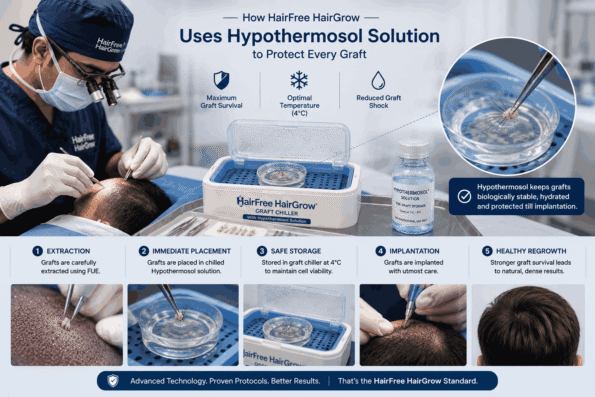
At HairFree HairGrow, every extracted graft is placed in a graft chiller with growth factor and Hypothermosol solution, not plain saline, regardless of whether the procedure is I-FUE, BIG FUE, or Sapphire FUE. Grafts are held at a controlled, cool temperature from the moment of extraction until they’re implanted one by one, which keeps metabolic stress to a minimum throughout the procedure.
“The gap between extraction and implantation is where a lot of preventable graft loss happens if it isn’t managed properly,” says Dr. Chintan Bhavsar, Co-Founder & Chief Surgeon at HairFree HairGrow (M.D. Skin & V.D., Reg. No: G-50296). “
Using a chilled Hypothermosol-based holding solution instead of saline is a small operational choice that has a real, measurable impact on how well grafts survive and grow after transplantation.
This is worth knowing because holding solution quality is not something patients can see in before-and-after photos; it’s a behind-the-scenes clinical choice that affects your results months later, when new hair either does or doesn’t come through.
When you’re comparing clinics for your hair transplant, it’s a fair question to ask directly: “What holding solution do you use for grafts during the procedure?” A clinic that can answer this confidently, and explain why, is usually one that takes graft-handling protocol seriously.
Frequently Asked Questions
-
1. Is Hypothermosol the same as normal saline?
No. Saline only keeps grafts moist and prevents drying out. Hypothermosol goes further, it supplies antioxidants, buffers pH, maintains ionic balance, and provides energy substrates that actively protect follicle cells from damage during storage.
-
2. Does Hypothermosol guarantee 100% hair growth?
No solution can guarantee 100% growth, since graft survival also depends on surgical technique, extraction quality, patient health, and post-transplant care. What Hypothermosol does is meaningfully improve the odds compared to saline, particularly in longer or higher-graft-count sessions.
-
3. Is Hypothermosol used only in expensive clinics?
Not necessarily by price, but by protocol. Hypothermosol costs more than saline, so some clinics skip it to cut costs. Patients researching clinics should ask directly whether Hypothermosol (or a similar advanced holding solution) is part of the standard protocol, rather than assuming based on price alone.
-
4. Does HairFree HairGrow use Hypothermosol in every hair transplant?
Yes. HairFree HairGrow uses a graft chiller with growth factor and Hypothermosol solution as a standard part of its graft-handling protocol across its FUE techniques, to support maximum graft survival.
-
5. How long can grafts survive in Hypothermosol?
Research shows meaningful survival benefits even within the first 6–8 hours, with the advantage growing larger the longer grafts are stored, up to several days in extended-storage studies.
Sources
- Cooley JE. Bio-Enhanced Hair Restoration. Hair Transplant Forum International. 2014;24(4):121, 128–130. ISHRS. ishrs-htforum.org/content/24/4/121
- A review of cellular biopreservation considerations during hair transplantation. Hair Transplant Forum International, ISHRS. ishrs-htforum.org/content/23/1/1
- Beehner M. 96-hour study of FU graft “out-of-body” survival comparing saline to Hypothermosol/ATP solution. Hair Transplant Forum International. 2011. researchgate.net/publication/341948554
- Hair restoration surgery: challenges and solutions. PMC, National Library of Medicine. pmc.ncbi.nlm.nih.gov/articles/PMC4507484
- The optimal holding solution and temperature for hair follicle grafts. Hair Transplant Forum International, ISHRS. ishrs-htforum.org/content/22/1/17