
A hair transplant for receding hairline is a permanent hair restoration procedure that rebuilds the frontal hairline using healthy donor hair follicles.
Every morning, millions of people look in the mirror and notice their hairline has crept back a little further. Some reach for a hat. Others try a new hairstyle and hope nobody notices. And some, after months or years of watching it happen, decide it’s time to do something permanent about it.
If you’re seriously considering a hair transplant for a receding hairline, this guide is for you. It covers everything from candidacy to recovery, cost to results, all the honest information you need to make a confident decision about the most effective hair loss treatment for men available today.
Are You a Good Candidate?
Before anything else, you need to know whether a hair transplant is even right for you. Not everyone who wants one is a suitable candidate, and a good surgeon will tell you this upfront.
The majority of receding hairlines are caused by androgenetic alopecia, commonly known as male pattern baldness, a genetic and progressive condition where DHT (dihydrotestosterone) attacks hair follicles over time. A transplant works by relocating DHT-resistant follicles from your donor site to the thinning areas. But your overall scalp health is just as important as donor density; a compromised scalp won’t hold grafts as effectively, no matter how skilled the surgeon.
You’re generally a good candidate if:
- You’re 25 or older (hairlines in younger men are still changing, making it too early to plan a permanent solution)
- Your donor area, the back and sides of your scalp, has thick, healthy hair
- Your hair loss has been stable for at least 1–2 years
- You have realistic expectations about what the procedure can and cannot do
You may not be a candidate if:
- You have uncontrolled medical conditions like diabetes or hypertension
- Your donor area itself is too thin to provide enough grafts
- You’re experiencing diffuse thinning across the entire scalp (a more complex pattern to treat)
Surgeons typically use the Norwood Scale to classify hair loss, which runs from Stage 1 (minimal recession) to Stage 7 (extensive baldness). Receding hairlines usually fall at Norwood 2 or 3, and this is actually the ideal stage for transplant, when donor supply is still strong.
Noticing your hairline moving back every few months?
Early hairline restoration can help achieve more natural density and better long-term hair transplant results.
FUT vs. FUE: Which One Is Better for a Receding Hairline?
This is the question almost every patient asks first. There are two primary techniques, and understanding the difference matters.
| features | FUT (Strip Method) | FUE (Follicular Unit Extraction) |
|---|---|---|
|
How it works |
A strip of scalp is removed from the donor area; follicles are extracted from it |
Individual follicles are extracted directly from the scalp one by one |
|
Scarring |
A single linear scar (usually hidden by hair) |
Tiny scattered dots — nearly invisible |
|
Recovery time
|
10–14 days |
5–7 days |
|
Grafts per session |
Higher volume possible |
Slightly lower per session |
|
Best for receding hairline |
✓ Suitable |
✓✓ Recommended |
For a receding hairline, FUE is the preferred technique. Here’s why: hairline restoration requires incredibly precise, natural-looking placement, single follicles placed one at a time, angled exactly right. FUE allows for exactly that level of precision. The near-invisible scarring is also a major benefit since hairlines are highly visible areas.
Direct Follicular Implantation is an advanced form of FUE where a specialized pen-like tool implants follicles directly without pre-made incisions. It offers slightly better control over angle and direction, making it a popular premium choice for hairline transplants specifically.
Step-by-Step: What Happens From Day One to Final Results
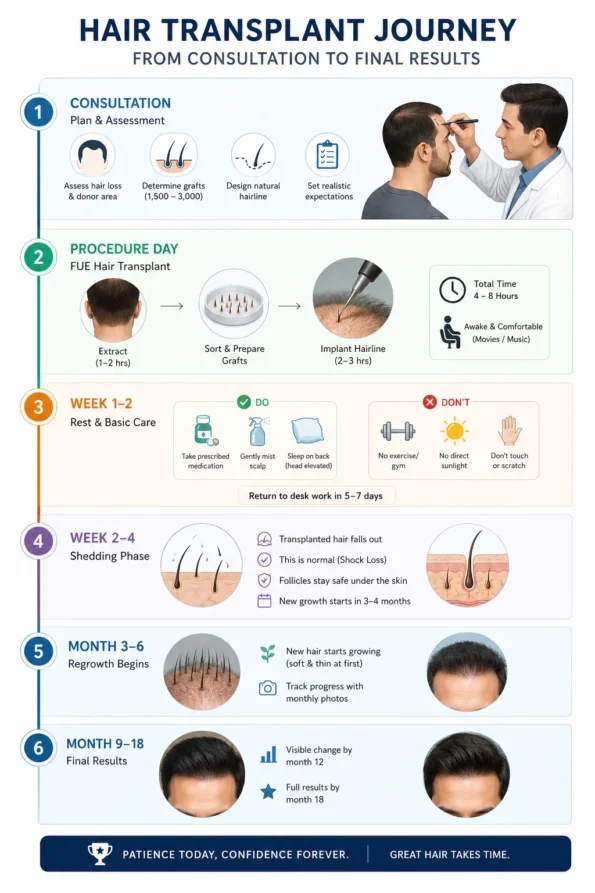
The Consultation - Where It All Starts
Your surgeon will assess your hair loss pattern, donor area density, and overall scalp health. This is where the plan gets made:
- How many grafts you need (for a receding hairline, typically 1,500 to 3,000 grafts is sufficient)
- Which technique is best for your specific case
- What your hairline design will look like
- What realistic results you can expect
One important note: a good surgeon will never guarantee results. If a clinic promises “100% success” walk away. That’s a red flag, not a selling point.
Procedure Day
The procedure is performed under local anesthesia, so you won’t feel pain, just a brief sting from the initial injections, and then you’re comfortable throughout.
A typical FUE session looks like this:
- First 1–2 hours: Follicles are extracted from the donor area
- Middle phase: The team sorts and prepares the grafts
- Final 2–3 hours: Follicles are implanted along the hairline
Total time: 4 to 8 hours, depending on the number of grafts. You’re fully awake, most patients watch movies or listen to music to pass the time.
Week 1–2: Rest and Basic Care
The first few days, your scalp will look red and feel slightly tender, completely normal. Some patients experience mild forehead swelling around days 2–3, which resolves on its own.
Do:
- Take prescribed antibiotics and pain medication
- Gently mist the scalp as instructed by your clinic
- Sleep on your back with your head slightly elevated
Don’t:
- Exercise or go to the gym (at least 2 weeks)
- Expose the scalp to direct sunlight
- Touch, scratch, or pick at the transplanted area
Most patients with desk jobs return to work within 5–7 days.
Week 2–4: Shedding Phase - Don't Panic
This is the part nobody warns you about clearly enough, and the reason so many patients call their clinic in a panic four weeks after surgery.
The transplanted hair will fall out. Around weeks 2–4, the newly implanted hairs shed. Nearly all of them. You’ll look in the mirror and think something went terribly wrong.
Nothing went wrong.
This is called shock loss, and it’s a completely normal part of the process. The follicle itself is safe beneath the skin; it goes into a dormant state temporarily. Within 3–4 months, it begins growing again. The hair that regrows is permanent. The shedding phase is just biology doing what it does.
Month 3–6: Regrowth Begins
New hair starts emerging slowly, fine, thin strands at first. Don’t obsess over daily progress. The difference is visible month to month, not day to day. Track your progress with monthly photos rather than mirror checks.
Month 9–18: Final Results
Full results from a hair transplant take 12 to 18 months to appear. By month 12, you’ll see a dramatic difference. By month 18, the hair has fully thickened and settled. Most patients say the most rewarding moment is comparing their day-zero photo to their one-year photo; the transformation is often striking.
Patience is not optional here. It’s part of the process.
Wondering how many grafts your receding hairline may need?
A proper scalp and donor assessment helps create a natural-looking frontal hairline restoration plan.
Real Patient Case Study: Norwood 3 Hairline Restoration

A 32-year-old patient with a receding hairline and temple thinning underwent a FUE hair transplant at HairFree HairGrow Clinic using 2,200 grafts focused on the frontal hairline area.
During the first month, he experienced normal shock loss, where the transplanted hairs temporarily shed before new growth started.
By month 4, early hair growth became visible around the temples. Around month 8, the hairline looked fuller and more natural. By month 12, the final result showed improved density and a softer, natural-looking hairline design that matched his facial features.
The patient also continued medications recommended by his surgeon to maintain surrounding native hair and support long-term results.
How Much Pain Is Involved? (An Honest Answer)
Let’s be direct about this.
- During the procedure: The local anesthesia injections cause brief, mild discomfort; certain spots on the scalp are more sensitive than others. After that, you feel almost nothing. It’s more boring than painful.
- First 2–3 days after: Mild soreness and tightness, easily managed with the prescribed painkillers.
- Overall: Most patients rate their discomfort around 3–4 out of 10, consistently less than they expected going in.
Side Effects and Risks: What You Should Know
A reputable hair transplant clinic will always tell you this. So will we.
Common and temporary
- Redness and mild swelling (resolves within 1–2 weeks)
- Scabbing over transplanted follicles (clears by week 2)
- Itching during healing (do not scratch)
- Temporary numbness or tightness on the scalp
Rare but possible
- Infection (largely avoidable with proper aftercare)
- Poor graft survival if post-operative instructions aren’t followed
- Unnatural-looking hairline if placed by an inexperienced surgeon
The biggest risk isn’t the technique, it’s the surgeon. An experienced, board-certified surgeon dramatically reduces every risk on this list. Check credentials carefully, study before-and-after photos for hairline cases specifically, and never choose based on price alone.
Hair Transplant Cost in India: What to Budget
Hair transplant cost in India is calculated per graft, meaning the total price depends on how many grafts you need.
| Technique | Cost Per Graft (India) |
|---|---|
|
FUE |
₹25 – ₹80 per graft |
|
FUT |
₹15 – ₹50 per graft |
|
Big Fue |
₹70–₹130/graft |
Approximate budget for receding hairline restoration:
- 1,500 grafts → ₹40,000 – ₹1,20,000
- 2,500 grafts → ₹70,000 – ₹2,00,000+
These ranges vary by clinic reputation, surgeon experience, and city. Clinics in Mumbai, Delhi, and Bangalore tend to charge more. Tier-2 cities often offer comparable quality at better value.
Don’t forget these additional costs:
- Follow-up consultations
- Post-operative medicines (₹2,000 – ₹5,000)
- PRP sessions if recommended
- Time off work during recovery
Medical tourism offers packages (Turkey, Thailand) from ₹80,000–₹1,50,000 all-inclusive, but factor in travel, accommodation, and the reality that your follow-up care will be remote.
How to Find the Right Surgeon
Everything in this guide comes second to this point. The procedure is straightforward. The surgeon is what makes or breaks the result.
Look for:
- ABHRS certification or equivalent international board credential
- A before-and-after gallery that specifically includes hairline cases, not just crown or general density results
- Verified patient reviews on independent platforms, not just the clinic’s own website
- A consultation where the doctor listens more than they sell
Tired of hiding your receding hairline in photos and social situations?
The right FUE hair transplant can restore both your hairline and confidence naturally.
Frequently Asked Questions
-
Is a hair transplant permanent?
Yes. Transplanted hair is permanent because the follicles come from the donor area at the back of the scalp, a zone that is genetically resistant to DHT, the hormone responsible for male pattern baldness. These follicles retain that resistance even after transplantation. However, your existing natural hair can continue to thin over time, which is why surgeons often recommend Minoxidil or Finasteride alongside the procedure.
-
Can the hairline keep receding after a transplant?
The transplanted hair will not recede. But if your natural hair loss is still progressing, surrounding areas can thin, creating gaps over time. A skilled surgeon accounts for this by designing a hairline that anticipates future loss, not just current loss.
-
How many grafts do I need for a receding hairline?
For hairline restoration alone, most patients need 1,500 to 3,000 grafts depending on how far back the recession has progressed. Patients combining hairline work with crown coverage will need significantly more.
-
Can the transplant fail?
With an experienced surgeon, graft survival rates are typically 85–95%. The main causes of poor results are inadequate aftercare, sun exposure too soon after surgery, and, most significantly, surgeon inexperience. Technique quality is everything.
-
What is the minimum age for a hair transplant?
Most surgeons recommend waiting until at least 25 years of age. Before that, the hair loss pattern hasn't stabilized, and transplanting too early risks needing additional procedures as loss continues.
-
Will the results look natural?
In the hands of a skilled surgeon, yes, completely natural. FUE hair transplant places individual follicular units one at a time, mimicking the way hair naturally grows at the hairline. The softness, angle, and direction of each graft determines how natural the final result looks.