

If you’re dealing with significant hair loss and wondering whether a 4000 grafts hair transplant is the right move, you’ve come to the right place. This isn’t a small procedure it’s one of the most comprehensive single-session hair transplants available today, designed for people who have lost hair across a large portion of their scalp.
But how do you know if 4000 grafts is what you actually need? What areas does it cover? How much does it cost? And most importantly, what kind of results can you realistically expect?
We’re breaking it all down in this guide no medical jargon, no vague promises. Just honest, clear information to help you make an informed decision.
What Is a 4000 Grafts Hair Transplant?
A graft is a tiny unit of tissue that contains one to four hair follicles. So when we talk about a 4000 grafts hair transplant, we’re talking about extracting and transplanting roughly 4000 of these units from the donor area (usually the back and sides of your scalp) to thinning or bald areas.
This number of grafts is recommended for people with advanced hair loss, usually classified as Norwood Scale Grade 5 to 7. At this stage, the hair loss covers the top of the scalp, crown, and mid-scalp region extensively.
The procedure is performed using either FUE (Follicular Unit Extraction) or FUT (Follicular Unit Transplantation) methods, with FUE being the more popular choice today due to minimal scarring and faster recovery.
Not Sure If 4000 Grafts Is Right for You?
Get a FREE scalp analysis & graft estimation from our hair experts.
How Much Area Can 4000 Grafts Cover?
One of the most common questions people ask is about 4000 grafts hair transplant area coverage and the answer depends on your hair type, density goals, and the technique used.
As a rough guide:
- 4,000 grafts can cover the entire top of the scalp from the hairline to the crown
In terms of surface area, 4,000 grafts can cover approximately 160–200 cm² depending on placement density. That’s enough to restore a naturally full appearance across multiple zones of the scalp in a single session.
Keep in mind density matters as much as coverage. A skilled hair transplant surgeon will distribute grafts strategically to create the most natural-looking result, not just fill space.
4000 Grafts Hair Transplant Results — What to Expect
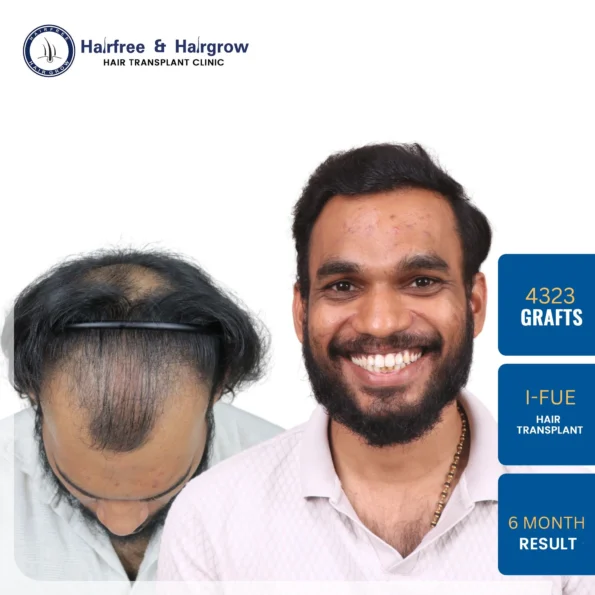
Let’s be honest: results don’t happen overnight. Here’s a realistic timeline for 4000 grafts hair transplant results:
Months 1–3: The Shedding Phase
Most transplanted hairs fall out within the first few weeks. This is completely normal; it’s called “shock loss” and is part of the process. The follicles are alive and resting.
Months 4–6: New Growth Begins
Fine, new hairs start emerging. At this stage, growth may look patchy that’s expected.
Months 9–12: Visible Transformation
This is when patients start seeing real density. Most people notice a significant improvement in coverage and fullness.
Month 12–18: Final Results
The full outcome of your transplant becomes clear. Hairs mature, thicken, and settle into their natural growth pattern.
Most patients who look at 4000 hair grafts before and after photos are genuinely surprised by how natural and dense the results can look especially when the procedure is performed by an experienced surgeon.
See What Your Results Could Look Like
Talk to our experts to get a personalised hairline design and density plan based on your face structure and hair type.
Hair Transplant Success Rate — How Reliable Is the Procedure?
Modern hair transplant success rate figures are quite impressive. When performed at a reputable clinic by a qualified surgeon, the graft survival rate typically falls between 90–95%. This means the vast majority of transplanted follicles survive and produce permanent hair growth.
Factors that influence success include:
- Surgeon’s skill and experience
- Quality of donor hair
- Post-operative care and following instructions
- Patient’s overall health and scalp condition
- Choosing a certified, experienced clinic
At Hairfree Hairgrow, every procedure is preceded by a thorough scalp analysis to assess donor density, hair texture, and realistic coverage goals all of which contribute to achieving the best possible outcome.
4000 Grafts Hair Transplant Cost — What Should You Budget?
Hair transplant cost is naturally one of the biggest considerations, and it varies significantly by geography, clinic, and technique.
India vs. Global Cost Comparison
| Country | Estimated Cost (4000 Grafts) | Notes |
|---|---|---|
| USA / UK | ₹6,00,000 – ₹12,00,000+ | High operational costs |
| Turkey | ₹2,00,000 – ₹4,00,000 | Popular medical tourism hub |
| India | ₹80,000 – ₹2,50,000 | Best value without quality compromise |
Cost by Technique in India
Technique | Cost per Graft | Total for 4000 Grafts |
FUT (Strip Method) | ₹25 – ₹40 | ₹1,00,000 – ₹1,60,000 |
FUE (Standard) | ₹35 – ₹60 | ₹1,40,000 – ₹2,40,000 |
Sapphire FUE | ₹50 – ₹80 | ₹2,00,000 – ₹3,20,000 |
Hair Transplant Cost in India — Why It Makes Sense
Hair transplant cost in India is significantly lower compared to Western countries, yet the quality of care, surgical expertise, and technology used at top clinics is often comparable and in some cases, superior.
At a reputable clinic like Hairfree Hairgrow, a 4000 graft FUE hair transplant is available at a fraction of international prices, without compromising on safety, hygiene, or results.
The cost also includes pre-procedure consultation, post-operative care instructions, and follow-up visits so you’re not paying extra for essential support.
Are You a Good Candidate for a 4000 Grafts Hair Transplant?
Not everyone needs 4000 grafts. A proper consultation will determine the right graft count for you. That said, you’re likely a candidate if:
- You have Grade 5–7 hair loss on the Norwood Scale
- Your hair loss covers most of the crown, top, and frontal scalp
- You have a sufficient donor area at the back and sides of your head
- You’re in good health with no uncontrolled medical conditions
- Your hair loss has stabilized (not actively progressing rapidly)
If your hair loss is less advanced, a smaller session of 1,500–2,500 grafts might be more appropriate.
How to Choose the Best Hair Transplant Clinic
Choosing the best hair transplant clinic is arguably the most important decision in this entire journey. The graft count doesn’t matter if the surgeon placing them isn’t skilled.
Here’s what to look for:
- Board-certified surgeons with dedicated hair transplant experience
- Transparent before-and-after galleries of real patients
- Detailed pre-procedure consultation and scalp analysis
- Advanced FUE/FUT technology with sterile, modern facilities
- Clear pricing with no hidden costs
- Strong post-operative support and follow-up care
- Verified patient reviews and testimonials
Why Choose Hairfree Hairgrow for Your Hair Transplant?
Hairfree Hairgrow isn’t just another clinic it’s one of India’s most trusted names in hair restoration, operating since 2012 across 10+ cities including Surat, Ahmedabad, Pune (Pimple Gurav), Pune Kharadi, Hyderabad, Kolkata, Bangalore, Bhopal, Delhi (Gurugram), Nagpur, Mumbai, Vapi (Silvassa), and Bangladesh.
What sets them apart:
- 21,000+ successful hair transplants performed
- 30+ expert surgeons and trichologists
- Advanced technology — Sapphire blades, Graft Chiller System, KEEP Implanters, digital scalp mapping
- Transparent, affordable pricing with EMI options available
- Complete care — from consultation to post-op follow-ups
Ready to Take the Next Step?
If you’re considering a 4000 grafts hair transplant, don’t rely on guesswork.
Quick Summary: Is a 4000 Grafts Hair Transplant Worth It?
For the right candidate, absolutely. A 4000 grafts hair transplant delivers one of the most dramatic and permanent cosmetic transformations available — restoring not just hair, but confidence.
Here’s the quick recap:
- Coverage: Can cover the entire top of the scalp from hairline to crown
- Results: Natural, permanent results visible from Month 9–18
- Success Rate: 90–95% graft survival at experienced clinics
- Cost in India: Significantly more affordable than Western countries
Best For: Norwood Grade 5–7 hair loss
FAQs
-
Q1. How many hairs will I actually get with 4000 grafts?
On average, one graft contains 1.8 to 2.2 hairs. So with 4000 grafts, you're looking at approximately 7,200 to 8,800 individual hairs being transplanted. The exact number depends on your natural follicle groupings.
-
2. Can 4000 grafts be done in one session?
Yes, in most cases 4000 grafts can be safely completed in a single session lasting 6–8 hours. For patients with very extensive hair loss (Grade 7+), two sessions may be recommended to protect the donor area and ensure graft survival.
-
3. Is a 4000 graft hair transplant permanent?
Yes. Transplanted follicles come from the DHT-resistant zone at the back of your scalp. Once transplanted and established, they continue growing for life — just like natural hair.
-
4. When can I go back to work after a 4,000 graft hair transplant?
Most patients return to desk jobs or light work within 5–7 days. Strenuous physical activity should be avoided for at least 2–3 weeks post-surgery.
-
5. How do I know if I have enough donor hair for 4000 grafts?
The average person has between 6,000 to 8,000 usable grafts in their donor area. A professional scalp analysis like the one offered free at Hairfree Hairgrow will map your donor density and confirm whether 4000 grafts is viable for you.