Quick Answer
No, you do not need to shave your entire head. Using our BIG FUE no-shave technique, we work through your existing hair, with at most a small hidden patch trimmed in the donor area.
Introduction
Ask any woman what stops her from booking a hair transplant consultation, and the answer is rarely the cost or even the fear of surgery itself. It is one question: “Will I have to shave my head?”
That fear makes complete sense. Your hair is not just hair. It is tied to how you show up in the world every single day, at work, in photos, in front of family. Losing it, even temporarily, for a procedure meant to give you more of it back, feels like a contradiction.
This is exactly the problem the No-Shave Hair Transplant for Women was designed to solve. In this guide, we will explain honestly, without overselling, how the no-shave approach works, how our BIG FUE technique makes it more effective, who it is genuinely suited for, and what recovery actually looks like.
Do You Really Have to Shave Your Head? Myth vs Reality
Let us clear up the confusion first, because there is a lot of half-accurate information floating around online.
Myth: A hair transplant always requires shaving your entire head.
Reality: With advanced FUE-based techniques, the surgeon works directly through your existing hair. Neither the donor area (where grafts are taken from) nor the recipient area (where they are implanted) needs to be fully shaved.
That said, we want to be upfront about one thing: “no-shave” does not mean literally zero hair is trimmed. Some clinics market it that way, which sets unrealistic expectations. The reality is that a small, strategically placed patch in the donor area is often trimmed so the surgeon can clearly see individual follicular units and extract them with precision. This patch is small enough, usually just a couple of inches, that the surrounding longer hair naturally covers it. Nobody, not a colleague, not a stylist, will be able to tell.
This is why the accurate name for this approach is “no-shave” or “trans-channel” FUE, not “zero-shave.” Knowing this distinction before your consultation helps you walk in with the right expectations.
Expert Insight: “The women who come to us worried about shaving are usually surprised to learn how little is actually trimmed. My job isn’t to convince every patient that no-shave is right for her. It’s to be honest about who it genuinely suits, so the results actually hold up a year later.”
— Dr. Jinkal Kunjadiya, HairFree HairGrow, Surat
We know this fear is real, and it stops many women from even booking a consultation. You do not have to figure this out alone.
Talk to a surgeon who will give you a straight answer about your own hair, not a generic pitch
HairFree HairGrow No-Shave Approach: Built on the BIG FUE Technique
At HairFree HairGrow, our no-shave procedures are performed using our patented BIG FUE technique, which stands for Bio-Advanced Implanter with Graft chiller and Gro factor. It is a modified, more refined version of standard FUE, and it is what allows us to work through existing hair with a level of precision that older FUE methods cannot match.
Here is what makes BIG FUE different from a standard FUE procedure:
Bio-Advanced Enhancement
Extracted grafts are treated with biological growth factors that help preserve their vitality from the moment they leave the donor area to the moment they are implanted. Healthier grafts mean a higher survival rate, which matters even more in a no-shave setting where working around existing hair leaves less room for error.
Implanter Pen Precision
Instead of standard forceps, we use implanter pens that place each graft at the correct angle, depth, and direction in a single motion. This precision is essential for no-shave cases, where the surgeon is implanting between existing strands rather than into a fully visible, shaved field.
Graft Chiller Technology
Grafts are stored in a temperature-controlled, hypothermal solution throughout the procedure. This keeps follicles fresh and viable for longer outside the body, which is particularly useful in longer, more detailed no-shave sessions.
Pre-Made Slit Technique
Our team creates the recipient slits before extraction begins. This reduces the amount of time grafts spend outside the body and shortens overall procedure time, an advantage that becomes more noticeable in a technique that already takes longer due to the added precision required.
In simple terms, BIG FUE was built to solve the exact problems that make no-shave transplants difficult: graft survival, precision around existing hair, and minimizing damage to the follicles you already have.
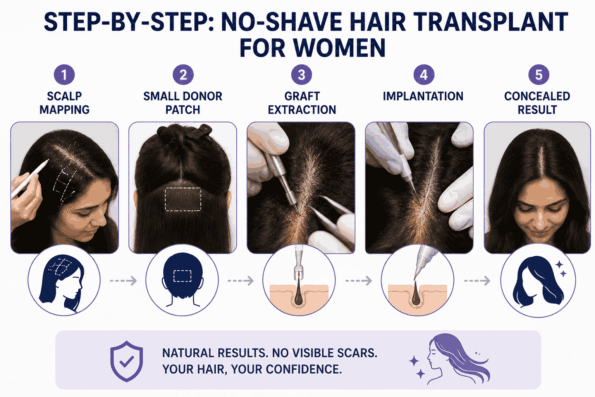
Step-by-Step: No-Shave Hair Transplant for Women
Step 1: Consultation and Scalp Mapping
Your surgeon examines your thinning pattern, hair density, and hair length to determine whether a no-shave BIG FUE approach is the right fit for you.
Step 2: Donor Area Preparation
A small, hidden section, usually in the occipital region at the back of the scalp, is identified. This is where grafts will be taken from, concealed by the surrounding hair.
Step 3: Bio-Advanced Extraction
Individual follicular units are extracted using micro-punch tools, carefully navigating around your existing hair rather than shaving broad sections. Extracted grafts are immediately treated with growth factors and placed in the graft chiller.
Step 4: Pre-Made Slit Implantation
Using sapphire blades and implanter pens, grafts are placed into pre-made micro-channels in the recipient area, matched to your natural hair growth angle and direction.
Step 5: Immediate Concealment
Because your surrounding hair remains untouched, the treated area blends in with your existing hairstyle almost immediately after the procedure.
Because of the extra precision this process demands, a no-shave BIG FUE session typically takes longer than a standard shaved FUE procedure and depends heavily on your surgeon’s skill and experience.
No-Shave BIG FUE vs Traditional FUE vs FUT
| Factors | No-Shave BIG FUE | Traditional (Shaved) FUE | FUT (Strip Method) |
|---|---|---|---|
|
Shaving required
|
Minimal, hidden patch only
|
Full or partial area shaved
|
Only strip area trimmed
|
|
Graft survival approach
|
Enhanced with bio growth factors and graft chiller |
Standard handling and storage
|
Standard handling and storage |
|
Visible downtime
|
Very low, blends into existing hair
|
Higher, needs styling or a wig for weeks
|
Linear scar needs covering
|
|
Procedure time
|
Longer, more technically demanding
|
Comparatively faster
|
Fastest for large sessions
|
|
Best for
|
Mild to moderate, localized thinning
|
Moderate to extensive hair loss
|
Large sessions needing dense packing |
|
Scarring |
Minimal, scattered micro-dots |
Minimal, scattered micro-dots
|
Linear scar at donor site
|
|
Graft yield per session |
Comparatively limited due to precision focus |
Higher, easier access |
Highest in a single session |
Who Is a Good Candidate? An Honest Breakdown
This is a section many clinics skip, because not every technique suits every patient. Here is our honest take.
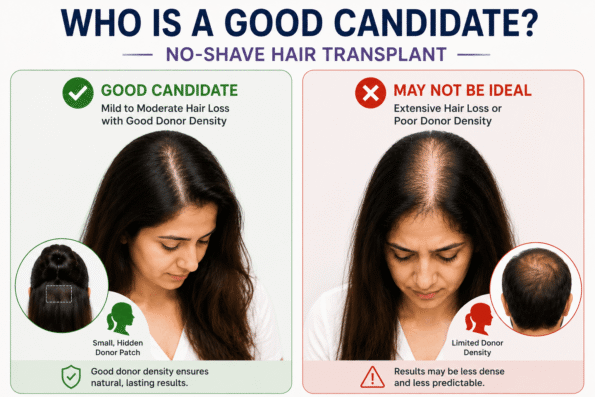
You may be a good candidate for no-shave BIG FUE if:
- You have mild to moderate, localized thinning, such as around the front hairline or parting area
- Your existing hair is already medium to long length, long enough to naturally cover the donor patch
- You need a limited number of grafts (this technique becomes significantly harder to execute cleanly for very large sessions)
- You want to go through the process without any visible change to your current hairstyle
This approach may not be the best fit if:
- You have extensive or diffuse hair loss that requires a large donor area
- Your existing hair density is already low, making it hard to conceal the donor patch
- You need a very high graft count (3000 and above) in a single session
It is completely normal for a surgeon to recommend a traditional FUE approach instead of no-shave during your consultation. That does not mean you are not a candidate for a transplant. It simply means a different technique will likely give you a better, more predictable outcome. The only way to know for certain is a proper in-person or video consultation where your scalp and hair loss pattern can be assessed directly.
Not sure which side of that line you fall on? That is exactly what a consultation is for.
Get an honest, personalized assessment of whether no-shave BIG FUE is right for your hair.
Is It Painful? Anesthesia and Comfort
A common concern that goes hand in hand with the shaving question is pain. At HFHG, no-shave BIG FUE procedures are performed using a block anesthesia technique, which is considered one of the least painful methods available and requires a lower dose of anesthetic medication than older approaches. Most patients report only mild discomfort during the initial numbing injections, with the rest of the procedure being largely painless. Swelling after the procedure is typically minimal to none.
Recovery: What You Will See, and What Stays Hidden
Day 1-3: Mild swelling and redness in the recipient area is normal. Because your surrounding hair remains in place, this is largely concealed without any special styling.
Day 4-10: Small scabs may form at the implant sites. This is a normal part of healing and they fall off on their own. Your clinic team will guide you through gentle washing instructions during this period.
Week 2-3: You may experience “shock loss,” where some transplanted hair, and occasionally some surrounding native hair, sheds temporarily. This is a well-documented, normal phase, not a permanent setback, and it too stays largely unnoticeable thanks to your existing hair coverage.
Month 3-4: New growth begins, initially fine and thin.
Month 6-12: Density builds gradually, with final results typically visible between 10 and 12 months.
The biggest advantage throughout this entire timeline is that you never have to manage a shaved look. You can continue your normal hairstyle, work, and social life without any major adjustment.
How to Choose the Right Clinic for a No-Shave Procedure
Since no-shave BIG FUE is more technically demanding than standard FUE, the surgeon’s experience matters more here than in most other procedures. Before you book, it is worth asking:
- How many no-shave procedures has the surgeon personally performed, particularly on female patients?
- Can the clinic show real before-and-after results specifically from no-shave cases, not just standard FUE?
- What technology is used for extraction and implantation, and how does it reduce graft damage?
- What is the clinic’s graft survival rate, and how do they measure or report it?
- Will you have a direct consultation with the operating surgeon before the procedure, not just a counsellor?
A clinic that answers these questions clearly and does not pressure you into committing on the first visit is generally a good sign.
Final Thoughts
A no-shave hair transplant for women is not a one-size-fits-all miracle solution, but for the right candidate, it is a genuinely life-changing option that protects your privacy, your confidence, and your daily routine without disruption. Our BIG FUE technique was built specifically to make this more precise and more reliable process possible, combining biological enhancement, implanter precision, and careful graft handling.
The most important step is still an honest, detailed consultation, where your scalp, your hair loss pattern, and your expectations can be properly assessed. We will tell you plainly which technique is right for you, no-shave or traditional, based on what will actually give you the best outcome.
Not sure if you are a candidate for a no-shave procedure?
Frequently Asked Questions
Q1. Do women have to shave their entire head for a hair transplant?
No. With a no-shave BIG FUE approach, the surgeon works through your existing hair. Only a small, hidden patch in the donor area may need trimming, and it stays concealed by the surrounding hair.
Q2. Is no-shave BIG FUE as effective as traditional FUE?
Result quality depends heavily on surgeon skill and precision. No-shave BIG FUE is a more technically demanding procedure, which is why an experienced surgical team matters. For mild to moderate cases, results are generally comparable to traditional FUE.
Q3. How much hair actually gets shaved in a no-shave transplant?
Only a small, strategically placed patch in the donor area, often just a couple of inches, which blends into the surrounding longer hair.
Q4. Is no-shave hair transplant more expensive than traditional FUE?
Generally, yes. The added precision, longer procedure time, and technology involved in techniques like BIG FUE typically make the per-graft cost somewhat higher than standard FUE.
Q5. What makes BIG FUE different from regular FUE?
BIG FUE combines biological growth factor treatment for extracted grafts, implanter pen precision, temperature-controlled graft storage, and a pre-made slit technique, all aimed at improving graft survival and precision, which is especially valuable in no-shave cases.
Q6. Who is the best candidate for a no-shave transplant?
Women with mild to moderate, localized thinning, such as along the hairline or parting, whose existing hair is medium to long enough to naturally cover the donor area.
Q7. Does a no-shave procedure take longer than a regular transplant?
Yes. Because the surgeon has to carefully work around your existing hair rather than a fully shaved, visible field, the procedure generally takes more time than a standard shaved FUE session.
Q8. Will anything be visible during recovery?
Very little. Small scabs may appear for a few days and heal naturally. Since your surrounding hair stays intact, the overall visibility during recovery is much lower compared to shaved procedures.
Q9. Is the procedure painful?
Most patients describe only mild discomfort during the initial anesthesia injections. HFHG uses a block anesthesia technique that is considered one of the least painful methods available, with minimal to no swelling afterward.