
Medically reviewed by Dr. Chintan Bhavsar, Co-Founder & Chief Surgeon, HairFree HairGrow M.D. Skin & V.D.
Quick answer:
BIG FUE differs from Standard FUE in three ways: graft storage (chiller + growth factors vs none), implantation tool (KEEP implanter vs forceps), and survival rate (98%+ vs 90-95%). BIG FUE typically costs 20-30% more but reduces healing time from 7-15 days to 3-5 days.
If you’ve spent any time researching hair transplant techniques, you’ve probably run into a wall of acronyms: FUE, FUT, Direct Follicular Implantation, and now BIG FUE. Most clinics market whichever technique they offer as “the best one,” which makes it genuinely hard to tell what’s a real upgrade and what’s just a new name on an old process.
So here’s a straight comparison of BIG FUE vs standard FUE, what’s technically different, what the numbers actually show, and who each one is better suited for.
What Is Standard FUE?
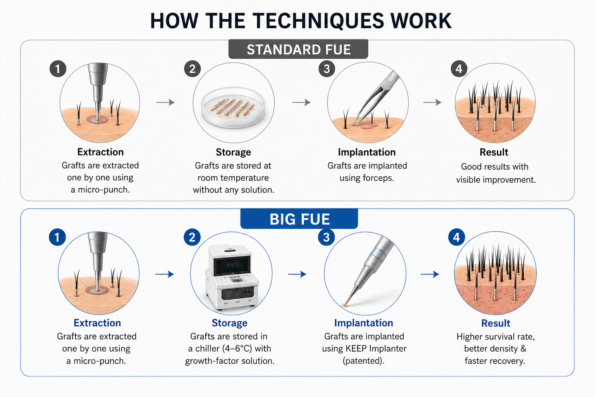
Standard FUE (Follicular Unit Extraction) is the technique most people already know. Individual hair follicles are extracted one at a time from the donor area using a micro-punch tool, then implanted into the balding area with forceps.
It’s a well-established method that works fine for smaller sessions. The tradeoff: grafts sit outside the body without much protection during the process, and forceps-based implantation gives less control over the exact angle and depth of each graft.
What Is BIG FUE?
BIG FUE stands for Bio Advance, Implanter FUE, and Gro Factor with Graft Chiller. It’s HairFree HairGrow’s proprietary technique that layers several advanced tools onto standard FUE, a graft chiller to control storage temperature, growth-factor solutions to protect follicles biologically while they’re outside the scalp, and the KEEP Implanter, a patented device developed by Dr. Koray Erdogan of ASMED, Turkey, used to control the exact angle and direction during implantation.
Worth being upfront about this: BIG FUE isn’t a brand-new surgical invention from scratch. It’s a refined, technology-supported version of FUE, built specifically to reduce graft damage and cut down recovery time.
BIG FUE vs Standard FUE: Side-by-Side Comparison
| Factor | Standard FUE | BIG FUE |
|---|---|---|
|
Graft survival rate
|
90-95%
|
98%+
|
|
Max grafts per session
|
3,000-3,500
|
4,000-6,000 (Giga session)
|
|
Healing time (donor area)
|
7-15 days
|
3-5 days
|
|
Scarring
|
Small white dots possible
|
Virtually none
|
|
Graft storage
|
Room temperature, no solution
|
Chilled (4-6°C) + growth-factor solution
|
|
Implantation method
|
Forceps
|
KEEP Implanter (patented)
|
|
Anesthesia
|
Standard local anesthesia
|
Low-dose block anesthesia
|
|
Pain level
|
Moderate, may need painkillers
|
Minimal |
|
Cost per graft (India, HFHG)*
|
₹50-100 + GST
|
Higher end of the range, city-dependent
|
Per-graft pricing at HairFree HairGrow varies by city (for example, Mumbai runs closer to ₹100-200/graft while Surat is typically ₹50-100/graft) and by baldness grade. A total package for 4,000-4,500 grafts generally falls between ₹2,00,000-₹3,00,000, plus 18% GST. Because BIG FUE involves additional equipment and biological solutions, it sits toward the higher end of whatever your city’s standard range is.
Use the hair transplant cost calculator for a number specific to your case, or get it confirmed in your consultation. Explore our complete guide to hair transplant cost in India before booking your consultation.
Is the extra cost of BIG FUE worth it? For larger sessions, the survival-rate gap and faster healing genuinely change the outcome; it’s not just a premium label on the same procedure.
Not sure which technique is right for you?
Get a personalized hair analysis from our expert surgeons and discover which procedure best matches your hair loss pattern.
There’s a straightforward biological reason behind the number, not just a marketing claim. Once a graft is extracted, its survival depends heavily on how long it sits outside the scalp and what condition it’s kept in. At room temperature, grafts start losing viability within an hour or two.
BIG FUE addresses this directly, grafts are stored in a chiller at 4-6°C along with a growth-factor solution, which slows cell degradation and keeps the follicle healthier until it’s implanted.
Pair that with the KEEP Implanter, which places each graft at a controlled angle and depth instead of relying on manual forceps handling, and you reduce trauma to the follicle at both ends of the process: extraction and implantation.
Which One Is Right for You?
Neither technique is “wrong.” The right call depends on what you’re optimizing for.
Standard FUE tends to make sense if:
- You’re working with a smaller session (under 2,000 grafts)
- Budget matters more to you than a faster recovery timeline
- Your case is straightforward, without major density challenges
BIG FUE is usually the better fit if:
- You need a large session (2,500+ grafts) done efficiently
- You want the shortest possible downtime, back to routine life in days, not weeks
- Maximum graft survival and density matter to you long-term
- Your donor area is being used more than once, and protecting follicle quality matters
If you’re not sure which category you fall into, that’s exactly what a proper scalp assessment during consultation is for. Donor density, hair type, how many hair grafts are needed, and target coverage all factor into the recommendation.
Choosing between Standard FUE and BIG FUE should never be based on marketing alone. Every patient has unique hair characteristics, donor availability, and expectations. A thorough consultation with an experienced hair transplant surgeon is the best way to determine which approach is most appropriate for your individual case.
Dr. Chintan Bhavsar, Co-Founder & Chief Surgeon, HairFree HairGrow
Our BIG FUE technique page has the full step-by-step breakdown of the procedure if you want to go deeper before booking a consultation. BIG FUE is available across all HairFree HairGrow branches, including Surat, Ahmedabad, Pune (Pimple Gurav), Pune Kharadi, Hyderabad, Kolkata, Bangalore, Bhopal, Delhi (Gurugram), Nagpur, Mumbai, Vapi, Silvassa and Bangladesh.
Still comparing your options?
Speak with our hair transplant experts to understand your graft requirement, expected density, and the most suitable technique for your case.
Real Cases: What BIG FUE Looks Like in Practice
Instagram influencer Sajid Shahid chose HairFree HairGrow for his hair transplant, opting for the BIG FUE technique to address thinning at the hairline and crown.
His procedure involved 1,680 grafts, carefully mapped and implanted to restore natural density while keeping the hairline proportionate to his face shape.
Because BIG FUE uses the graft chiller and growth-factor storage discussed earlier, his donor area healed within days rather than the 1-2 weeks typical of standard FUE, letting him return to content creation and public appearances sooner.
The result reflects exactly what the technique is built for: natural-looking density gains without the drawn-out recovery period associated with older FUE methods.
If you’d like to see more transformations, browse our hair transplant before and after results from patients treated across different baldness grades.
Still deciding between BIG FUE and standard FUE?
The most reliable way to know which technique fits your hair loss pattern, donor density, and budget is a one-on-one consultation with our surgical team.
FAQ
-
Is BIG FUE more painful than standard FUE?
No. BIG FUE uses a lower dose of block anesthesia and is generally reported as less painful than standard FUE, with minimal swelling and a smoother post-procedure experience.
-
How much more does BIG FUE cost compared to standard FUE?
BIG FUE typically costs more per graft than standard FUE because of the additional equipment involved, the graft chiller, growth-factor solutions, and the patented implanter tool. At HairFree HairGrow, per-graft rates generally fall between ₹50-100 plus GST depending on city and technique, with BIG FUE sitting at the higher end. Use the cost calculator or book a consultation for an exact quote.
-
Can BIG FUE be done in a single session?
Yes, for most patients. BIG FUE supports Giga sessions of up to 4,000-6,000 grafts in one sitting, though very large cases may still be split across two days for safety and precision.
-
Is BIG FUE available at all HairFree HairGrow clinics?
BIG FUE is offered across HairFree HairGrow's clinic network, including Mumbai, Pune, Surat, Ahmedabad, Hyderabad, Delhi/Gurugram, Kolkata, Bhopal, Nagpur, and Silvassa. Availability can vary slightly by location, so it's worth confirming with your nearest clinic when booking.
-
What is the KEEP Implanter?
The KEEP Implanter is a titanium implantation device patented by Dr. Koray Erdogan of ASMED, Turkey. It's used during the BIG FUE procedure to control the angle, direction, and depth of each graft for a more natural, uniform result.
-
How soon will I see results after a BIG FUE transplant?
Initial growth begins within 3-4 months, with full, visible results showing up between 6 to 9 months after the procedure. Understanding the hair transplant recovery timeline can help you know what to expect each month.